The establishment of the center marked an important step toward bringing greater scientific and technological rigor to bomb and mine clearance, gradually shifting from experience-based and manual methods to standardized technical procedures. The goal was to improve safety for troops and civilians while accelerating the clearance of explosive remnants of war for national development.
Special and hazardous mission
After the war, hundreds of thousands of tons of UXO remained scattered across the country, posing risks to lives and property of people and hindering socio-economic development. Manual clearance was time-consuming and carried significant safety risks, creating the need for a specialized force capable of mastering technology, providing professional advice and handling complex and dangerous explosive remnants.
Over 30 years of construction and development, the center has grown from a unit with limited facilities and a small specialized workforce into a relatively comprehensive organization. It now manages three clusters with 10 facilities across the country and has hundreds of vehicles and pieces of equipment for detecting UXO in various environments, along with a modern, integrated system for handling Level-5 ammunition.
    |
 |
|
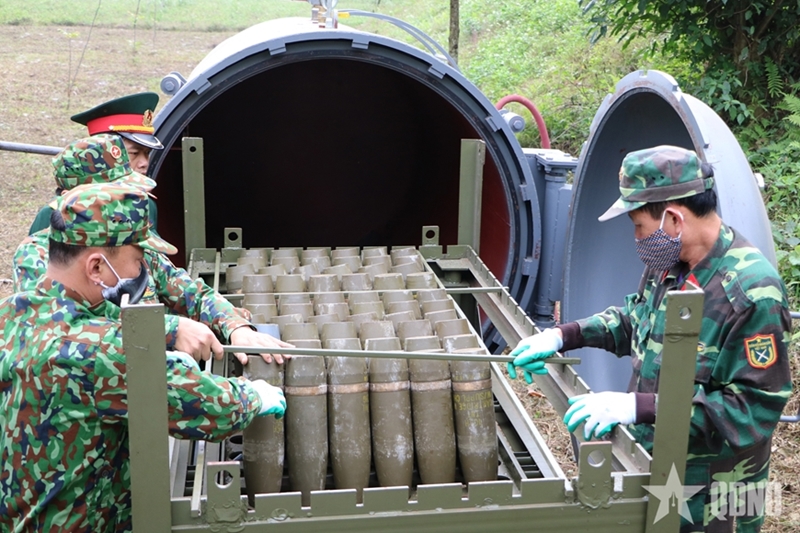
Officers and personnel of the center carry out the dismantling and defusing of Level-5 ammunition. |
In 2015, the center was assigned a specialized counter-terrorism bomb and mine detection and disposal team, along with two dual-role teams within the Engineering Corps’ and Ministry of National Defense’s counter-terrorism forces. The mission requires high mobility and rapid, precise responses. Guided by the motto "Proactive, cautious, decisive, and victorious," the center personnel have helped ensure security for major political events of the Party, State and military, as well as major international diplomatic events held in Viet Nam.
The disposal of Level-5 ammunition and UXO left from war remains a long-term and highly hazardous mission since deteriorated ammunition and explosive remnants can detonate at any stage, creating risks that persist day and night. In carrying out these missions, there have been casualties and sacrifices.
As the military’s leading and final-level unit in bomb, mine and ammunition disposal, the center has safely processed tens of thousands of tons of bombs, mines and ammunition over the past 30 years. It has also handled thousands of tons of bombs and mines recovered from clearance projects and hundreds of tons of military weapons and supporting equipment from the Ministry of Public Security. Hundreds of thousands of hectares of land have been cleared for defense, security and socio-economic development projects.
The center’s personnel have contributed to major projects including National Road 1A, the Ho Chi Minh Route, border patrol roads, the Sao Vang-Dai Nguyet and Block B-O Mon projects, as well as UXO clearance projects across the northern border areas, central Viet Nam and the southwestern region. Each hectare of cleared land creates additional space for development while contributing to the safety and security of local communities.
Technology first, safety above all
The center considers scientific research, technological application and professional advisory work essential to improving efficiency, shortening processing time and reducing safety risks. It has advised on the development of legal documents, technical procedures and cost norms for bomb and mine clearance and Level-5 ammunition disposal. It has also conducted surveys and assessments of post-war bomb and mine contamination, helped develop a nationwide contamination map, and contributed to policies and mechanisms for addressing the consequences of post-war bombs and mines.
The center also helped establish the Viet Nam Bomb and Mine Action Center (VNMAC) and develop the “National Action Program on Overcoming Post-War Bombs and Mines” (known as Program 504), which was approved by the Prime Minister.
Through defense external relations, the center has participated directly in negotiations and mobilized tens of millions of U.S. dollars, as well as modern detection and disposal equipment from international organizations, to support efforts to address the consequences of bombs and mines.
The center has consistently linked scientific research with practical missions. Its personnel have developed a detailed understanding of the structure and operating principles of UXO in Viet Nam’s inventory and those used during the war, enabling them to develop appropriate disposal procedures. Dozens of research projects, technical initiatives and improvements have been implemented, including a Ministry of National Defense-level project to research, design and manufacture a mobile ammunition dismantling and defusing device under the KC.BM Program. The project won the first prize in the mechanical engineering and automation category at the Viet Nam Fund for Supporting Technological Creations (VIFOTEC) Awards in 2021.
For improvised bombs and mines, the center regularly updates information on manufacturing and use methods, studies their structures and operating principles, develops disposal procedures, compiles training materials and produces simulation models for training.
Its approach is consistent: practical missions are the starting point, research and technology are the tools, standardized procedures and force organization are the foundation, and safety is the highest priority. Every new initiative, procedure and piece of equipment is aimed at making disposal more effective, faster and safer.
Although the war ended decades ago, the mission of bomb and mine disposal soldiers continues. Every completed mission helps protect lives; every hectare of cleared land opens new space for development; and every technology mastered helps reduce danger. In this way, engineering soldiers continue their combat mission in peacetime, quietly, resolutely and wholeheartedly, for the safety of the people and the development of the country.
For its outstanding achievements, the center has been awarded the title of Hero of the People’s Armed Forces and eight orders of various types.
By Senior Colonel NGUYEN THE LUONG, Director of Technology Center for Bomb and Mine Disposal
Translated by Tran Hoai