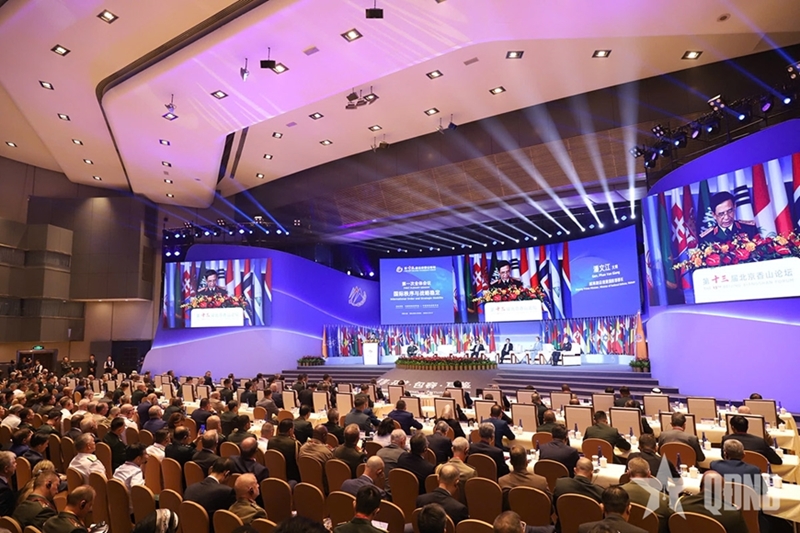
Held from September 15 to 17 under the main theme “Building consensus on stability and jointly promoting security governance,” the forum marks the 20th anniversary of the Beijing Xiangshan Forum. This year’s event brought together nearly 100 official delegations, as well as experts and scholars from countries, regions and international organizations. More than 60 participants were ministerial-level officials or higher-ranking officials and military leaders. The forum featured two plenary sessions and eight parallel sessions.
    |
 |
|
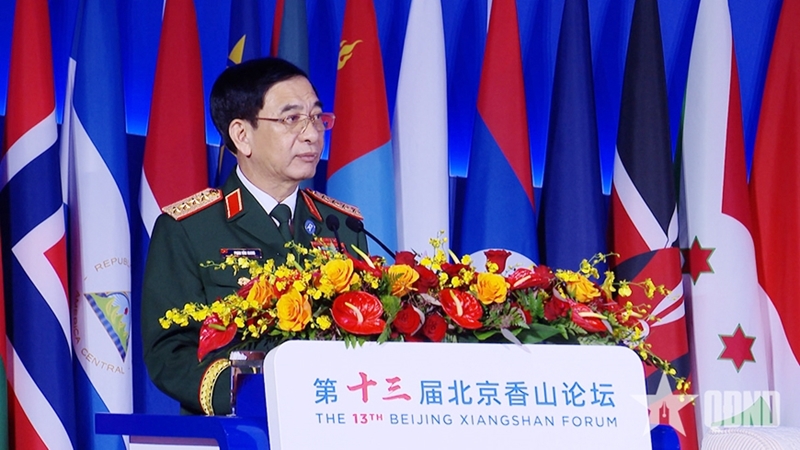
General Phan Van Giang speaking at the first plenary session of the 13th Beijing Xiangshan Forum |
In his opening remarks, Chinese Minister of National Defense Sr. Lt. Gen. Dong Jun stressed the need to build an equal, mutually beneficial, consensual, cooperative and win-win multipolar world. The Chinese minister outlined several views.
First, amidst the emerging security environment, consensus should be built through sustained and comprehensive cooperation that delivers long-term benefits.
Second, stability should be maintained through multilateralism. In a turbulent world, fair governance and strategic approaches are needed to ensure regional and global stability. Multilateralism should be respected by safeguarding the U.N.-centered international system and supporting a greater role for the U.N. in addressing international issues, while taking into account the legitimate security interests of all countries.
Third, risks should be prevented by drawing lessons from history, with prevention playing an important role in global security governance.
Fourth, issues should be addressed through dialogue and consultation.
Fifth, security and development should be pursued jointly. Development is the best guarantee for security; countries should proactively strengthen resilience while respecting one another and upholding equality in development. China supports common security and development, and welcomes all parties in sharing opportunities and strengthening the foundations for common security.
Sixth, cooperative relations should be deepened through concrete actions.
In his remarks at the first plenary session, General Phan Van Giang said the world is undergoing profound, complex and unpredictable changes. Peace and stability remain a shared aspiration of the international community. Countries continue to seek common values in promoting a fair and inclusive order based on international law.
However, military conflicts are taking place in many parts of the world; international law is not being adequately respected; strategic competition aimed at rallying and consolidating forces remains widespread; and the use or threat of force, including weapons of mass destruction, is causing growing division and global concern.
General Phan Van Giang stressed that upholding and promoting multilateralism also means seeking to build a fair and inclusive international order based on international law and international institutions. Such an order requires strategic stability, in which a peaceful environment is ensured, countries are treated equally and respect one another, mutually beneficial cooperation is pursued, and issues are resolved through dialogue on the basis of respect for international law and institutions, the U.N. Charter and regional commitments.
To strengthen the foundations of the international order and build the desired strategic stability, the Vietnamese defense chief highlighted four key priorities that need to be addressed.
First, countries need goodwill and sincerity, strategic trust and a shared sense of responsibility. It is particularly important for major powers to uphold their responsibilities. The greater a country’s capabilities, the greater its responsibility should be. Regardless of whether they are large or small, countries should respect each other’s independence and legitimate interests. They should not seek security for themselves at the expense of another country’s stability, nor allow competition to narrow the space for cooperation.
Second, international law, including the U.N. Charter, must be respected and regarded as the foundation governing relations among states. Otherwise, it would be difficult to build a fair and inclusive international order and achieve strategic stability.
|
|
 |
|
A view of the first plenary session of the 13th Beijing Xiangshan Forum |
Third, the role of multilateral mechanisms should be promoted, with the U.N. playing a central role in global security governance. In the Asia-Pacific, ASEAN plays a central role in shaping the regional architecture, maintaining peace and stability, preventing conflicts, promoting dialogue and building trust among countries both within and outside Southeast Asia. Viet Nam has consistently respected and fully implemented the Declaration on the Conduct of Parties in the South China Sea (DOC), while seeking to accelerate negotiations toward an effective, substantive and feasible Code of Conduct in the South China Sea (COC). Regarding the East Sea (aka South China Sea), Viet Nam remains committed to resolving disputes through peaceful means and on the basis of respect for international law, including the 1982 U.N. Convention on the Law of the Sea (UNCLOS).
Fourth, solidarity and consensus, as well as mutual assistance and support, are needed. In a world marked by continued turbulence, countries are becoming increasingly interdependent, and no country can effectively address increasingly complex security challenges, both traditional and non-traditional, on its own.
In his address, General Phan Van Giang also expressed his sympathy over the flash floods that recently struck the China-Nepal border region. He announced that the 3rd Viet Nam Defense Expo, scheduled to take place in December 2026, will be held under the theme “Peace – Friendship – Cooperation for Joint Development.” The theme reflects Viet Nam’s desire to cooperate with other countries in building stronger national defense capabilities, ensuring the ability to safeguard independence, sovereignty and territorial integrity, protect national interests, and contribute together to peace in the region and the world.
Translated by Quynh Oanh