At Brigade 249 under the Engineering Corps in Quang Oai commune, Ha Noi, which serves as the location for the exercise, forces have been present and actively preparing for the mission over the past half month. In addition to air force, engineering, chemical and border guard units, the exercise also involves a large contingent of military medical personnel from the three countries.
    |
 |
|
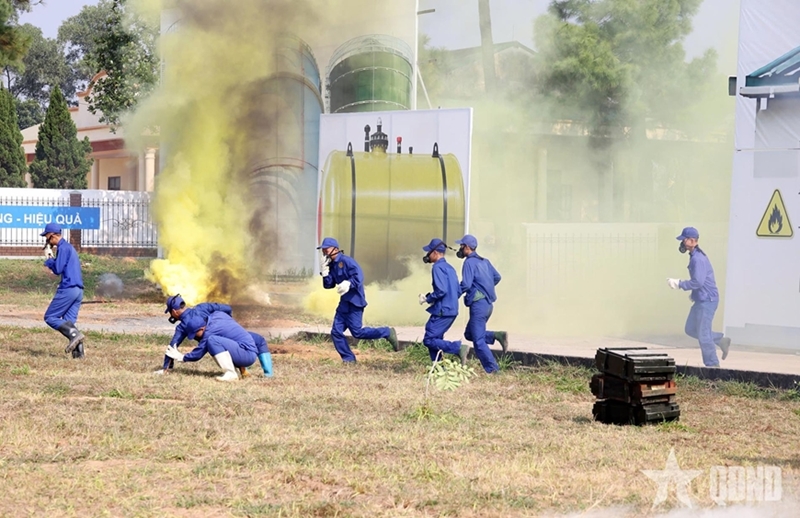
Forces simulate a response scenario for hazardous chemical leaks and dispersion. |
The exercise content is divided into three training scenarios. Among these, response to hazardous chemical leaks and dispersion receives significant attention due to the dangerous nature and unpredictable consequences of such incidents on human lives, ecosystems, and socio-economic stability.
According to Colonel Nguyen Dinh Thang, Director of the Military Institute of Radiological Medicine and Oncology, the third scenario simulates a hazardous chemical leak at a chemical plant following a super typhoon. Approximately 1,000 tons of sulfuric acid and production chemicals spill and disperse, affecting around 200 working employees while threatening nearly 6,000 residents in surrounding areas and the environment. Following the incident, military medical forces deploy the military medical team for chemical, radiation, and nuclear incident response from the institute to areas near the site for casualty treatment. The specialized medical team provides emergency and hyper-emergency treatment and complete decontamination for victims suffering from toxic chemical exposure, radiation, or combined injuries.
Upon receiving casualties, the medical team conducts toxic testing and triage, categorizing victims into poisoned and non-poisoned groups while classifying injury severity to streamline treatment and maximize saved lives. Under this scenario, rapid response time is critical to preserve the golden hour for saving lives while preventing chemical absorption and dispersion in human bodies.
|
|
 |
|
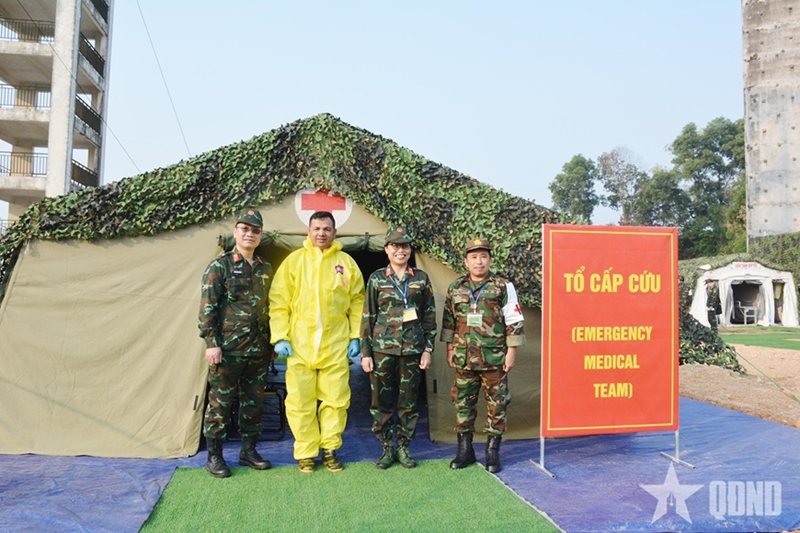
Colonel Nguyen Dinh Thang encourages participating forces. |
Victims exhibiting life-threatening signs, such as asphyxiation, shock from toxic chemical exposure, external bleeding, or severe wounds, receive medical priority. Simultaneously, the medical team coordinates with reinforced emergency teams from hospitals to provide immediate first aid and transfer victims with severe trauma to the nearest hospitals when conditions permit.
According to the colonel, upon receiving the exercise plan in September, leadership of the institute selected highly qualified officers, doctors, and medical staff to undergo training for the exercise. Following nearly a month of training at the institute and the training ground of the brigade, team members have thoroughly understood assigned tasks, coordinated well with other forces, and stood fully ready for the exercise.
On the training field, despite hot weather conditions, personnel have maintained strict training discipline and actively practiced planned contents. During training, despite fatigue and strain, all members have made all-out efforts, while care from higher levels and active coordination from Lao and Cambodian military medical teams has helped continuously improve operational capacity. All members have mastered relevant skills and stand ready for the joint exercise.
|
|
 |
|
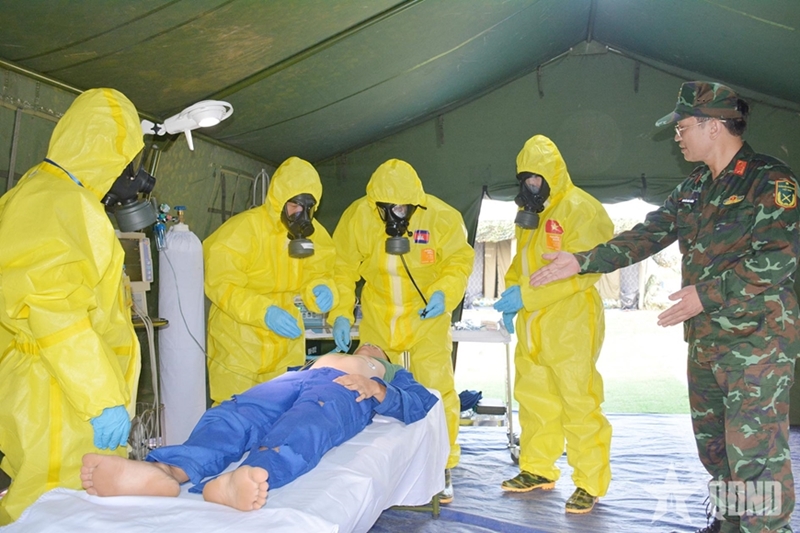
Military medical forces of the three countries coordinate smoothly during casualty emergency treatment. |
Major Ha Viet Dung, Head of the Military Medical Team for Chemical, Radiological and Nuclear Incident Response at the Military Institute of Radiological Medicine and Oncology, underlined that the mission requires expertise, strict discipline, and precise execution of responsibilities. Units must coordinate seamlessly across reception, triage, emergency care, decontamination, and victim transport. Exercise success relies on individual competence and close coordination across all forces.
Training activities have helped Vietnamese military doctors refine skills in handling toxic chemical incidents while providing opportunities to exchange professional expertise with Lao and Cambodian colleagues, further strengthening solidarity, friendship, and close bonds among Viet Nam and neighboring nations.
Translated by Hai Son