In addition to training and maintaining combat readiness, military engineers undertake important peacetime missions, including counterterrorism, disaster response and search and rescue (SAR) operations, defense construction, and postwar bomb and mine clearance. Though a battlefield without gunfire, these missions are highly demanding and dangerous, requiring strong political resolve, determination, and professional expertise.
    |
 |
|
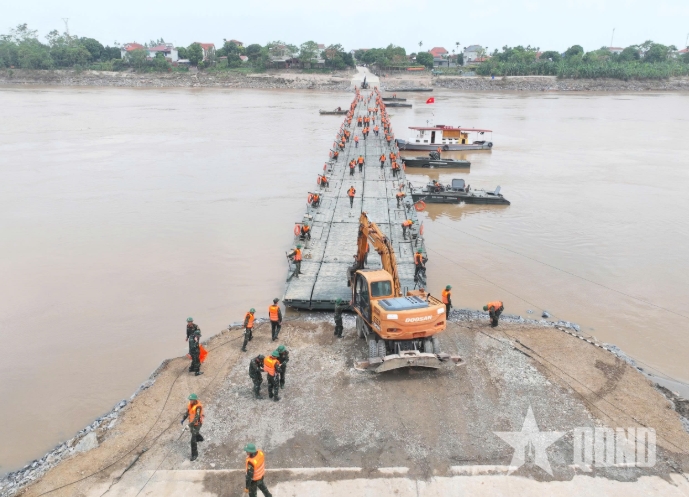
Officers and soldiers of Brigade 249 under the Engineering Corps deploy a pontoon bridge across the Lo River in Phu Tho province. (Photo: Van Tien) |
“Battle” without gunfire and mission to go first and leave last
Over the past years, the Engineering Corps has strictly carried out higher level resolutions and directives on combat readiness, maintained duty routines, exercises, and improved mobility, while closely monitoring situational developments and coordinating with other forces to ensure security and safety at major national and international events held in Viet Nam.
Notably, the corps has comprehensively renewed its training content and methods, emphasizing practical, synchronized, and specialized training, as well as mastery of weapons and technical equipment.
When disasters or incidents occur, military engineers are the those who “go first and leave last,” reaching the most dangerous areas and overcoming difficulties to fulfill their missions. According to Major General Tran Trung Hoa, Commander of the Engineering Corps, thousands of officers and soldiers, together with specialized equipment, have been mobilized for emergencies at home and abroad.
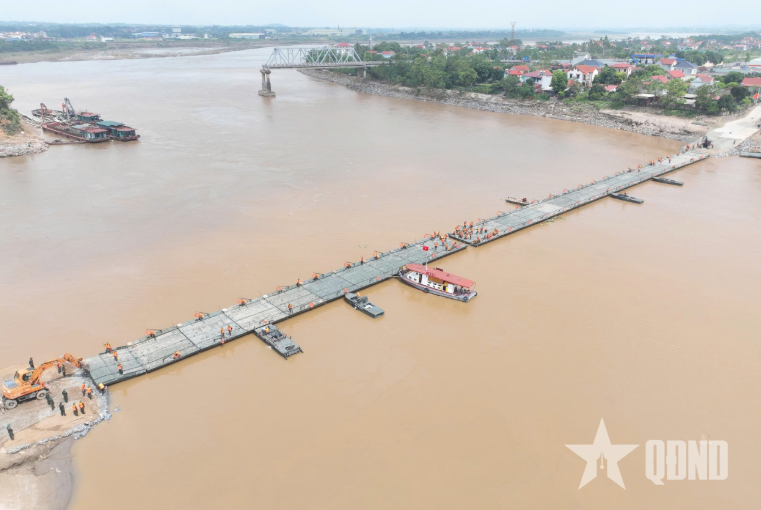
They have responded to landslides and floods, rescued workers trapped in the Da Dang hydropower tunnel collapse, deployed the Phong Chau and Doan Hung pontoon bridges, and supported people in disaster relief and SAR. Internationally, they have participated in disaster-response missions in Laos, Türkiye, Myanmar, and Venezuela, demonstrating the spirit of “serving the people” and international solidarity.
Defense construction is particularly difficult because it must be carried out in harsh and hazardous environments while ensuring safety and secrecy. Military engineers have completed numerous strategic defense projects across the country, including defense facilities, DK1 platforms, border patrol roads, the Ho Chi Minh Trail, the Truong Son Dong Road, and major national projects such as the North-South 500kV power transmission line and major hydropower projects.
The corps has also advised on hardened and underground strategic facilities and the integration of military and dual-use infrastructure. It is applying new scientific and technological advancements to improve construction and facility management while linking socio-economic development with stronger defensive area building in peacetime.
In postwar bomb and mine clearance, the corps has helped establish a legal framework and implement the National Action Program on Overcoming Consequences of Post-war Bombs and Mines for the 2010-2025 period. Contaminated land has been reduced from 6.1 million hectares to 5.57 million hectares, while hundreds of thousands of contaminated hectares have been cleared, millions of children educated on bomb and mine safety, and thousands of victims supported.
To accelerate mine clearance, the corps is implementing a project to enhance bomb, mine, and explosive ordnance clearance capacity for the 2025-2030 period and beyond, while proposing a national program for the 2026-2045 period aimed at clearing all contaminated land nationwide by 2045.
In addition, engineering forces have actively participated in the ongoing 500-day campaign to search for, collect, and identify martyrs’ remains, closely combining bomb and mine clearance with the recovery of fallen soldiers’ remains and reflecting the nation’s tradition of “When drinking water, remember the source.”
Enhancing capability to “fight in peacetime”
To meet new requirements, Major General Tran Trung Hoa emphasized that the Engineering Corps will continue implementing the Party’s military and national defense policies, focusing on improving overall quality, combat strength, mobility, and the ability to respond to unexpected situations.
It will review and improve plans for combat readiness, civil defense, disaster response, SAR, counterterrorism, and other contingencies, while conducting close-to-reality training and exercises. For high-risk missions, it will prepare multiple response levels and ensure rapid, accurate, and safe action.
|
|
 |
|
Officers and soldiers of Brigade 249 under the Engineering Corps deploy a pontoon bridge across the Lo River in Phu Tho province. (Photo: Van Tien) |
The corps will build an elite, compact, strong, highly mobile, and specialized force, prioritizing SAR, bomb and mine clearance, underground facilities, bridges and roads, river crossings, and complex incident response. It will also strengthen professional training, survival skills, first aid, and safety procedures.
Furthermore, it will accelerate the application of science and technology, digital transformation, and modern equipment, including bomb and mine detection systems, unmanned equipment, engineering robots, landslide and flash-flood warning systems, and digital databases supporting command and control.
For disaster response and SAR, the corps will coordinate with local authorities to survey key areas, conduct joint exercises, and improve mobility and response capabilities.
In defense construction, it will improve surveying, design, construction, management, and inspection while applying advanced technologies and new materials. In bomb and mine clearance, it will strengthen contamination mapping and hazard assessment and expand mechanization and automation to reduce risks to personnel.
The corps will expand international cooperation and make greater use of advanced expertise and technology, while improving training, safety management, and clearance capacity. It will also participate in United Nations peacekeeping and international SAR missions, align its forces with international standards, foreign language proficiency and knowledge of international law, and incorporate international experience into training and operations.
Translated by Mai Huong