It is no coincidence that Resolution No.06-NQ/TW identifies foreign affairs as a key, regular task. In a world changing rapidly and marked by uncertainty, any disagreement or shift in relations among major powers can have a direct impact on Viet Nam’s development environment.
General Secretary of the CPV Central Committee and President To Lam has also stressed that domestic and foreign affairs always go hand in hand and complement each other; foreign affairs are the extension of domestic affairs. If the country is to develop, it cannot simply focus on getting its own house in order. It must also know how to open its doors in the right direction, choose the right partners for cooperation, turn relationships into tangible benefits, and transform trust into concrete markets, technologies and knowledge.
    |
 |
|
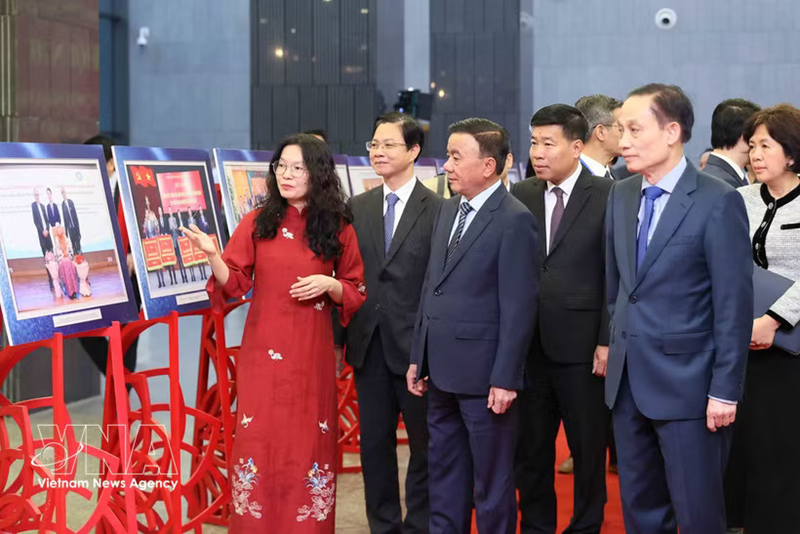
Politburo member and standing member of the Party Central Committee’s Secretariat Tran Cam Tu and delegates visit an exhibition showcasing outstanding images on people-to-people diplomacy activities in 2025. |
Viet Nam’s relationship with Malaysia illustrates this clearly. In the first half of 2026, bilateral trade reached USD 10.8 billion, up 40% from the same period in last year. The two countries have maintained a Comprehensive Strategic Partnership since November 2024. Yet the goal now is not merely to preserve good relations, but to deepen them further, creating greater openness and facilitating economic, trade and investment cooperation in a balanced direction, while promoting the digital economy, green economy, science and technology, and innovation. The target of raising bilateral trade to USD 20 billion underlines the same requirement.
The direction is equally concrete in relations with the U.S. Viet Nam regards the U.S. as one of its foremost partners of strategic importance, while calling for the early conclusion of negotiations on a reciprocal trade agreement and urging restraint in the use of excessive trade-defense measures that could affect the overall bilateral relationship. The two sides also need to promote mutually beneficial cooperation in science and technology. Achieving breakthroughs in science and technology, innovation and national digital transformation is a priority for Viet Nam as it pursues its strategic growth objectives.
The same requirement applies to foreign capital and businesses. Viet Nam is not merely seeking to attract investment; it is increasingly focused on selecting projects that bring good technology and are aligned with the country’s domestic development needs. The decision by Germany’s LAPP to regard Viet Nam as a key market, amid rising demand from AI data centers, automation, renewable energy and smart infrastructure, is one example. This is precisely the direction set out in Resolution No.06-NQ/TW, which is moving from “attraction” to “selectivity,” with priority given to high technology and projects that establish deep linkages with the domestic economy.
The resources available for development do not lie solely in investment projects or overseas markets. The more than 6.5 million Vietnamese living abroad are also a source of national strength. Remittances rose from USD 2.3 billion in 2004 to USD 17.7 billion in 2025. Total remittances sent to Viet Nam from 1993 to the present, although the figures are not yet complete, have exceeded USD 250 billion, equivalent to disbursed FDI over the same period. These figures show that overseas Vietnamese are not simply people to be mobilized and cared for; they are genuinely a resource for the country.
Resolution No.23-NQ/TW takes this thinking a step further, moving from mobilizing, bringing together and caring for overseas Vietnamese to accompanying them and creating enabling mechanisms. Experts, scientists, entrepreneurs, intellectuals and young people abroad can contribute not only by returning to Viet Nam, but also from afar, through networks connecting knowledge, technology, investment and markets. When each Vietnamese representative office becomes a hub connecting Vietnamese resources in its host country or locality, foreign affairs will be brought much closer to the task of national development.
For these resources to translate into real-world benefits, foreign affairs must also reach localities, businesses and the people. Thailand and Viet Nam have just marked the 50th anniversary of their diplomatic relations. In Can Tho, cooperation has been given concrete form through business connections, investment, trade, tourism and education. In 2025, Thai investment in the Mekong Delta city stood at approximately USD 119.25 million. In the first six months, Can Tho exported around USD 13.9 million worth of goods to Thailand and imported USD 3.8 million. The figures show that foreign policy only truly matters when it is connected to products, markets and development needs.
Looking beyond the local level to the wider region, the Association of Southeast Asian Nations (ASEAN) is an important space for Viet Nam to expand cooperation. Viet Nam has been a member of the organization for 31 years and is working with other member states towards a united and resilient community that maintains its central role. In a region of around 800 million people, strengthening the bloc is also a means for Viet Nam to expand its strategic space and create greater room for development.
Yet as cooperation expands, foreign affairs must go hand in hand with national defense and security to create a position of strength. Viet Nam-Malaysia cooperation in defense, security and law enforcement at sea; cooperation with Cambodia in combating transnational crime; and exchange of views on the East Sea on the basis of international law all demonstrate how a “security-development belt” can be built on trust, coordination mechanisms and the ability to resolve differences through peaceful means.
The 258.939-km Viet Nam-Cambodia border is another manifestation of this requirement in everyday life. A peaceful border is maintained not only by forces tasked with protecting national sovereignty, but also through good-neighborly relations, people-to-people exchanges, economic cooperation and consensus at the grassroots level. If done well, safeguarding sovereignty and expanding cooperation can reinforce one another.
It is increasingly clear that foreign affairs are becoming ever more closely intertwined with national development. As General Secretary and President To Lam has stressed, Viet Nam remains steadfast in pursuing a foreign policy of independence, self-reliance, self-strengthening, peace, friendship, cooperation and development, multilateralization and diversification of external relations.
Maintaining a firm national standing, opening up avenues for cooperation and building the national strength needed to ensure that the country’s voice carries weight and influence: this is how the foreign-policy orientation set out at the 14th National Party Congress is translated into practice – safeguarding the country early and from afar, while opening the way towards rapid, sustainable and self-reliant development.
Source: VNA