The following is the full text of the Joint Statement.
JOINT STATEMENT ON DEEPENING THE COMPREHENSIVE STRATEGIC PARTNERSHIP BETWEEN VIET NAM AND AUSTRALIA
1. On the occasion of his visit to Australia, His Excellency To Lam, General Secretary of the Central Committee of the Communist Party of Viet Nam and State President of Viet Nam, met the Honorable Anthony Albanese MP, the Prime Minister of Australia in Canberra, on the traditional land of the Ngunnawal peoples.
    |
 |
|
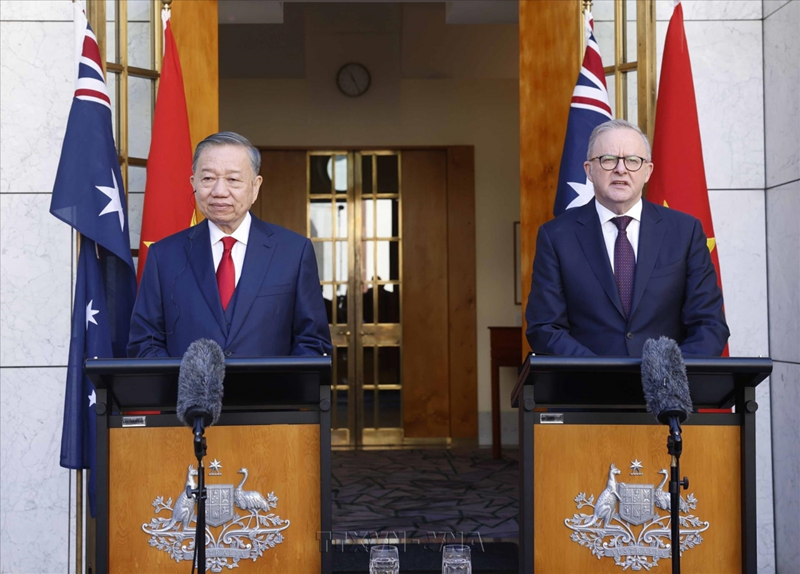
Party leader and President To Lam and Australian Prime Minister Anthony Albanese at a joint press conference in Canberra, Australia, August 11, 2026 |
2. Leaders reaffirmed the strength of the Viet Nam – Australia Comprehensive Strategic Partnership (CSP) built on mutual strategic trust and understanding over more than 50 years. They welcomed the substantial progress in deepening the CSP, reflecting the increasing convergence of strategic interests and agreed that cooperation should be ambitious and forward-looking.
Deepening Political, Defense, Security and Justice Cooperation
3. Leaders reaffirmed their commitment to further strengthen political trust and mutual understanding through promoting frequent high-level exchanges and contacts, maintaining and effectively utilizing existing dialogue and consultation mechanisms, and promoting exchanges among relevant agencies, parliaments, localities, businesses and people of the two countries.
4. Leaders acknowledged the two countries’ close defense and security ties, which contribute to peace, stability and development of the region. Leaders welcomed the updated Joint Vision Statement on Further Defense Cooperation. They reiterated their commitment to further strengthen defense and security engagement, including through dialogue and consultations, personnel training, inter-service cooperation, information sharing, military medicine, peacekeeping cooperation, maritime security, search and rescue and counter-terrorism. They agreed to continue multinational operational exchanges building on Viet Nam’s participation in Exercise KAKADU in 2024 and 2026, and observation of Exercise TALISMAN SABRE in 2025.
5. Leaders highlighted bilateral maritime cooperation under Australia Southeast Asia Maritime Partnerships to address shared maritime challenges in accordance with the United Nations Convention on the Law of the Sea (UNCLOS). Leaders welcomed progress of an Australia-Viet Nam Maritime Law Enforcement Agreement and a Cooperation and Mutual Assistance Agreement to enhance operational capability between agencies and contribute to regional security.
6. Leaders agreed to step up cooperation in countering transnational organized crime such as cybercrime, online scams, drug trafficking and smuggling, people smuggling and human trafficking and terrorism financing. Both sides acknowledged Viet Nam's role in hosting the signing ceremony for the United Nations Convention against Cybercrime and recognized the importance of fostering regional and international cooperation to prevent and combat cybercrime.
7. Leaders agreed to promote cooperation in the legal and judicial fields and effectively implement the 2024 Statement of Intent on Continued Cooperation between the Attorney-General’s Department of Australia and the Ministry of Justice of Viet Nam. They also agreed to promote cooperation in mutual legal assistance, extradition and transfer of sentenced persons under the signed treaties between the two countries.
Enhancing Economic Engagement
8. Leaders welcomed the progress of economic, trade and investment relations after 5 years of implementation of the Enhanced Economic Engagement Strategy (EEES). They agreed to strengthen trade and investment ties and enhance economic resilience, including through Invested: Australia’s Southeast Asia Economic Strategy to 2040, to facilitate greater market access for each other’s products and business-to-business engagement. They recognized the role of Australia’s Deal Team in Ho Chi Minh City and Ha Noi to mobilize capital to finance development at scale in Viet Nam and acknowledged Viet Nam is a key focus of Australia’s blended finance portfolio, receiving over a third ($83 million) of Australia’s financing.
9. Leaders welcomed the Memorandum of Understanding on Cooperation in Agriculture and Sustainable Development and close cooperation in agriculture, fisheries and forestry as well as on advancing market access, including agreement to reinstate access for Australian kangaroo and deer meat to Viet Nam so trade can commence to Viet Nam as soon as possible in 2026.
10. Leaders emphasized the importance of resilient and diversified supply chains, including in critical minerals. They welcomed initiatives to deepen high-quality and sustainable investment, including Export Finance Australia’s (EFA) $1.3 billion in finance to support infrastructure development and exports to Viet Nam since 2017.
11. Leaders reaffirmed their commitment to a predictable, transparent, open, inclusive, fair, sustainable and rules-based multilateral trading system, with a reformed World Trade Organization at its core. Australia welcomed Viet Nam’s joining of the Multi-Party Interim Appeal Arbitration Arrangement. They reaffirmed their commitment to strengthening regional economic architecture and Australia reaffirmed support for Viet Nam as Chair of the Comprehensive and Progressive Agreement for Trans-Pacific Partnership 2026 and host of the Asia-Pacific Economic Cooperation 2027.
Harnessing Knowledge and Connecting People
12. Leaders recognized the strong and deepening people-to-people ties at the heart of the bilateral relationship. They affirmed that education, training and people links remain fundamental pillars of the bilateral relationship. Leaders agreed to strengthen cooperation in higher education, vocational education and training, joint research, student and academic exchanges, and professional development. Viet Nam recognizes the valuable contribution of Aus4Skills over the past 10 years to human resource development and knowledge exchange, and welcomes a further 9-year investment (2026-2035).
13. Leaders agreed to further promote youth, cultural, sporting and tourism exchanges, thereby strengthening the social foundations of the bilateral relationship. They agreed to continue to facilitate business and leisure travel between our countries. Leaders reaffirmed their commitment to the Consular Agreement between Australia and Viet Nam, to facilitate friendly relations and cooperation between our two nations.
14. Leaders welcomed the Protocol to Amend and Supplement the Air Services Agreement. They welcomed education and research connections between the two countries and a Memorandum of Understanding on Cooperation in Vocational Education and Training. They appreciated RMIT's contribution to international education in Viet Nam over a 26-year period and welcome stronger cooperation of Australian universities in contributing to the building of high-quality workforces in Viet Nam. They also welcomed the announcement of an amended Investment Registration Certificate for RMIT University’s campus in Hanoi.
15. Leaders renewed their commitment to promote and protect human rights in accordance with international law and to strengthen and contribute to the work of the United Nations Human Rights Council and its mechanisms. They affirmed that both countries would continue sincere, frank and constructive conversations, including through our annual Human Rights Dialogue. They committed to cooperating to foster inclusive societies that embrace and provide equal opportunities and respect for the human rights of all people, without discrimination of any kind.
Strengthening Climate, Environment and Energy Cooperation
16. Leaders discussed the prolonged impact of disruptions to global energy supply chains on their respective economies and welcomed the Joint Statement on Economic Resilience Cooperation and convening of the Ministerial Energy and Minerals Dialogue. They affirmed that accelerating the energy transition, including through electrification and renewable energy deployment, are critical enablers for each country to strengthen economic resilience, and welcomed increased cooperation between energy regulators. Viet Nam also appreciated Australia’s contribution and support for the ASEAN Power Grid.
17. Leaders agreed to continue strengthening cooperation in environmental protection, address climate change, and emissions reductions, thereby contributing to the achievement of the Sustainable Development Goals and international climate commitments. They recognized the importance of urgent climate action to deliver on the Paris Agreement, including successive Nationally Determined Contribution (NDCs) that reflect the highest possible ambition. They committed to enhance cooperation on NDC implementation, support the clean energy transition, and reach net zero by 2050. Leaders reaffirmed their shared commitment to enhancing cooperation in integrated water resources management (IWRM), water accounting and data-driven water governance, digital transformation, drought risk management, and the restoration of water resources and aquatic ecosystems, with the aim of advancing water security and strengthening climate resilience.
18. Viet Nam welcomed Australia’s leadership as COP31 President of Negotiations and support of Fiji and Tuvalu to host Pre-COP under the COP31 Pacific Partnership.
19. Viet Nam welcomed the implementation of Aus4Adaptation and recognized the contribution of this program in building capacity for adaptation to climate change in the Mekong Delta.
20. Leaders reaffirmed their commitment to deepening collaboration to address shared marine environmental challenges through marine science and monitoring, sustainable marine resource management and maritime domain awareness. They welcomed Australia’s Partnerships for Infrastructure program, including maritime decarbonization, and recognized their commitment to the High Seas Biodiversity Treaty (BBNJ) to promote the conservation and sustainable use of marine biodiversity.
Supporting Science, Technology, Innovation and Digital Transformation
21. Leaders welcomed deepening cooperation in science, technology and innovation, and work on digital transition and inclusion, including promoting the safe, secure and responsible development and deployment of emerging technologies. They welcomed the Joint Statement on the Enhancement of Science, Technology and Innovation Connectivity between Australia and Viet Nam.
22. Leaders welcomed the signing of a Health Cooperation Memorandum of Understanding to strengthen collaboration on health care, medical science and research.
Reinforcing Regional and International Cooperation
23. Leaders reaffirmed unwavering support for multilateralism, ASEAN and international law, including the United Nations Charter, which underpin regional peace, security and stability.
24. Leaders reaffirmed their commitment to a peaceful, stable and prosperous Indo-Pacific region that is inclusive, resilient and free from coercion, where sovereignty is respected and competition is managed responsibly. They reaffirmed the importance of strengthening collective capacity to respond to changing dynamics and emerging challenges in the Indo-Pacific region.
25. Leaders reaffirmed the importance of ASEAN centrality and the vital role of ASEAN and ASEAN-led mechanisms in maintaining an open, transparent, resilient, inclusive and rules-based regional architecture, which, inter alia, helps promote dialogue, cooperation, confidence building and transparency so as to reduce the risk of misunderstanding and miscalculation, to prevent crisis and conflict. They agreed to continue working closely to deepen the ASEAN - Australia Comprehensive Strategic Partnership, which is marking its 5th anniversary this year, and reaffirmed the importance of effectively implementing the ASEAN Outlook on the Indo-Pacific (AOIP). They acknowledged the ASEAN Future Forum as a key initiative driving important discussions on ASEAN’s future.
26. Australia reaffirmed its strong support for ASEAN centrality, unity and cohesion, as well as ASEAN’s leading role in promoting dialogue, cooperation and confidence-building in the region. Leaders recalled their commitment in the ASEAN-Australia Joint Leaders’ Statement on Conflict Prevention and Crisis Management in the ASEAN-led Regional Architecture to strengthen cooperation through ASEAN-led mechanisms to promote open communication and dialogue, promote strategic trust, and maintain transparent, predictable and responsible conduct in order to reduce the risk of misunderstanding and miscalculation and prevent conflict in the region.
27. Leaders called for the implementation of the ASEAN Five Point Consensus on Myanmar. They called for immediate cessation of violence; unhindered humanitarian access; and genuine and inclusive dialogue.
28. Leaders expressed concern about the situation in the South China Sea (aka East Sea) and re-emphasized the importance of upholding peace, security, stability, freedom of navigation and overflight, unimpeded lawful commerce, respect for legal and diplomatic processes and peaceful resolution of disputes, without resorting to the threat or use of force, in accordance with international law, particularly the UNCLOS 1982. They reaffirmed the UNCLOS sets out the comprehensive legal framework within which all activities in the ocean and seas must be carried out. They reiterated the importance of the full and effective implementation of the 2002 Declaration on the Conduct of the Parties in the South China Sea in its entirety. They noted that any Code of Conduct on the South China Sea must be effective, substantive, in accordance with international law, particularly UNCLOS, and not affect the enjoyment of the rights of any state under international law. They also highlighted the critical role that straits used for international navigation and sea lanes of communication play to global trade and economic security.
29. Leaders agreed to advance cooperation through the Mekong – Australia Partnership (MAP) to strengthen resilience and promote inclusive and sustainable development in the Mekong sub region.
Source: VNA