On the morning of June 25, his daughter, La Hong Diep, announced the heartbreaking news: "My father passed away yesterday afternoon." Although he is gone, his remarkable legacy remains an enduring symbol of patriotism and sacrifice.
As long as my heart beats, I will keep fighting
Born in 1931 in Dinh Phong commune, Cao Bang province, into a poor Tay ethnic farming family, La Van Cau endured a childhood marked by hardship. The death of his father while performing forced labor under French colonial rule instilled in him a deep hatred of colonial oppression and an unwavering love for his homeland.
In 1948, he overstated his age in order to enlist in the Cao Bang provincial local armed forces before joining Company 671, Battalion 251, Regiment 174. Throughout his military service, he adhered to three guiding principles of fighting until the last drop of blood, as long as his heart was still beating, he would continue fighting; standing united with and supporting his comrades; and strictly observing battlefield discipline.
Driven by his ideal and determination, La Van Cau fought in 29 battles and earned distinction through exceptional acts of bravery.
At the age of 17, during an ambush on Road No.4 at Bong Lau - Lung Phay Pass in Lang Son province, he volunteered for an assault team. Amid heavy fighting, he killed a French soldier aboard the lead tank, seized the enemy's submachine gun, eliminated three more soldiers at close range, and later shot six additional enemy troops, making significant contribution to his unit's victory.
During the first Phan Dinh Phung Campaign to attack the Dong Khe Post in May 1950, he insisted on remaining in combat despite being wounded. Even as enemy paratroopers launched a counterattack, he and his comrades succeeded in bringing a captured 12.7 mm machine gun back to their unit.
The defining moment of his military career came during the second Dong Khe Battle in the Border Campaign in 1950.
Leading a five-man demolition team tasked with destroying a key enemy bunker, La Van Cau continued advancing with a 12-kilogram demolition charge after his comrades had been killed or wounded. Enemy fire shattered his right arm and severely wounded his face, yet he refused to retreat. Realizing that his mangled arm prevented him from moving forward, he persuaded Squad Leader Nong Van Pheo to amputate the injured limb with a machete.
    |
 |
|
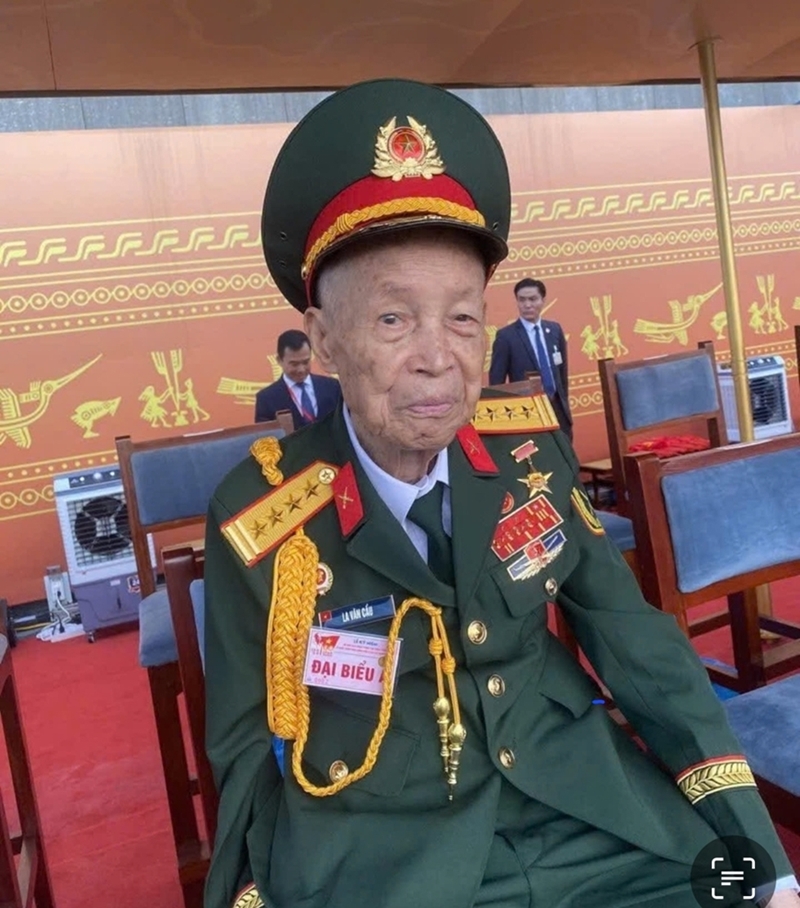
Sr. Col. and Hero of the People’s Armed Forces La Van Cau |
After receiving only basic first aid, he pressed on toward the bunker. When enemy soldiers pushed the demolition charge back through the firing slit, La Van Cau, left with only one arm, forced it back into position with his foot before detonating it and diving into a nearby trench. The explosion destroyed the enemy strongpoint, but also left him unconscious.
Upon regaining consciousness, he requested permission to continue fighting but was ordered to withdraw for medical treatment. Although a stretcher had been prepared, he refused to use it after seeing that many other soldiers were more seriously wounded. Instead, he walked nearly four kilometers across mountainous terrain to reach the field medical station. The following day, severe infection forced doctors to amputate his arm at the shoulder.
His extraordinary heroism earned widespread recognition. Following the Border Campaign, General Vo Nguyen Giap praised him as one of the leading figures in the movement to destroy the enemy. In 1951, he had the honor of meeting President Ho Chi Minh at the Viet Bac War Zone. At the First National Congress of “Soldier of the Year” and Model Cadres in May 1952, he was awarded the Third-Class Military Exploit Order and the title of Hero of the People's Armed Forces. On August 10, 1952, he also received the title of Hero of Patriotic Emulation.
Even decades later, Hero La Van Cau spoke calmly about the amputation of his arm, describing it simply as a duty that had to be fulfilled. Despite living with permanent disabilities after the war, he continued serving the country with the resilience and determination that had defined his military career. He was among the few wounded officers who rendered the military salute with their left hand.
Beautiful comradeship
Before his passing, Hero La Van Cau fulfilled one of his final wishes by reuniting with his longtime comrade and close friend, Major General Nguyen Van Ninh, former Deputy Director of the Operations Department under the General Staff. The reunion took place while both men were receiving treatment at the Central Military Hospital 108.
Their friendship spanned nearly eight decades. Both lost their fathers to French colonial forces at the age of three, grew up under colonial occupation, and volunteered to join the resistance at the age of 16 with the shared goal of securing Vietnam's independence.
The Border Campaign in 1950 became a defining chapter in both of their lives. While Hero La Van Cau fought on despite suffering devastating wounds during the Battle of Dong Khe, Nguyen Van Ninh was responsible for providing logistical support to the frontline troops. After the campaign, both men were assigned to the Political Division of the Military Medical Department, where their comradeship continued to deepen.
Over the years, Sr. Col. La Van Cau became a living legend of the Vietnam People's Army. His story has been included in school textbooks, and roads and schools across Vietnam have been named in his honor. Major General Nguyen Van Ninh likewise earned recognition as a "living encyclopedia" on Vietnam's Missile Force and the Truong Sa (Spratly) Islands.
|
|
 |
|
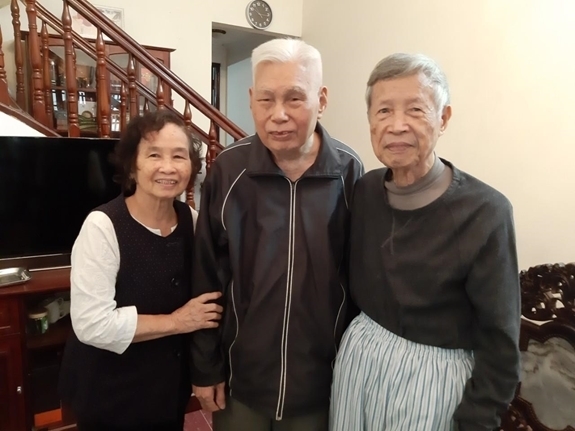
Hero of the People’s Armed Forces La Van Cau and his wife and Major General Nguyen Van Ninh (center) in March, 2020 |
Following their military careers, both veterans continued to exemplify the qualities of "Uncle Ho's Soldiers" through community service. They wrote books and newspaper articles, delivered talks on Vietnam's revolutionary traditions, educated younger generations, and remained active contributors to society.
In 2019, Hero La Van Cau was honored as an "Outstanding Citizen of the Capital," while Nguyen Van Ninh received Hanoi's "Good People, Good Deeds" award.
After a lifetime devoted to his country, Hero La Van Cau peacefully reunited with the comrades who had sacrificed their lives for Vietnam, leaving behind an enduring legacy as one of the finest embodiments of the courage, selflessness, and noble character associated with "Uncle Ho's Soldiers."
Translated by Tran Hoai