The FTA would increase access to markets with strong demand for premium food products in line with the Southeast Asian country’s strategy of shifting exports towards increasing added value, the association said.
The Vietnam Association of Seafood Exporters and Producers (VASEP) said that the trade deal, which covers Switzerland, Norway, Iceland and Liechtenstein, came as seafood exporters face growing protectionism and increasingly stringent food safety and sustainability requirements in major markets.
    |
 |
|
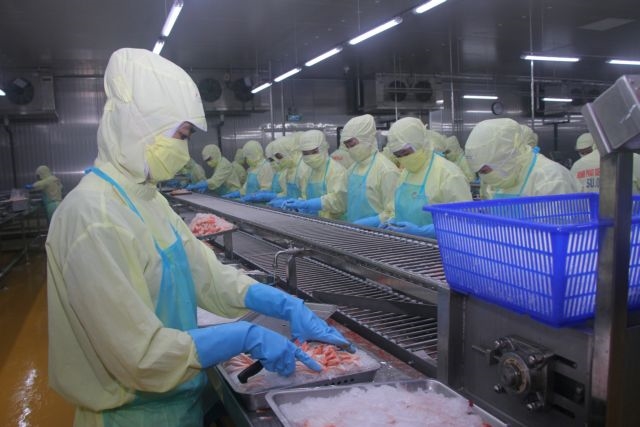
Workers process seafood for export at a plant in Ca Mau province. To expand market share in EFTA countries, Vietnamese seafood companies will need to strengthen standards across the entire supply chain. |
According to the association, Vietnamese exporters should not compete on price but focus on higher-value products such as processed shrimp, premium frozen shrimp, pangasius fillets and portioned cuts, processed pangasius, tuna, squid, octopus, crab, shellfish and ready-to-cook seafood products for retail chains.
VASEP urged exporters to fully comply with origin requirements, certification procedures, food safety regulations and technical standards to be able to benefit from the preferential tariffs under the trade deal.
Early preparations in quality control, sustainability certification, traceability systems, compliance with rules of origin and packaging, as well as closer relationships with retailers, importers and food service distributors in Switzerland, Norway and Iceland, are needed for exporters to be able to seize opportunities from the trade deal.
Norway, Iceland and Liechtenstein are members of the European Economic Area and closely aligned with EU standards, while Switzerland maintains similarly strict requirements on food safety, traceability, environmental protection, labor practices and corporate social responsibility.
To expand market, share in the EFTA countries, Vietnamese seafood companies will need to strengthen standards across the entire supply chain, from aquaculture and fishing vessels to processing plants, cold storage, packaging and sustainability certification.
Over the longer term, VASEP said the EFTA could become a valuable niche market, helping Vietnam raise both the value and sustainability of its seafood exports while strengthening its position in global seafood supply chains.
Beyond trade, the FTA could strengthen cooperation in technology and investment as Norway and Iceland are recognized for their expertise in marine aquaculture, fisheries management, cold-chain technology, seafood processing and logistics.
VASEP said the agreement could create opportunities for cooperation in technology transfer, raw material supply, investment, supply chain management and product development.
At the same time, lower tariffs are expected to make seafood imports from the EFTA countries, particularly Norwegian and Icelandic salmon, mackerel, cod, whitefish and frozen seafood products, more competitive in the Vietnamese market.
This would increase competition in premium retail and also encourage domestic producers to improve product quality, invest in value-added processing, strengthen branding and modernize distribution systems, the association said.
Although seafood exports to the EFTA bloc remain modest, recent growth suggests untapped potential.
In 2025, seafood exports to Switzerland rose by 15% year-on-year to USD 34.1 million, while shipments to Norway nearly doubled, increasing 95% to USD 18.5 million.
In the first five months of 2026, exports to Switzerland fell by 15% from a year earlier to USD 13.4 million, equivalent to around 0.3% of the country's total seafood exports. Shipments to Norway, however, climbed 36.7% to USD 7 million over the same period, with May exports alone rising by 11.5% year-on-year to USD 1.64 million.
Source: VNA