In recent years, under the leadership and direction of the Central Military Commission, the Ministry of National Defense, and the Vietnam Border Guard Party Committee and Command, border diplomacy has been carried out with diverse, flexible, and effective approaches, becoming a highlight in the defense diplomacy. This effort aligns with the Resolution of the 15th Congress of the Vietnam Border Guard’s Party Organization for the 2020–2025 term, which aims to “renew and improve the quality and effectiveness of border diplomacy, thus building borders of peace, friendship, cooperation, and development.”
    |
 |
|
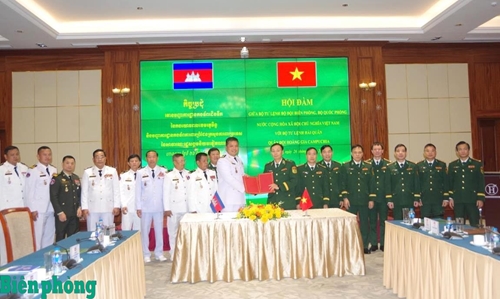
At a talks between the Vietnam Border Guard and Royal Cambodian Navy |
Key achievements include the signing and implementation of international treaties and agreements on border management; establishing bilateral and multilateral cooperation mechanisms; organizing regular meetings, exchanges, and seminars; and coordinating with forces from China, Laos, and Cambodia to conduct joint patrols, training, and exercises and respond to incidents along the border.
The force has strengthened cooperation with neighboring countries, other nations, and international organizations to combat crimes such as smuggling, drug trafficking, human trafficking, and illegal migration. Partnerships with entities such as UNODC, IOM, and the U.S. Agency of Drug Enforcement Administration in Vietnam, and participation in programs like AAPTIP, have improved capabilities in immigration control and anti-human trafficking. Defense and border cooperation has also expanded to countries such as Russia, Australia, the U.S., India, and Thailand, with all exchanges conducted under strict security.
Innovative diplomatic activities have been promoted, including Border Defense Friendship Exchanges, Political Work Exchanges with China’s National Immigration Administration, and Young Officers’ Exchanges. Twinning models between Vietnamese border posts and corresponding units in China, Laos, and Cambodia have strengthened military-to-military ties and enhanced cooperation in border management. These programs have extended to communities, with 224 pairs of residential clusters along the Vietnam–China, Vietnam–Laos, and Vietnam–Cambodia borders now formally twinned.
The force has also worked closely with local authorities and border residents to ensure compliance with bilateral agreements while supporting socio-economic development programs in border areas. These initiatives have helped build comprehensive strength in border regions and foster solidarity between local communities on both sides of the border.
Looking ahead, the global and regional situation is expected to remain complex. Vietnam, despite achieving significant socio-economic and defense milestones after nearly four decades of renovation, still faces challenges from increasingly aggressive hostile forces and complex criminal activities in border and maritime areas. At the same time, organizational restructuring of the political system and adjustments to the border guard force will place higher demands on border work.
According to Major General Hoang Huu Chien, Deputy Commander and Chief of Staff of the Vietnam Border Guard, to address these challenges and fulfill the objectives of the 16th Border Guard Party Congress for the 2025–2030 term, the Border Guard Party Committee and Command have been determined to consistently implement the foreign policy of independence, self-reliance, peace, friendship, cooperation and development, diversification and multilateralization of external relations; effectively carry out the Resolution on International Integration in the New Situation, along with related directives from the Central Military Commission and Ministry of National Defense; and enhance the quality of situation assessment and forecasting to provide strategic advice on border management, protection, and defense diplomacy.
The force will coordinate closely with central and local agencies, as well as neighboring countries’ border forces, to manage and protect borders and checkpoints, prevent crimes, and address sovereignty violations. They will also finalize the demarcation of the Vietnam–Cambodia land border and combat illegal migration, smuggling, and cross-border trafficking; and strengthen joint search and rescue efforts in border and adjacent areas.
In addition, public communication on the Party’s and State’s policies on international integration, defense diplomacy, and border guard diplomacy will be strengthened. Disseminating information about solidarity and friendship between Vietnam and neighboring countries, as well as with other international partners, will be promoted to raise awareness among authorities, forces, and border communities about the importance of building borders of peace, friendship, cooperation, and development.
|
|
 |
|
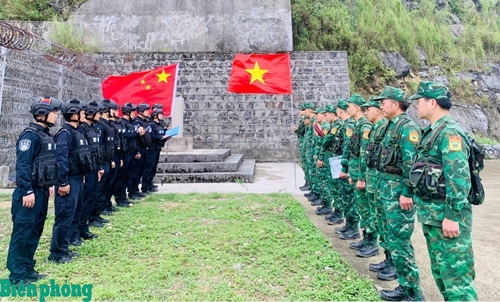
Vietnamese and Chinese units in a bilateral patrol |
The border guard force will also expand friendship exchange activities and twinning programs between Vietnamese and foreign border units, and promote cooperation programs that support socio-economic development in border areas. They will foster people-to-people diplomacy and strengthen partnerships with international organizations and foreign agencies in crime prevention, training, and technical support.
Through these measures, the Border Guard aims to further enhance the effectiveness of border diplomacy, contributing to firmly safeguarding national sovereignty, territorial integrity, and border security while fostering peace, friendship, and cooperation with neighboring countries.
Source: Baobienphong
Translated by Tran Hoai