As a bridge between Vietnamese agencies and relevant U.S. partners, the embassy has undertaken a range of activities to expand information sources, gain access to archival records, apply new technologies and mobilize additional resources for this deeply humanitarian mission.
    |
 |
|
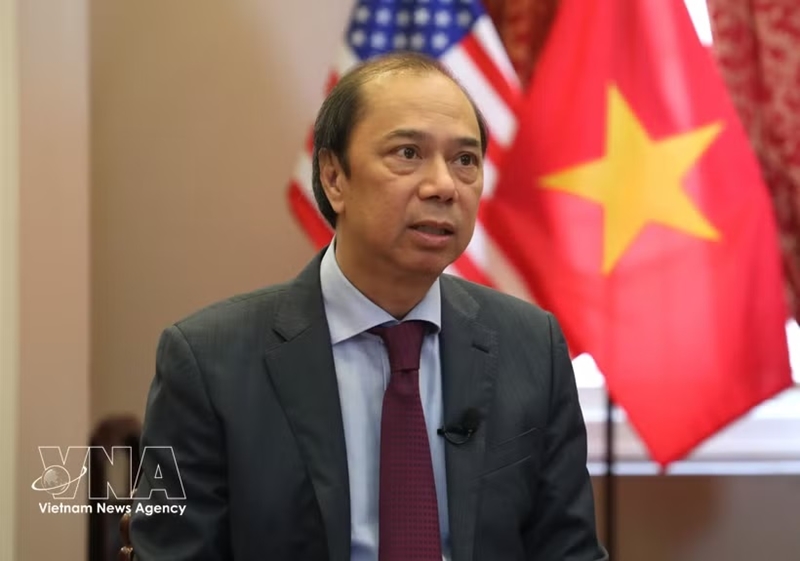
Vietnamese Ambassador to the U.S. Nguyen Quoc Dung |
In an interview with Viet Nam News Agency correspondents in Washington D.C. on August 18, Vietnamese Ambassador Nguyen Quoc Dung described cooperation in addressing war legacies, including the search for missing personnel from both sides, as a bright spot in Viet Nam - U.S. relations. He said the work is not only humanitarian in nature but also contributes to healing the wounds of war, strengthening mutual trust and promoting reconciliation between the two peoples.
According to the ambassador, under the Memorandum of Understanding on the Viet Nam War Accounting Initiative (VWAI), signed by the Vietnamese Ministry of National Defense and the U.S. Department of Defense (now Department of War) in 2021, the U.S. provided Viet Nam with 46 sets of records by the end of fiscal year 2025, of which Viet Nam verified 45.
In the first six months of 2026 alone, Texas Tech University (TTU) provided Viet Nam with 600 pages of documents and 50 selected case files on missing Vietnamese military personnel. These materials were selected, processed and analyzed from more than 200 digitized records concerning 1,500 Vietnamese personnel contained in U.S. archives. The U.S. has also returned more than 40 war artifacts to Viet Nam.
Dung highlighted the embassy’s role in engaging the U.S. administration, Congress and relevant agencies and organizations, and serving as a bridge between Vietnamese agencies, particularly the Office of the National Steering Committee on the Search for, Collection and Identification of Martyrs' Remains, and U.S. counterparts and partners. The embassy has also worked to connect U.S. archives, universities, veterans’ organizations and businesses to broaden information sources, promote technological applications and deepen practical cooperation.
As part of the 500-day campaign to accelerate the search for, recovery and identification of martyrs’ remains, the embassy is encouraging the U.S. side to continue prioritizing resources for VWAI for 2025-2030. It is also promoting the digitization and sharing of records, as well as research involving aerial imagery and maps and the application of technologies such as ground-penetrating radar, remote sensing and forensic archaeology, he shared.
The diplomat went on to say that a major advantage is the continued positive development of bilateral relations, with cooperation in addressing war legacies receiving attention from both sides. Many U.S. agencies, organizations and individuals have demonstrated goodwill and expressed their willingness to work with Viet Nam.
The embassy has also received close guidance from Vietnamese agencies and active coordination from partners including the U.S. - ASEAN Business Council (USABC), Mission: POW/MIA, Texas Tech University, the University of Georgia, the Defense POW/MIA Accounting Agency (DPAA) and U.S. archival agencies.
However, the passage of time, the declining number of witnesses and the dispersion or limited accessibility of documents pose significant challenges. Resources, technology and mechanisms for coordinating and processing information among domestic and overseas stakeholders also need further improvement, Dung stated.
Therefore, in the coming period, the embassy will focus on three key areas: building a system of records and a network of partners for searches; closely coordinating with the Office of the National Steering Committee and U.S. partners to effectively implement VWAI; and stepping up external communications on the 500-day campaign and the humanitarian and reconciliation significance of Viet Nam - U.S. cooperation in addressing war legacies.
The ambassador expressed his belief that, with the determination of Vietnamese agencies and continued support from U.S. partners, efforts to search for, recover and identify martyrs’ remains will achieve further practical results, fulfilling the legitimate aspirations of martyrs’ families and the Vietnamese people.
Source: VNA