More than the voice of the people and the soldiers, these issues also embody a unique value, that is battlefield fine arts. More than 70 years later, the 33 issues are recognized as invaluable journalistic heritage, worthy of being considered a national treasure.
1. Painter Nguyen Bich, one of the five journalists involved in producing the PAN’s 33 issues published at the Dien Bien Phu Front, from December 28, 1953 to May 16, 1954, was responsible for drawing the logo, mastheads, diagrams, battle maps, caricatures and illustrations. In total, he created 11 maps, four full-page posters, nine caricatures, one portrait sketch, and numerous small illustrations for poems, articles, and section titles. His works both supported the content and carried strong informative and aesthetic value.
    |
 |
|
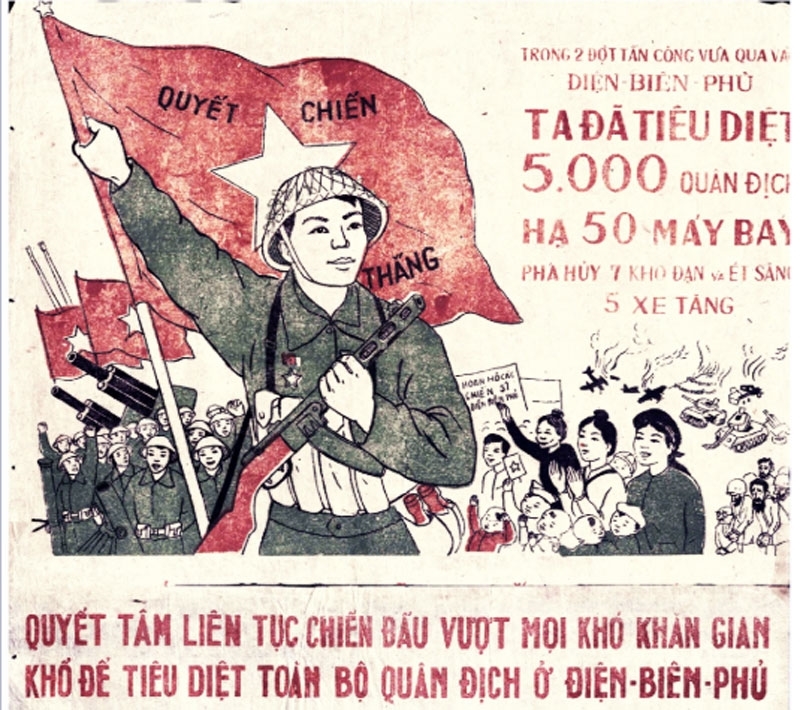
Poster in one of the PAN’s 33 issues published at Dien Bien Phu Front |
Nguyen Bich’s posters went beyond realistic depiction, becoming flames of heroic spirit that encapsulated the spirit of the era. The poster printed with issue No.125 on February 24, 1954, depicting a soldier waving the flag “Determined-to-Fight, Determined-to-Win” at the foot of an artillery hill, became a visual symbol of the whole campaign. Within a small space, dozens of figures, artillery, aircraft, and tanks, were rendered clearly and rhythmically. Strong contrasts in scale and firm, decisive lines conveyed the offensive spirit of the Dien Bien Phu troops and people.
Notably, the full-page poster in issue No.148 dated May 16, 1954, the victory celebration issue, portrayed a soldier raising the victory flag, his face resembling General Vo Nguyen Giap, with a jubilant sea of people behind him. The composition was divided into two parts with the left featuring the soldier and victory symbols, the right presenting text and figures. This layout ensured both visual balance and clarity of information. This was battlefield information presented in poster form. Combat data such as “Eliminating over 21 battalions and 10 companies of the enemy, totaling 16,200 troops” were enlarged into focal points, boosting morale of troops and recording military achievements. The firm, declarative tone of the text reinforced its motivating power. The soldier in uniform, wearing helmet, with gun in hand symbolized fighting will and the strength of the People’s Army. His raised arm created strong visual momentum, expressing the determination to win. This work stands as an iconic fine art symbol of the Dien Bien Phu Campaign and a landmark of 20th-century Vietnamese press art.
The caricatures in the 33 issues continued the tradition of Mai Van Hien, a war zone cartoonist known for mocking French troops. At Dien Bien Phu, Nguyen Bich’s caricatures retained this spirit which was humorous but sharply critical. Antagonists were depicted with crisp lines and stark black and white contrasts, producing strong visual effects. Caricature became “combat laughter,” helping soldiers relieve tension during life and death moments.
Nguyen Bich’s caricature “Cutting off the enemy’s air supply” in issue No.132 dated March 15, 1954, used satire to expose the French military’ deadlock after its air supply routes were completely cut off. The central enemy figure appeared emaciated and panicked, trapped in barbed wire; exaggerated imagery underscored the collapse and despair of the stronghold. Burning aircraft illustrated the failure of distant efforts, while the small, helpless figure of Navarre in the corner mocked the confusion of the French command.
The maps drawn by Nguyen Bich combined military accuracy with graphic language. Clear layouts, coherent lines, and balanced proportions helped journalists, soldiers, and civilians follow battlefield developments while also offering aesthetic value. These maps were crucial visual documentation, reflecting each shift in the battlefield, from enemy defensive layouts and Vietnamese attack directions to encirclement and tightening operations throughout the campaign. In an era without satellite imagery or modern printing, each map was both real-time news and a “map of memory” of a world-shaking victory.
2. Despite being limited to just two bamboo-paper pages per issue, the newspaper’s layout maintained a clear hierarchy of main and secondary news, with headlines, images, and text harmoniously integrated, demonstrating professional design skills. The masthead and the line “Democratic Republic of Vietnam - Independence, freedom, happiness” were presented solemnly, like an unyielding oath of soldier-journalists.
It can be said that Nguyen Bich was the first graphic designer of Vietnam’s battlefield journalism, laying the foundation for military press art. His ability to handle narrow space by balancing text and imagery created a dynamic visual rhythm, conveying a modern and pro-active spirit that was rare in early resistance journalism.
Compared with Cuu quoc (National Salvation) Newspaper (1942), Su that (Truth) Newspaper (1946), or Ve Quoc quan (National Guards) Newspaper (1947) which was later merged with Quan du kich (Guerilla) Newspaper into the PAN in 1950), the art of the PAN’s 33 issues published at Dien Bien Phu battlefield was more pro-active and combat-oriented. While Chien khu (War Zone) Newspaper (1946) focused on rear-area dissemination, the PAN at Dien Bien Phu directly depicted combat developments with intense realism and battlefield accuracy. Other resistance newspapers typically used simple illustrations, and static layouts, whereas these 33 issues employed full-page posters and coordinated lines, shapes, and text for immediate dissemination impact.
Compared with contemporary international military newspapers such as the U.S.’s Stars and Stripes or Soviet Union’s Krasnaya Zvezda, the PAN at Dien Bien Phu Front, though materially rudimentary, surpassed them in symbolic meaning and the seamless fusion of art and combat. No other newspaper in the world had been written, drawn, printed, and distributed right in the trenches, only a few hundred meters from campaign headquarters. Here, art was not merely visual, it was part of the spiritual arsenal.
According to Article 53, Chapter IV of the Law on Cultural Heritage 2024, documentary heritage may be recognized as a national treasure if it possesses outstanding historical, cultural, scientific, and aesthetic value, transmitted across generations and marking historical turning points tied to places, events, or people, with national, regional, or global influence. The PAN’s 33 issues published at the Dien Bien Phu Front fully meet this definition through their physical carriers, namely hand-printed paper, ink, and original drawings by a battlefield artist.
Furthermore, the art within these issues testifies to the creative capacity of Vietnamese soldier-artists and represents the essence of revolutionary art: The art for humanity, for freedom, for the Fatherland. Each poster and battle map carries not only visual value, but also a cultural, combat, and national memory.
Painter Nguyen Bich contributed to this special value. He was posthumously awarded the State Prize for Literature and Arts in 2017. His works not only served combat missions, but also became an enduring part of Vietnam’s revolutionary art heritage.
By Assoc. Prof., Dr. Quach Thi Ngoc An (National University of Arts Education)
Translated by Mai Huong