From 2010 to 2025, nationwide efforts cleared 530,000 hectares of contaminated land. State and international funding supported this recovery, restoring safe areas for housing, production, and infrastructure.
    |
 |
|
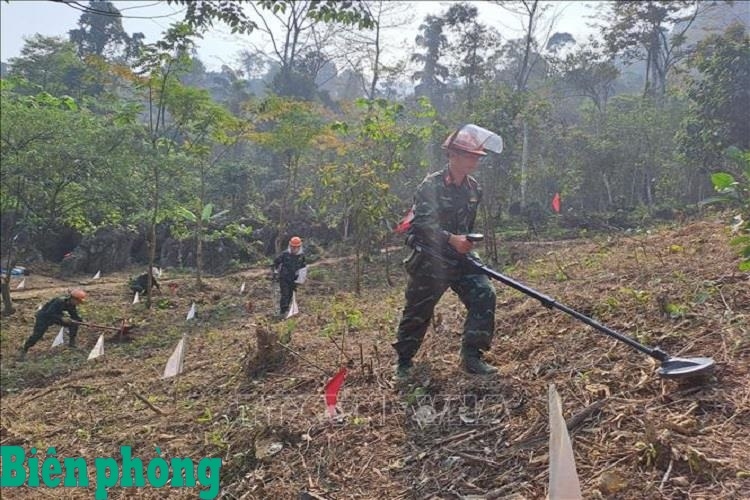
A clearance team of Brigade 543 conducting landmine and UXO clearance operations in Tuyen Quang province |
Despite progress, Vietnam faces formidable challenges as millions of hectares remain contaminated by landmines and UXO, particularly in disadvantaged and mountainous regions. These "invisible enemies" hinder livelihoods and development, incurring silent costs in lost opportunities for farming, infrastructure, and housing.
Launched in 2010, Program 504 adopted a dual-track approach: addressing the "land" through clearance and the "human" through victim support and risk education. Over the past 15 years, the program has established a systematic governance framework. Nationwide mapping of contaminated areas now allows for better prioritization and cost estimation, replacing previously fragmented efforts with data-driven management.
Approximately 530,000 hectares have been cleared through sustained efforts by engineering units and specialized teams under difficult conditions. While the state budget remains central, diversified international aid has bolstered capacity building and technical standards. Crucially, community-focused risk education and rehabilitation projects have helped victims reintegrate into society.
However, bottlenecks persist. Resources are insufficient for the scale of contamination, and clearance costs remain high. Gaps in data connectivity and the need for advanced technology further slow progress.
At a recent conference in Hanoi summarizing Program 504 (2010–2025), the government set a landmark goal: basically clearing landmines and UXO by 2045. Moving forward, Vietnam will focus on strengthening legal frameworks, standardizing procedures, and leveraging digital transformation. Addressing this war legacy remains both a humanitarian duty and a vital development task, requiring strict accountability to ensure safety and efficiency.
|
|
 |
|
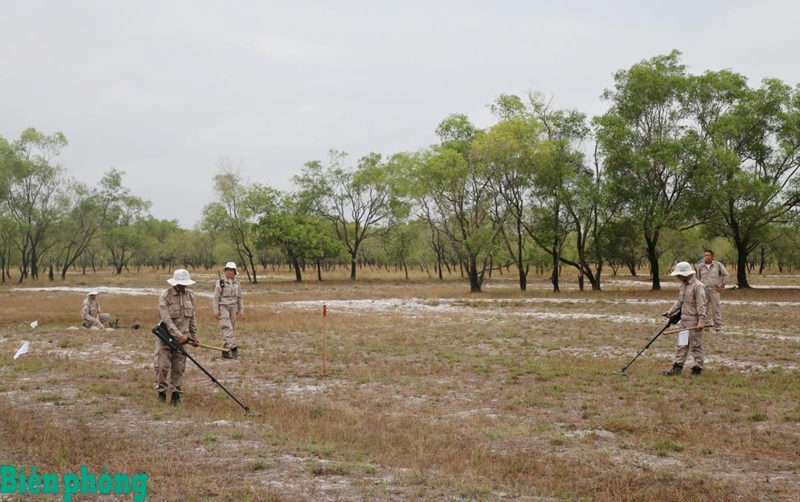
Clearance forces operating in Quang Tri province |
Accelerating clearance across millions of hectares requires advanced technology, including digital mapping and modern detection tools, to enhance efficiency and frontline safety. This effort must integrate risk education and victim support, ensuring communities remain safe while clearance progresses. Building on Program 504’s institutional and data foundations, the journey toward the 2045 vision demands greater discipline and tighter integration with development planning. Each cleared square meter secures livelihoods and growth, transforming war legacies into a foundation for sustainable peace.
Translated by Tran Hoai