The meeting was co-chaired by Deputy Prime Minister Pham Thi Thanh Tra, who heads the steering committee; Deputy Minister of National Defense Sr. Lt. Gen. Nguyen Van Gau; and Deputy Minister of Home Affairs Nguyen Thi Ha.
The organizing committee announced the Prime Minister’s decision to consolidate the steering committee, adopted updated operating regulations, and discussed the 2026–2030 action program, along with a draft plan by the Ministry of National Defense to collect samples from unidentified graves for DNA testing.
    |
 |
|
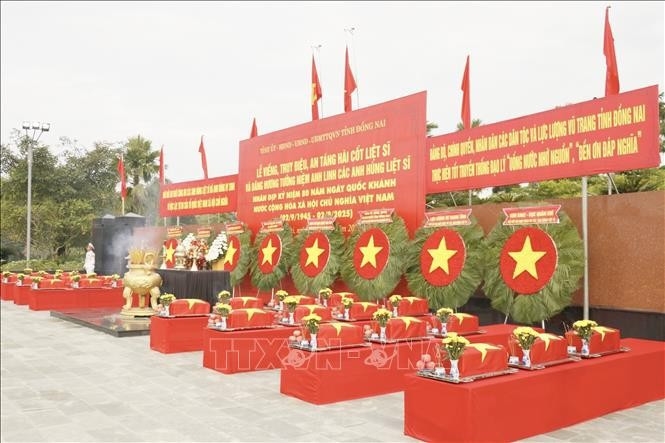
Dong Nai province holds a memorial and burial service for the remains of 30 fallen soldiers on August 27, 2025. |
The program will be implemented in two phases. During the first phase, from January 2026 to July 2027, authorities aim to address major backlogs by searching for and repatriating about 7,000 sets of remains, collecting samples from roughly 230,000 unidentified graves nationwide, conducting DNA analysis on approximately 18,000 samples, and establishing a genetic database of martyrs’ relatives.
The second phase, from August 2027 to December 2030, targets the recovery of an additional 3,000 sets of remains and DNA testing of about 30,000 samples, while intensifying verification and updates of incomplete grave information.
The "500-Day-and-Night Campaign" is expected to mobilize the entire political system to accelerate the efforts of identification and repatriation of martyrs' remains.
Addressing the conference, Tra stressed that the work must adhere to the principle of “six clarities” to ensure effectiveness, particularly in the lead-up to the 80th anniversary of War Invalids and Martyrs’ Day (July 27, 1947–2027), with longer-term goals extending to 2030.
Describing the mission as both a state responsibility and a moral commitment, she called for closer coordination among ministries, sectors and localities to ensure synchronized and efficient implementation. The Ministry of National Defense, acting as the standing agency, was tasked with refining working regulations, clarifying responsibilities, and strengthening coordination mechanisms.
Key priorities for 2026 include completing institutional and policy frameworks, accelerating mine and unexploded ordnance clearance in key areas to support search operations, expanding sample collection for unidentified remains, and ensuring the steering system operates in a unified, effective and well-coordinated manner nationwide. Relevant ministries were also assigned to coordinate funding to support the implementation.
Source: VNA