More than publications in wartime, they are invaluable historical documents inseparably linked to the Dien Bien Phu Victory that “resounded across the five continents and shook the globe.”
Fully understanding this value, Dien Bien province has been implementing many practical measures to preserve this legacy while organizing exhibitions and educational activities to promote the vitality of this priceless heritage.
Special weapon in historic campaign
Fully aware of the importance of journalism to the historic Dien Bien Phu Campaign, the Central Military Commission, with strategic foresight and decisive leadership, directly through the General Department of Political Affairs, directed the establishment of a frontline editorial office of People’s Army Newspaper located near the bunker of the Commander-in-Chief and the Political Chief at the front.
    |
 |
|
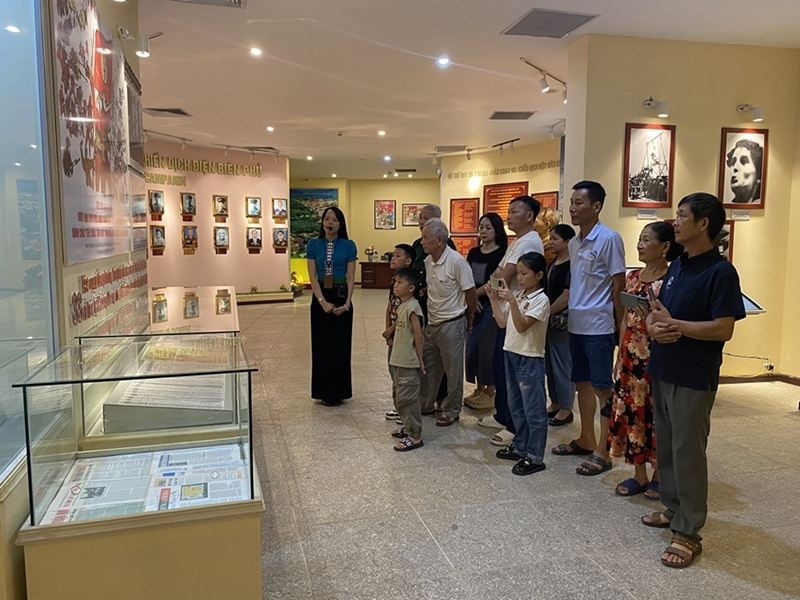
Visitors explore the PAN’s 33 issues on display at the Dien Bien Phu Victory Museum. |
Under extraordinarily harsh wartime conditions, only five journalist-soldiers staffed the frontline newsroom. Despite severe shortages of equipment and supplies, they wrote, edited, printed, and distributed the newspaper right at the battlefield. In the remote mountains amid intense fighting, the regular publication of a newspaper demonstrated not only professional competence but also courage, resilience, and dedication. It affirmed the vitality and determination of Vietnam’s revolutionary press.
Scholars and researchers have assessed that the 33 issues published on the Dien Bien Phu battlefield hold exceptional and unique value. They are regarded as part of Vietnam’s documentary heritage of memory and represent a remarkable achievement in the history of revolutionary journalism in Vietnam and beyond.
Published continuously from the campaign’s preparation phase until the victory on May 7, 1954, the 33 issues provided timely and truthful coverage of battlefield developments. They encouraged troops and civilians to mobilize their full strength in pursuit of victory in a battle that would leave a lasting mark on history. Beyond reporting combat operations, the newspaper documented key aspects of Party and political work within the military, mass mobilization, enemy mobilization, and logistical support.
While focused on frontline realities, the newspaper also included smaller sections with lyrical and artistic elements, softening the tone of wartime reporting and offering readers moments of reflection. Produced manually under conditions of material scarcity, the issues nonetheless featured maps, drawings, and illustrations that conveyed strong visual impact. The layout was accessible and reader-friendly, tailored primarily to soldiers at the front.
The 33 issues were therefore more than wartime news bulletins. They were products of special political, military, and cultural significance. They bolstered morale, strengthened confidence in ultimate victory, and reinforced the military’s resolve to fight and win. Each issue stands today as a living witness to history, preserving the collective memory of a heroic era in Vietnam’s journey.
Preserving and promoting priceless heritage
Today, the site of the frontline editorial office of the PAN in Muong Phang commune, Dien Bien province, has been officially designated as a component relic of the Special National Historical Site of the Dien Bien Phu battlefield under Decision No.2367/QĐ-TTg dated December 23, 2015, issued by the Prime Minister. The boundaries of the protected area have been clearly defined in accordance with regulations, and the site is being preserved in its original state by relevant authorities and local government.
According to historical witnesses, the editorial compound included a central space for the newsroom; huts serving as living and working quarters for the artist and printing section; huts for the frontline printing house; a radio communications station; a kitchen and communal dining area; and facilities for clerical, administrative, medical personnel, and the distribution platoon. Based on the Government-approved master plan for the preservation and restoration of the Dien Bien Phu battlefield site, the province has continued reconstructing the editorial working huts, completing visitor pathways, and developing related infrastructure. These efforts aim not only to conserve the site but also to support educational visits and public engagement.
Beyond preserving the physical site, Dien Bien province has taken steps to ensure that the 33 issues do not remain confined to archival storage. From June 12 to 21, 2025, the Department of Culture, Sports and Tourism of Dien Bien province, in coordination with the PAN, organized a photo exhibition, titled “33 special issues of the PAN published at Dien Bien Phu Front” at the Campaign Headquarters Site in Muong Phang. The event commemorated the 100th anniversary of Vietnam Revolutionary Press Day (June 21, 1925 - 2025) and paid tribute to generations of revolutionary journalists who wielded their pens like weapons, contributing to the historic victory at Dien Bien Phu.
The exhibition served not only as a commemorative event but also as an educational platform. Through wartime-printed pages, visitors encountered authentic stories that conveyed the hardships, sacrifices, and steadfast spirit of former generations. Such activities help foster gratitude, national pride, and a sense of responsibility among younger generations in the ongoing mission of national construction and defense in peacetime.
At the Dien Bien Phu Victory Museum, replicas of the issues are currently on display, alongside photographs and documents related to reporters who covered the campaign. Through images, archival materials, artifacts, and interpretive commentary, visitors gain insight into the working conditions of wartime journalists and the critical role of revolutionary journalism during the campaign.
However, certain limitations remain. Current displays are largely general in nature, and presentation methods have yet to provide immersive and interactive experiences, particularly for younger audiences. The content at the frontline editorial office site and the museum remains somewhat fragmented, without a specialized and highly interactive exhibition theme.
To address these challenges, Dien Bien province is implementing a comprehensive plan for renewal. In coordination with the PAN, the State Records and Archives Department under the Ministry of Home Affairs, and military history research institutions, efforts are underway to digitize the entire collection of issues and related materials. The goal is to establish an electronic database to serve research and educational needs.
The provincial cultural sector also plans to expand experiential programs and traditional talks about the 33 issues for students, youth, and young soldiers in the area. Through these initiatives, the legacy of the 33 issues will continue to reach broader audiences in more dynamic ways.
Preserving and promoting the value of the 33 issues of the PAN is not merely an act of safeguarding a heroic past. It is a bridge connecting history with the present. Through sustained efforts, this legacy continues to inspire aspirations for contribution and reaffirms the irreplaceable role of revolutionary journalism in the cause of national construction and defense.
By Tran Hai Ha, Acting Director of the Department of Culture, Sports and Tourism of Dien Bien province
Translated by Tran Hoai