The 33 issues of the People’s Army Newspaper (PAN) published on the Dien Bien Phu Battlefield contain articles, directive messages, battlefield diaries, operational maps, images of soldiers, calls from President Ho Chi Minh, and many other vivid historical testimonies. Viewed through the lens of documentary heritage, this collection possesses not only news value, but also profound historical, cultural, educational, and scholarly significance.
    |
 |
|
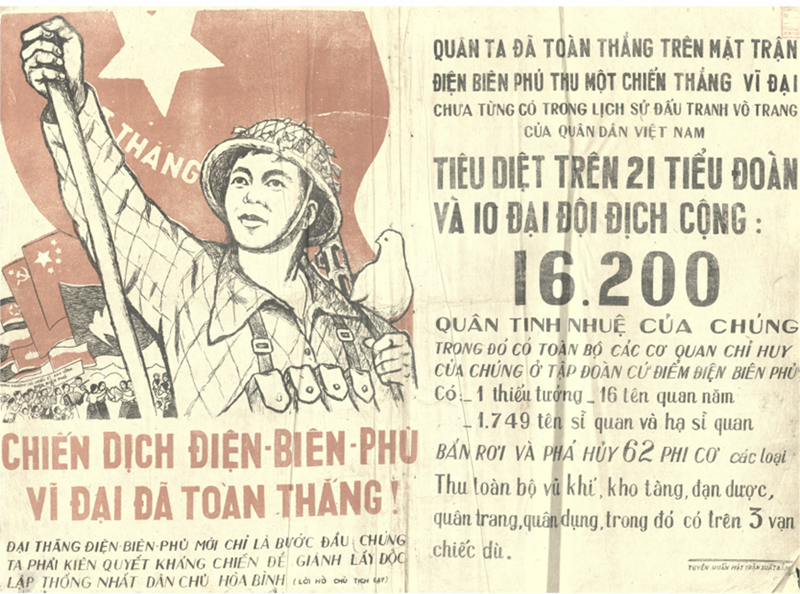
PAN’s page published on Dien Bien Phu Battlefield, issue No.148, May 16, 1954. |
Regarding historical context, all 33 issues were published between late 1953 and mid-1954, when Vietnam’s troops and people entered the decisive confrontation with French colonialists at Dien Bien Phu Front. Their content focuses on preparations for the campaign, reflected in articles on troop movements, logistics supplies, and determination; our military’s victories in Lai Chau, Northwestern region, and Upper Laos that created encirclement and isolation of Dien Bien Phu; direct instructions from the Party Central Committee and the General Command; emulation atmosphere and the spirit of “Determined-to-fight, and Determined-to-win”; battlefield maps, battle diagrams, and tactical commentary; as well as calls, Lunar New Year greetings, and messages from President Ho Chi Minh.
The front pages of many issues prominently display major slogans, such as “Determined to annihilate all enemy forces at Dien Bien Phu” and “steady attack, firm advance.”
Therefore, these 33 issues faithfully mirrored the atmosphere of the campaign and the frontline life of the Vietnam People’s Army during the most intense phase of the anti-French colonialists on the Dien Bien Phu Front.
In terms of historical value, first and foremost, the issues are direct records of the Dien Bien Phu Campaign. Many provide detailed accounts of developments, such as the article “Course of enemy’s retreat from Lai Chau to Dien Bien and our pursuit” (Issue No.116, December 28, 1953) reflecting the opening operations of the campaign. Issue No.120 published on February 1, 1954 reveals our strategic thinking and the formation of the encirclement of the Dien Bien Phu stronghold. These materials enable readers to grasp the scale, dynamics, and tempo of the campaign, serving as valuable references for military studies in general and Dien Bien Phu Campaign research in particular.
Many issues are precious sources on leadership and command of our military and many articles directly convey the guidance of President Ho Chi Minh and the General Command. For instance, the article “President Ho teaches us: Determined to be truly deep and sincere” (Issue No.118, January 13, 1954) demonstrates President Ho Chi Minh’s care for troops that could boost troops’ morale. Communiqués, orders, and instructions of the General Command (Issue No.119, January 26, 1954, among others) reflect resolute and rigorous command. These are important primary sources for studying Vietnam’s military leadership during the resistance war.
In terms of cultural value, the issues portray the image of the soldier within resistance culture. Many articles and illustrations depict hallmark cultural values of the resistance war, such as the image of a soldier raising the “Determined-to-fight and Determined-to-win” flag symbolizing the indomitable spirit of the Vietnam People’s Army. Articles such as “Role models of courage and determination to annihilate enemy” (Issue No.117, January 3, 1954), “Soldier deals with delayed-action bombs” (Issue No.120, February 1, 1954), and “Sister Xuan’s bravery before delayed-action bombs” (Issue No.119, January 26, 1954) highlight heroic models that embody the nation’s moral and cultural values. These images became integral to Vietnam’s resistance culture.
In terms of educational value, the 33 issues nurture patriotism and national pride. Slogans, encouragements, and role models in combat, such as “Raise determination to overcome all difficulties,” “Salute courageous military engineers,” and “Pathet Lao liberation army wins big,” conveyed through the issues have strong emotional impact. These materials help younger generations understand the value of independence, appreciate the sacrifices of older generations, and take pride in the nation’s fighting tradition.
The 33 issues are vivid tools for history education. Campaign maps, illustrations, and posters on the front pages provide powerful visual aids, enabling students to approach history through lively images rather than textbooks alone.
In terms of scholarly and research values, the 33 issues are primary sources for historiography and military science. They include campaign diagrams and marching maps (Issues No.122, February 12, 1954 and No.123, February 18, 1954), enemy - our force statistics, battle reports, and analyses of the Navarre Plan and French defensive tactics (Issues No.154, February 22, 1954 and No.127, March 3, 1954). These are direct evidence that objectively recreates the Dien Bien Phu Campaign, enables accurate study of the “steady attack, firm advance” strategy, and explains the failure of the Navarre Plan from a contemporary perspective. These materials are so valuable that no secondary sources can replace.
They are also valuable for studying wartime communication, demonstrating the art of dissemination and encouragement, the role of journalism in organizing the battlefield, and methods of building social consensus during the resistance war. Many articles reveal the intertwining of information, encouragement, and education, which is a defining feature of Vietnam’s revolutionary tradition.
Additionally, the issues provide rich material for researching the language of revolutionary journalism. Articles with concise, decisive, action-oriented styles, such as “Advancing into Lai Chau town,” “Comrade, have you ever…,” and “Navarre has failed,” reflect the encouraging vocabulary of wartime journalism, offering valuable material for literary and linguistic studies.
The issues revive the memories of a generation with nights of marching through the Northwest forests, Party cell meetings under bombing, Lunar New Year (Tet) holidays in the trenches, President Ho Chi Minh’s New Year letter (Issue No.120, February 1, 1954), and Vietnam - Laos - China solidarity in hardship. This collection helps recapture the battlefield atmosphere and preserve collective memory, an important form of intangible cultural heritage, for future generations.
Given that the originals were printed on thin, fragile wartime paper, the digital versions of the 33 issues are crucial for preserving content integrity, reducing physical damage, and enabling digitization and broad dissemination for future generations. From an archival perspective, this is a model example of converting historical materials into digital form for long-term preservation.
The PAN’s 33 issues published on the Dien Bien Phu Battlefield are invaluable documentary heritage, comprehensively reflecting the pulse of a heroic historical era. Viewed as documentary heritage, they hold significance in history (recording events, tactics, and battlefield leadership), culture (portraying the soldier and national spirit), scholarship (providing primary research sources), education (nurturing patriotism and revolutionary tradition), and memory preservation (safeguarding the spirit of an entire generation). Preserving and utilizing the value of these 33 issues is not only an archival task but also a responsibility to safeguard national memory, helping future generations understand that today’s independence and peace were earned through immense sacrifice, willpower, and faith of their forebears.
By Dr. Pham Viet Ha (Ministry of Culture, Sports and Tourism)
Translated by Mai Huong