Unique journalistic phenomenon
To appreciate their significance, the 33 issues must be viewed in the context of global journalism during the 1950-1954 period, when media systems served opposing war efforts: Western journalism supporting national interests, and revolutionary journalism supporting national liberation struggles.
During the Korean War (1950-1953), journalism mainly targeted the home front to rally public support. Newspapers like Seoul Shinmun and Junjung Shinmun deployed trained combat correspondents and freelancers, but their editorial offices, printing facilities, and logistics operated safely in cities such as Seoul or New York. Their production relied on modern, interdependent technical chains.
    |
 |
|
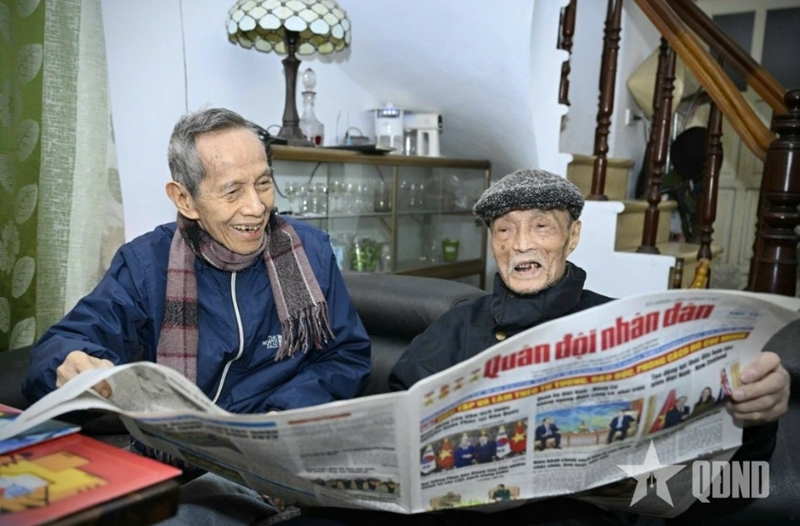
Senior Colonel, journalist Nguyen Khac Tiep (right), and Senior Colonel, journalist Pham Phu Bang, two of the five soldier-journalists who produced the 33 issues of the People’s Army Newspaper on the Dien Bien Phu Front (Photo taken in 2022) |
This model contrasted completely with the way the PAN produced its 33 issues on the Dien Bien Phu battlefield. Western journalism often served military strategies and the interests of “war owners,” whereas the 33 issues served soldiers and the just cause of the Vietnamese people.
Information gathering differed sharply as well. Western outlets reported from afar, while the PAN’s reporters worked at the very frontline, embedded in trenches and command posts, capturing the breath of the battlefield. Distribution depended entirely on manpower, with soldiers delivering copies through combat zones.
Wartime newspapers published by the U.S. and Allies during World War II were mostly entertainment-oriented. Titles like Stars and Stripes or Life Magazine sometimes used photos and entertainment contents to boost morale. They lacked political purpose and did not carry the mission of inspiring a just struggle as the PAN’s issues did. Chinese wartime journalism also operated from battlefield bunkers within war zones, yet their operational models and the value they contributed to their respective fronts were markedly different.
At the Dien Bien Phu battlefield, the PAN established a frontline newsroom under orders from the General Command of the Vietnam People’s Army. The team consisted of only five people, chief editor Hoang Xuan Tuy, managing editor Tran Cu, reporters Pham Phu Bang and Nguyen Khac Tiep, and layout artist Nguyen Bich. Each took on multiple roles: writing, editing, illustrating, printing, and distribution, all while maneuvering under bombardment and sometimes fighting. They combined principles of modern journalism with the flexibility required in a people’s warfare, creating an unprecedented model.
The value of the 33 issues is reflected in three key aspects. The first one was speed of information. Reporters stayed close to battle lines and command posts, ensuring timely coverage and narrowing the distance between soldiers and chain-of-command. The second one was self-reliant production. All stages of production were manual, dependent on skill, endurance, and courage. The last aspect was the unique working environment. The newsroom operated inside the most intense combat zone, from which reporters fanned out to follow operational direction and document victories and enemy crimes.
The organization and operation of these 33 issues had no precedent in the world journalism and would be virtually impossible today. Their model, content, and mission embody the essence of Vietnamese revolutionary journalism: partisan, combative, rooted in the people, and serving the people. Beyond news and illustrations, the issues served as an ideological “combat unit,” boosting morale and striking at the invader’s will.
Lessons for modern journalism
From these extraordinary issues, today’s press can draw valuable lessons, from organizing frontline newsrooms to maintaining production under extreme conditions, and, above all, from the dedication of soldier-journalists. The “n-in-1” model they embodied far exceeds today’s “3-in-1” or “5-in-1” journalist concepts.
Unlike Western correspondents who reported from safe distances, the PAN’s reporters stood at the very center of battlefield, truly “inside the heart of the war.” Each line they wrote carried the raw breath of the trenches and reflected the harsh yet heroic combat life of Vietnamese soldiers.
They not only wrote, printed, and distributed the newspaper, but also read it aloud to troops, an exceptional form of direct interaction. This ensured rapid information flow and created immediate feedback: Soldiers could comment or respond right after hearing an article. This practice reveals a combat-driven journalistic spirit rarely seen elsewhere.
From December 1953 to May 1954, amidst severe shortages and relentless bombardment, the five PAN staff members published 33 issues, each only two thin bamboo-paper pages yet filled with information about life on the frontline, from battle developments to daily struggles of soldiers and civilians. Their impact lay not only in fast reporting and illustrations, but also in their power to uplift morale and inspire soldiers to victory.
The story of the 33 issues reinforces a core principle: The PAN journalism must follow the pulse of the battlefield; each work must be rooted in soldiers’ lives. A reporter detached from real life cannot produce work that carries the breath of the time. Today’s PAN journalists must continue this tradition, capturing the pulse of life and history, upholding the spirit of dedication, and embracing hardship when necessary.
The Dien Bien Phu victory was the pinnacle of Vietnam’s culture of national defense and a victory of global stature. The elements that contributed to it, including the 33 issues, are therefore priceless. This collection is the first and only set of journalistic publications in the history of Vietnamese revolutionary journalism produced directly on the battlefield. They have clear ownership (the PAN), documented witnesses, and exceptional historical and informational value.
The memories of the Dien Bien Phu battlefield and the resounding victory were captured truthfully and movingly through these issues. Their contribution to the victory and to the transformation of global history is undeniable.
The value of the Dien Bien Phu Victory and the contribution embedded in the 33 issues will endure not only during national commemorations, but in generations to come. Thus, the PAN’s 33 issues produced on the Dien Bien Phu battlefield fully deserve recognition as outstanding memory heritage of Vietnam and humanity.
By Assoc. Prof., Dr. Bui Chi Trung (Deputy Director of the School of Journalism and Communications, University of Social Sciences and Humanities, Vietnam National University, Hanoi)
Translated by Tran Hoai