Following the victory of the first key battle attacking Buon Ma Thuot town in the second phase (March 10-11, 1975), the Campaign Command had to determine the target for the third phase, which was also the second key battle. In the initial combat plan, the command actively anticipated the scenario of attacking the counterattacking forces (mainly Division 23 of the enemy) upon the command’s attack on Buon Ma Thuot, assigning this mission to Division 10.
    |
 |
|
Troops enter Hoa Binh Airport in Buon Ma Thuot town, March 1975. (Archive photo) |
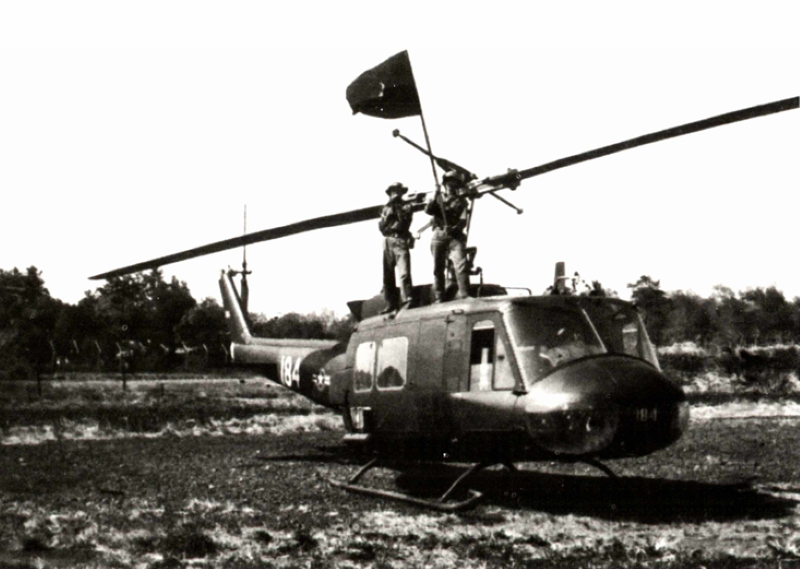
On the night of March 12, 1975, the Division 10 Command assessed that the enemy could not use Road No.14 (as it was occupied by Division 320) and would be forced to conduct a heliborne landing along Road No.21, East of Buon Ma Thuot, for a rescue mission. This area was favored, being close to Bases No.45 and 53, and Hoa Binh Airport. However, on the morning of March 13, because Base No.45 had fallen and Base No.53 was partially controlled by the Vietnamese troops, the enemy had to use helicopters to drop troops into an unprepared area in Nong Trai - Phuoc An, later deploying an element in Chu Cuc.
Firmly grasping the situation, the Division 10 Command identified the main target as defeating Division 23, the enemy’s strongest force in the Central Highlands, which was counterattacking in the Nong Trai - Phuoc An - Chu Cuc area in an attempt to “recapture” Buon Ma Thuot, proving the accurate anticipation and assessment of the enemy’s landing area and tactics.
Evaluating the enemy, the Campaign Command pointed out that the enemy threw Division 23 into a counterattack in a passive and surprised position after Buon Ma Thuot had been captured. They could not land the entire division simultaneously but had to drop troops in a situation of isolation, lacking tank and artillery support, and without firm bases as staging areas. Therefore, the Command decided to employ Division 10 (minus one regiment), reinforced by a tank battalion, Infantry Regiment 95A, and campaign-level artillery and anti-aircraft artillery units. This force was strong enough to defeat the enemy’s counterattacking force of about 5,600 troops in Nong Trai - Phuoc An - Chu Cuc area (Dak Lak province).
Regarding the tactics, the Campaign Command mapped out three steps: Firstly, rapidly seizing Bases No.45 and 53, Hoa Binh Airport, and Chu Nga before the enemy reinforcements arrived, forcing them to land in disadvantageous areas. Secondly, mobilizing forces to encircle and annihilate the enemy’s main counterattacking force (Regiment 45) right after their landing, before they could fortify their positions. Thirdly, developing the offensive in stride, pursuing and eliminating the remnants of Division 23 and local forces from east of Phuoc An to Chu Cuc.
During combat, the Campaign Command exercised decisive leadership, with the Vietnamese troops pro-actively capturing Ban Don, Chu Nga, and Base No.45, blocking the enemy’s path to Buon Ma Thuot. Upon the enemy’s landing, Vietnamese troops actively launched attacks while they had yet to gain a firm foothold. After seizing Nong Trai, the troops shifted to attack the enemy’s Regiment 44 and deployed forces toward Khanh Duong. Thanks to close coordination, timely seizure of opportunities, and flexible application of tactical forms (such as mobile encirclement, raid, offensive in stride, and deep penetration), Vietnamese forces gradually broke the enemy’s posture and secured victory.
After the five days of fighting (March 14-18, 1975), the Vietnamese troops annihilated and disintegrated Division 23 and the enemy’s local forces, capturing and destroying numerous war vehicles, ending the campaign’s third phase, and liberating the northeastern region of Dak Lak province.
Nong Trai - Phuoc An - Chu Cuc battle held immense strategic, campaign, and tactical significance. Vietnamese forces successfully executed the division-level mobile offensive tactic, defeating the enemy’s division-scale airborne counterattack. This victory completely shattered the enemy’s plot to “recapture” Buon Ma Thuot, pushing the enemy in the northern Central Highlands to the brink of annihilation while fleeing along Route 7 (the third key battle). This laid the premise for liberating the entire Central Highlands and several south-central coastal provinces, opening a turning point that escalated the strategic offensive into the General Offensive and Uprising in Spring 1975, culminating in the historic Ho Chi Minh Campaign that liberated the South and reunified the country.
Translated by Minh Anh