It is time to recognize this collection as a national memory treasure that deserves preservation, digitization, introduction, exhibition, and consideration for nomination to the UNESCO Memory of the World Register.
Unique, exceptional phenomenon in history of journalism
What first makes these 33 issues unique lies not only in their content, but also in the model of its combat newsroom located right on the slope of Pu Ma Hong Hill in Muong Phang, just a field away from the bunker of the Commander-in-Chief and the Political Chief of the front. Reporters worked closest to the command headquarters, receiving information from the campaign’s top leadership in the most timely and accurate manner; thus, only hours later, that information reached soldiers, frontline conscripted laborers, and all offensive directions.
    |
 |
|
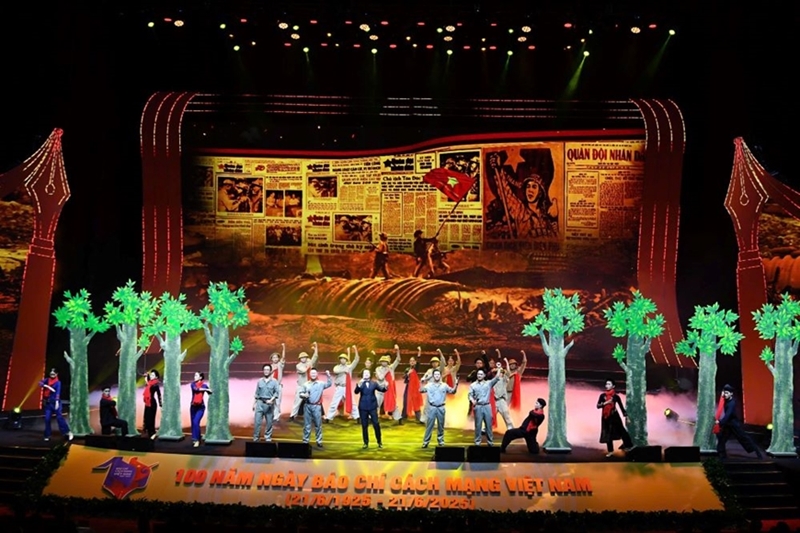
The image of the PAN’s 33 issues published on Dien Bien Phu Battlefield in 1954 displayed at the ceremony commemorating the 100th anniversary of Vietnam’s Revolutionary Press, June 2025 |
At that time, the frontline newsroom had only five members. Each person not only performed a single task but also undertook everything from writing, news collection, editing, proofreading, illustration, printing, to hand-delivering newspapers to soldiers. They were journalists, combatants, campaign staff, and connectors of the troops’ fighting spirit all at once.
The uniqueness also lies in the entirely manual journalistic process. There was no electricity, no communications system, no industrial printing line, and no professional logistics supply. The newsroom did not stand outside the war; it stood right inside it. The five soldier-journalists did not describe battles from afar; they lived within the very breath of combat. They marched together, dug trenches together, and withstood artillery bombardment together. These experiences enriched every line of articles with authenticity, vividness, emotion, and fighting spirit. Anyone rereading these issues can clearly feel that they were not neutral media products, but the living voice of the battlefield, a line of spiritual energy for troops confronting the strongest colonial force of France.
Another remarkable point is the high publication frequency: from every four to five days, to every two to three days, and even daily when the fighting entered its most decisive phase. This reflects extraordinary information-processing speed, organizational capacity, and devotion by the war correspondent crew. Amidst gunfire and combat duties, publishing each issue demanded intellect, courage, and fortitude. They not only created content, but also safeguarded the newsroom, protected transport routes, and ensured uninterrupted information flow, an element of strategic value in war.
Equally notable is the diversity of information across the 33 issues. Some praised heroic examples, such as soldiers who “used their backs as machine-gun tripods,” while others frankly reported violators of military discipline. This demonstrates that combat journalism did not provide one-dimensional information, but upheld objectivity, truthfulness, and respect for military discipline, without avoiding negative issues. Such multidimensionality defines the quality of Vietnam’s revolutionary journalism: For victory, for discipline, for military building, and for historical truth safeguarding.
The fusion of journalistic intellect, communication art, fighting spirit, and professional ethics made the PAN’s 33 issues published on Dien Bien Phu Battlefield a vivid testament to the culture of Vietnam’s people’s warfare.
Treasure of national memory and culture of national defense
These 33 issues do more than record battlefield information. They are a vivid corpus of “the people’s warfare memory.” If memory is what remains after war, then this memory is not an individual’s recollection but a collective memory that is the memory of an entire battlefield, an entire force, and a nation fighting the most powerful invading army in Indochina at the time.
Their greatest value lies in being born amidst hardship and within the very state of combat. Every news item, poem, and story captured events as they were happening, breathing and alive. Therefore, these issues have become “on-site memory,” recorded at a time when victory was not yet inevitable and danger still surrounded every soldier and journalist.
This is what gives the 33 issues their special authenticity and emotional power: No distance between writer and event, no veil of time, no retrospective reconstruction driven by political will, only what soldiers saw, heard, endured, sacrificed, fought for, and defended, hill by hill and trench by trench. Created amidst hardships, scarcity of resistance war, these issues possess a distinct aesthetic. Thin bamboo paper, hurried line illustrations, poems, Tet greetings, and the signature of President Ho Chi Minh printed right in a forest hut in Muong Phang, together they form a wartime aesthetic that is rustic but powerful, simple but heroic. This is not the beauty of modern technology or glossy design, but the beauty of simplicity and the aspiration for victory.
More importantly, these issues transmitted both information and spirit. They were a special offensive, striking directly at soldiers’ minds, strengthening morale, tempering will, spreading faith, nurturing unity, upholding discipline, and reinforcing belief in victory day by day. Therefore, these 33 issues possess not only informational value, but fighting spirit value, an invaluable asset of the Dien Bien Phu victory.
Here, memory lies not only in words but also in the act of making the newspaper itself: Five people simultaneously reporting, resisting bombardment, transmitting news, moving with the front, printing, and delivering by hand to every combat direction. They turned journalism into a cultural act, a combat act, and a creative act in which each issue was like a spiritual corps crossing forests and bombardment to reach soldiers in the midst of battle.
These issues should be viewed as a cultural institution within people’s warfare, not merely as a wartime media tool. In conditions that weapons were not an advantage, Vietnam’s people’s warfare relied on spiritual strength, the power of information, transparency, and mutual understanding, these 33 issues fulfilled the functions of nurturing combat culture, reinforcing discipline, building confidence in victory, and ensuring continuity among soldiers, leaders, and the battlefield. They did not just describe war; they helped make it by creating a unified, resilient spiritual space.
Compared with other memory heritage of Vietnam, such as the Nguyen Dynasty woodblocks, imperial archives, Han-Nom documents, and Hoang Sa - Truong Sa maps, the 33 issues share a common trait: They were born of history and carry the strength of national cultural memory. However, they differ in one crucial respect: They embody people’s warfare memory through journalism, a living heritage, updated daily, socially interactive, reflecting both combat and spiritual life of soldiers and people.
Thus, more than 70 years later, revisiting these 33 issues reveals not only the Dien Bien Phu battles or a resounding military victory, but also Vietnam’s culture of national defense expressed through combat journalism, a culture that does not merely record war, but creates victory through spiritual strength, memory, and community connection in the most perilous circumstances.
Honoring typical national memory heritage
Once these 33 issues are recognized as a national memory treasure, the question becomes: What should be done so that this living heritage is not only preserved in historical memory but also integrated into contemporary cultural life?
First, a comprehensive preservation project is needed. The original issues are extremely fragile, vulnerable to weather, time, and organic materials. This is alarming, as each issue carries not only information but handwriting, illustrations, emotions, and the historical atmosphere of Dien Bien Phu. Physical preservation is essential but insufficient. Full digitization is required, with open access data for museums, libraries, schools, research institutions, and the public. Digitization should go beyond scanning prints to include context, witness accounts, production processes, newsroom spaces, printing tools, transport routes, and distribution journeys in order to create a complete memory narrative with cultural, historical, and professional depth.
More importantly, the collection should be integrated into history and journalism education. In the era of integration and digital media, many young people may equate journalism with writing, filming, and publishing via modern technology. These 33 issues offer a deeper benchmark: Journalism is foremost responsibility to truth, to the nation, to people’s lives, and to soldiers’ safety; it requires engagement, closeness to life, companionship with the people in all circumstances, and the capacity to inspire and build trust. Introduced into curricula on history, defense, communication, and journalism, the 33 issues will become a spiritual asset, enriching the professional ethics of future journalists.
A strategic step is to consider nominating the collection for UNESCO’s Memory of the World Register. Compared with recognized memory heritages, the 33 issues meet all criteria: Clear ownership (the People’s Army Newspaper), a unique historical context (Dien Bien Phu Campaign defeating French forces and reshaping the world order); witnesses; uniqueness (a newsroom printing and distributing newspapers at the front); and global value (journalism not only recording war but participating in victory in a struggle for national salvation). UNESCO recognizes not only ancient documents but also wartime cultural memory created by communities and national institutions with strong humanistic value.
If successfully nominated, the 33 issues will not only be a source of pride for military journalism or Dien Bien Phu history, but also Vietnam’s contribution to humanity’s heritage, helping expand global understanding of how people’s warfare constructs memory, spirit, and victory. This would be a novel and meaningful contribution, potentially marking the first time combat journalism is recognized as a world memory heritage, opening new horizons for information and media heritage in history.
By Assoc. Prof., Dr. Bui Hoai Son from National Assembly’s Committee for Culture and Social Affairs
Translated by Mai Huong