Applying information technology to law dissemination
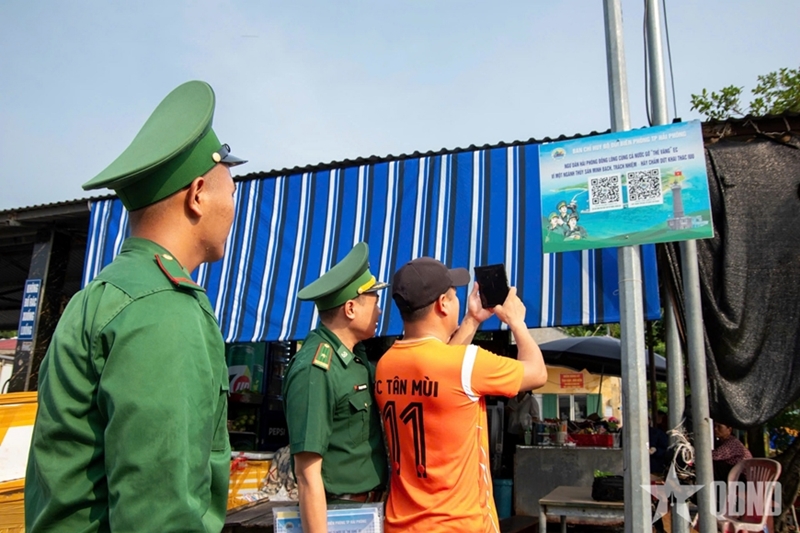
It is now common to see fishermen access legal regulations by scanning QR codes with their smartphones at border checkpoints and anchorages instead of thick manuals.
This is the result of the “Dual QR - handbook on IUU fishing prevention and crime reporting” model, an IT application initiative in the dissemination efforts of the unit. The model is designed to be compact, easy to recognize and use, and made of weather-resistant materials suitable for coastal conditions. Recently, the unit installed the model at 11 locations, including fish wharves, fishing ports, anchorages, and storm shelters with high vessel traffic, while distributing thousands of QR code stickers to locals.
    |
 |
|
Officers and soldiers of the Hai Phong municipal Border Guard Command inform and instruct fishermen on how to use the “Dual QR” codes. |
The first QR code is linked to a digital handbook on IUU fishing prevention. Regulations are digitized into short videos, infographics, and visual materials. With just a smartphone, fishermen can scan the code to look up information directly at the docks. This method makes laws more accessible, helping fishermen proactively understand regulations and improve their law compliance while operating at sea.
The second QR code provides a channel for reporting legal violations. Citizens can provide information related to IUU fishing, illegal entry and exit, smuggling, and other violations in border waters and port checkpoints. This digital channel helps the border guards monitor the situation, receive information, and handle cases right at the grassroots level.
Lieutenant Colonel Le Ngoc Thang, Deputy Chief of the Political Department of the Hai Phong municipal Border Guard Command, said that most fishermen today use internet-connected smartphones. He added that digital transformation and integrating the IUU handbook into a QR code not only helped them easily look up information anytime, anywhere, even at sea, but also saved significant printing costs. Since its implementation, the unit’s system has recorded thousands of accesses and dozens of reports. He affirmed that technology served as a vital bridge that brought the law closer to every fisherman.
At the fishing ports, border troops can directly guide fishermen on how to scan the QR codes, explain any queries, and show them how to send reports. A simple operation on the phone has helped raise legal awareness, encouraged people to provide information, and assisted authorities in maintaining local security and order.
Diversifying dissemination methods for high efficiency
Along with applying IT, the Hai Phong municipal Border Guard Command has comprehensively deployed various dissemination activities to help people access information through multiple channels.
|
|
 |
|
Officers of the Trang Cat Border Post distribute leaflets to fishermen. |
In key areas such as Nam Trieu and Do Son wards, the unit has organized large-scale dissemination conferences. Since the beginning of 2026, the unit has coordinated with local authorities to successfully hold seven conferences, attracting over 3,775 participants. At these events, fishermen’s questions regarding administrative procedures, fishing logbook regulations, and the installation of vessel monitoring systems (VMS) were thoroughly answered by officers.
In addition, border soldiers have gone directly to fishing vessels, anchorages, and docks to inquire about the fishermen’s offshore operations and distribute over 7,500 leaflets. Meanwhile, the grassroots loudspeaker system has also been mobilized to enhance dissemination efficiency.
Besides educational campaigns to raise fishermen’s awareness, strict patrol, control, registration, and supervision of departing and arriving vessels have also been prioritized. Lieutenant Colonel Dinh Van Trinh, Chief of Trang Cat Border Post, emphasized that they resolutely refused to grant departure clearance for fishing vessels that did not meet sailing conditions. Over the past year, the unit has inspected and registered hundreds of vessels with thousands of crew members. Through strict control at the docks and during sea patrols, officers and soldiers have issued direct reminders and required 100% of captains to sign commitments not to violate foreign waters. He stated that if any violations were detected, they would deal with them strictly according to regulations to ensure deterrence.
From dissemination and mobilization to inspection, control, and violation handling, the Hai Phong municipal Border Guard Command is gradually turning legal compliance into a voluntary awareness and habit of every fisherman. When technology is properly utilized and laws are conveyed in an accessible manner, the fight against IUU fishing translates into practice, thereby contributing to maintaining security and order at sea, protecting national sovereignty and prestige, and aligning with the national resolve to remove the E.C.’s IUU “yellow card.”
Translated by Duc Bien