    |
 |
|
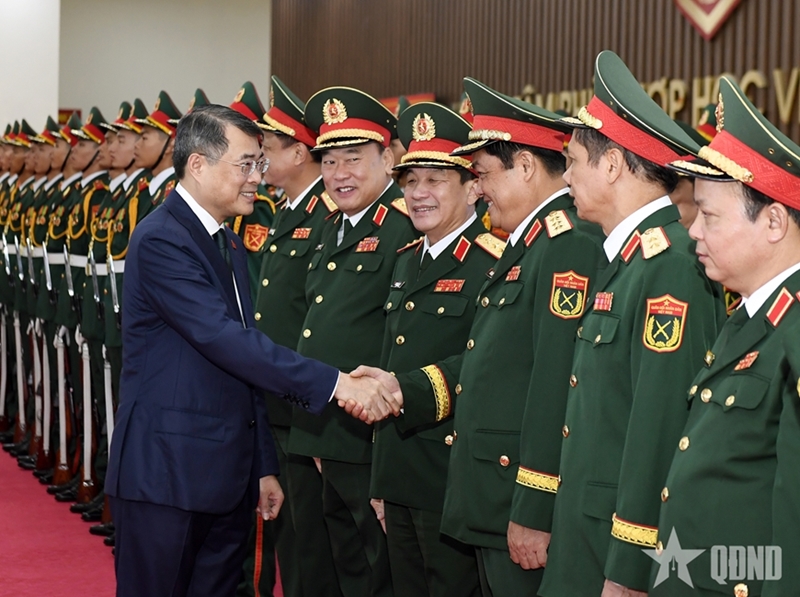
Prime Minister Le Minh Hung attends the opening of the 2026-2027 academic year at the National Defense Academy in Ha Noi on September 15. (Photo: qdnd.vn) |
For 50 years, the academy has closely followed the Party guidelines, policies and viewpoints, State laws, and orders from the Central Military Commission and Ministry of National Defense. That record, PM Le Minh Hung said, has let it fulfill all assigned tasks and build a distinct reputation and tradition.
The academy has trained tens of thousands of senior Party, State and military officials, and its studies have shaped Viet Nam's military and national defense theory and policy, feeding into key strategic decisions and building trust with other countries, he added.
The PM said safeguarding the Fatherland now carries tougher, more complex demands, requiring a peaceful and stable environment for development, firm protection of national interests, and zero tolerance for passivity and surprise in strategy. National defense no longer means just guarding territory, borders, seas and islands, but it extends to political, economic, cultural and ideological security, data, digital sovereignty and the country's strategic autonomy.
He called for turning those directives into concrete schemes, curricula, thematic studies, research projects, training scenarios and advisory products.
The leader called for major improvements in training for operational and strategic-level officers, as well as senior Party, State, and military officials, along with stronger scientific research. He said the academy should aim to be the nation’s top center for strategic military and defense advice.
|
|
 |
|
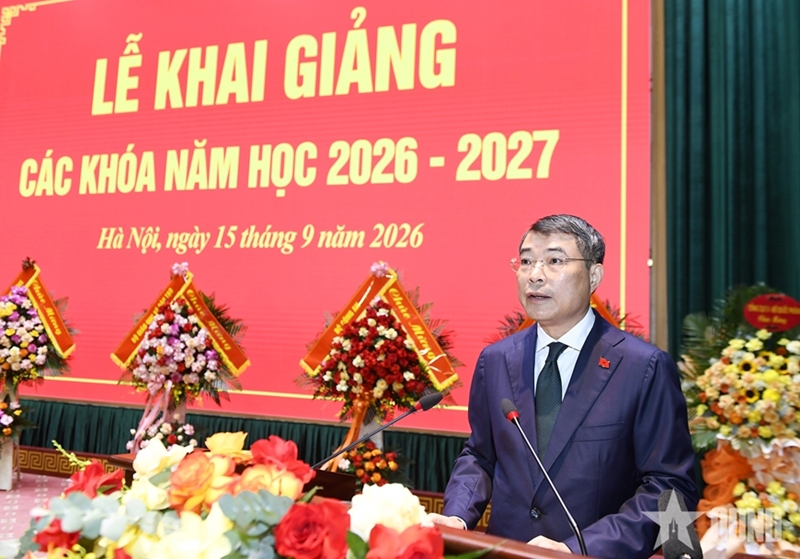
PM Le Minh Hung speaks at the opening of the National Defense Academy's 2026-2027 academic year. (Photo: qdnd.vn) |
The academy must track global and regional developments closely, accurately size up partners and rivals, and stay ahead of changes in the international security environment. It should produce practical output, such as strategic forecasts, early warning and policy proposals, and absorb global military advances and technology without copying foreign models outright, while avoiding isolation, conservatism and slow adaptation to change.
According to him, the academy should remain Viet Nam's research hub on all-people national defense, link defense policy with socio-economic development, and bolster the country's strategic autonomy. It should also develop theories, criteria and models for a modern all-people defense system suited to the country's new development model, its two-tier local administration and its evolving development space.
It should propose ways to fold defense and security requirements into regional and local development strategies, master plans, urban development and strategic infrastructure projects. That includes pairing marine economic development with protection of maritime sovereignty, ensuring the country can keep operating and recover quickly in a crisis, and converting economic and scientific resources into defense potential.
The Government leader also pressed for faster progress on science, technology, innovation and digital transformation, and building both a smart, modern academy and a corps of politically steadfast officials, lecturers and scientists with strategic thinking, practical skills, and a strong aspiration to contribute.
The academy should become a model for digital transformation and technology use, and a strategic-level knowledge and innovation hub, he said. That means building a modern ecosystem spanning training, research, simulation models and decision-support systems, backed by integrated digital infrastructure, databases and a military-and-defense knowledge repository. He called for wider use of artificial intelligence in research and forecasting, plus more hands-on training environments.
It should also help design a self-reliant, resilient, dual-use defense industry with real competitiveness. Focus should be placed on defense economy, pooling scientific and technological resources, building an innovation ecosystem, and linking the army with research institutes, universities and companies.
|
|
 |
|
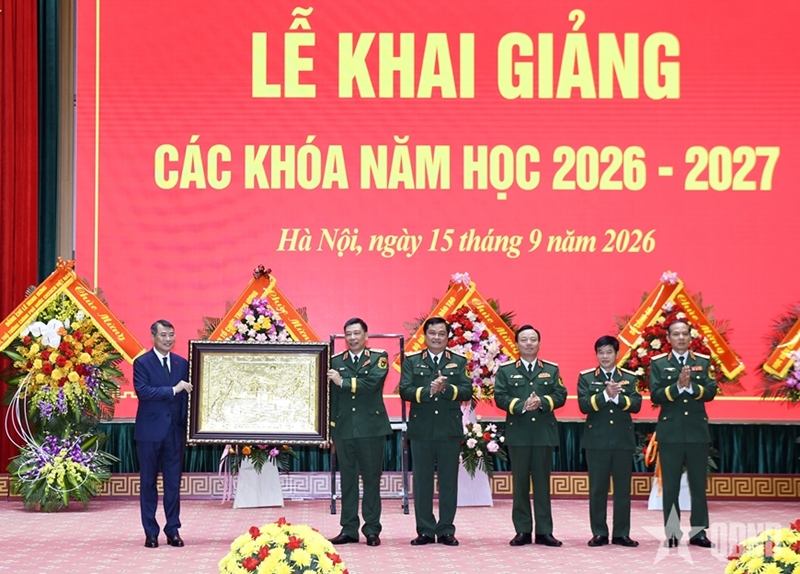
PM Le Minh Hung presents a souvenir to the National Defense Academy. (Photo: qdnd.vn) |
He said the academy should build a contingent of officials and lecturers who model political and ethical standards, combine strategic thinking with in-depth theoretical knowledge, understand real-world conditions, master Vietnamese military art, and absorb the best global knowledge and practice.
Given its role in defense diplomacy, the academy should expand substantive and effective international cooperation to raise its own standing and that of the army and country as a whole, he said.
Earlier, the PM offered incense at the academy's memorial site for President Ho Chi Minh and toured its traditional hall, library and a model showcasing digital transformation in training.
Source: VNA