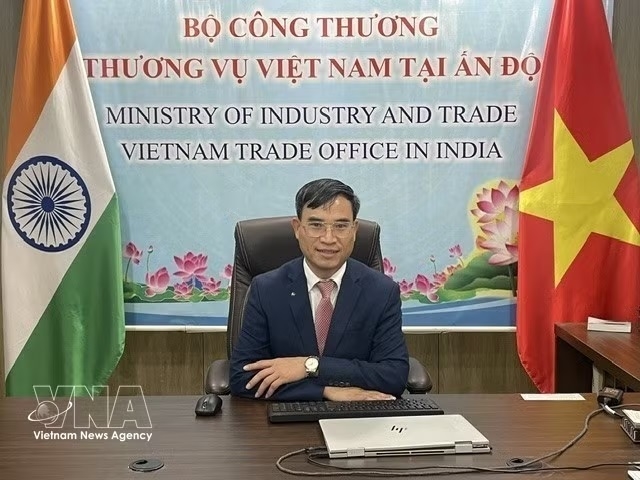
Talking to Viet Nam News Agency correspondents in New Delhi, Thuong said BRICS is opening a special “window of opportunity” for Viet Nam. The group now accounts for about 40% of global GDP at purchasing power parity and roughly one-fourth of international trade. According to U.N. Trade and Development (UNCTAD), intra-BRICS merchandise trade has increased more than 13-fold since 2003, reaching about 1.17 trillion USD in 2024.
    |
 |
|
Vietnamese Trade Counsellor in India Bui Trung Thuong |
BRICS’ strength lies not only in its economic scale but also in the complementarity of its members. China and India are major manufacturing, consumption and technology centers; Russia and Gulf countries are strong in energy; Brazil has advantages in agriculture, while Indonesia, South Africa, Iran, Ethiopia and Egypt add resources, markets and logistics positions.
For Viet Nam, becoming a BRICS partner provides deeper access to the group’s policy, business and expert networks, rather than viewing it merely as a diplomatic forum.
Thuong said India is particularly well positioned to connect Viet Nam with BRICS as both a founding member and an influential voice among the Global South. Instead of approaching BRICS as a single market, Viet Nam could adopt a “hub-and-spoke” model, with India as a connecting hub, other BRICS members serving as specialized markets and links, and Viet Nam contributing goods, services, technology and ASEAN logistics capabilities.
He noted that India’s development priorities and the theme of its 2026 BRICS chairmanship align closely with Viet Nam’s current needs, particularly supply chains, micro, small and medium-sized enterprises, sustainable finance and innovation.
China, another BRICS pillar, is Viet Nam’s largest trading partner. Statistics from the Department of Customs show bilateral trade reached about 153 billion USD in the first half of this year. Viet Nam imports large volumes of materials, components, machinery and equipment for production and export, reflecting its role in regional supply chains. However, Thuong said Viet Nam should diversify input sources while increasing the export of higher value-added products to China.
He said infrastructure links with China, including railways, expressways and smart border gates, could help reduce logistics costs and improve the trade balance over the medium and long term.
Russia, another major BRICS member and an energy powerhouse, also offers considerable potential. Bilateral trade reached about 4.77 billion USD in 2025, up 4% year on year, and 3.24 billion USD in the first seven months of this year, equivalent to 68% of last year’s figure.
The official suggested that building on its relations with India, China and Russia, Viet Nam could deepen cooperation with BRICS through four main areas: expanding trade and market access; attracting and promoting two-way investment; engaging deeper in global supply chains and logistics networks; and advancing cooperation in science-technology, innovation and digital transformation.
Thuong said India could serve as a key partner in human-resource training, startups and digital application; China in manufacturing and industrial technology; Russia in energy and basic science; and Gulf countries in capital and energy.
He stressed that cooperation should go beyond memoranda of understanding to concrete projects such as joint laboratories, engineer-training programs, co-investment funds and AI applications in agriculture, logistics and trade, turning commitments into practical results.
Source: VNA