The official visit to France by General Secretary of the Communist Party of Viet Nam (CPV) Central Committee and President To Lam from September 9-12 demonstrates the close ties the two countries have built and maintained, according to Dr. Sophie Boisseau du Rocher, a member of the Asie21 research group and former researcher at the Center for Asian Studies of the French Institute of International Relations (IFRI).
Speaking to Viet Nam News Agency correspondents in Paris, the expert said that although Viet Nam-France relations had experienced periods of tension and misunderstanding, the two countries have increasingly come to understand each other, make better use of their respective strengths and build common ground for deeper bilateral ties amid a rapidly changing geopolitical environment.
    |
 |
|
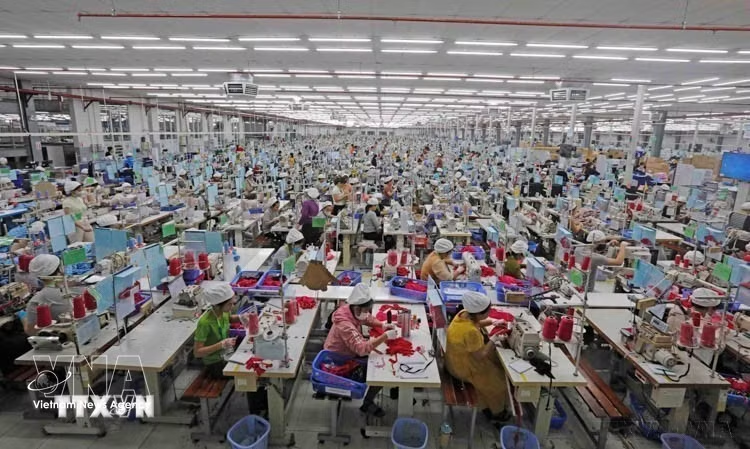
SCAVI Hue, a wholly French-invested company owned by Financière B’Lao, specializes in manufacturing underwear, sportswear and protective clothing at Phong Dien Industrial Park in Hue. |
This foundation has been strengthened through numerous cooperation networks and contacts in a wide range of areas, including defense and security. Since France released its Indo-Pacific Defense Strategy in May 2019, Paris has developed a number of strong partnerships in the region, with cooperation with Viet Nam seen as a “natural choice,” she said.
Viet Nam’s geostrategic position, active neutrality and flexible foreign policy have also attracted France’s attention as global power balances shift. At the same time, Viet Nam is pursuing a multilateral foreign policy and seeking to become a connectivity hub in a new Asia.
France has particular advantages in this process, Sophie said, noting that no other European country has a similar level of trust with Viet Nam or shares such close diplomatic approaches with the Southeast Asian country.
She noted that the top Vietnamese leader’s current trip follows his visit in October 2024 and comes after French President Emmanuel Macron’s visit to Viet Nam in May 2025, during which Macron sought to give fresh momentum to France’s Indo-Pacific strategy and reaffirmed France’s role as a force for “peace and balance.”
According to the expert, Viet Nam is important to Paris as France continues to value close ties with countries with which it has historical links. More importantly, Viet Nam occupies a distinctive position in Asia.
Sophie highlighted the country’s economic achievements since it embarked on the Doi Moi (Renewal) process 40 years ago, turning Viet Nam into one of Southeast Asia’s leading economic drivers. Viet Nam is also seeking to play a more substantive role in ASEAN, she said.
She described Viet Nam as a genuine stabilizing force in Southeast Asia and potentially a model for avoiding the middle-income trap. With Viet Nam targeting a position as ASEAN’s second-largest economy after Indonesia, its achievements represent a “very tangible miracle” that French businesses are eager to engage with more deeply.
Turning to bilateral ties, Sophie said the upgrade of Viet Nam-France relations to a Comprehensive Strategic Partnership on October 7, 2024 sent a strong and clear signal. France was the first European country to establish such a framework with Viet Nam, 11 years after the two countries established their Strategic Partnership in 2013.
The two countries share important interests, including maintaining stability in the East Sea (aka South China Sea), ensuring an open maritime space based on respect for international law, and promoting multilateralism to diversify partnerships. Viet Nam and France complement each other in these areas and should continue to build on their strengths, she said.
Following the adoption of the action plan to implement the Comprehensive Strategic Partnership in June 2025, the priority now is to deepen and give concrete substance to the plan, creating a foundation for practical and long-term cooperation that could even serve as a regional model, the expert said.
Sophie noted that both sides are seeking to deepen the partnership, with Viet Nam showing a clear determination to do so. General Secretary and President Lam’s visit provides an opportunity for France to put forward concrete proposals in areas such as defense and aerospace.
Paris can also build on policy similarities with Viet Nam to help strengthen the latter’s strategic autonomy, she said. Civilian nuclear energy, aviation, space and high technology are expected to be among the key areas for discussion.
Looking ahead, Sophie said there is considerable room for cooperation between Viet Nam and France. Beyond the mega-projects that are of particular interest to France, the two countries still have much to do to harness the potential of small and medium-sized enterprises, local authorities and universities.
She said the two countries also need to make better use of existing cooperation networks and provide sufficient resources for them to develop promising projects.
Sophie said diplomacy also needs to be leveraged more effectively to bring Europe and Southeast Asia closer together. Implementing projects of global significance could not only help Viet Nam and France play a pioneering role, but also have a direct impact on bilateral relations.
Source: VNA