Personnel arrangement to meet job requirements
One of Factory Z113's notable achievements in recent years has been the development of various unmanned aerial vehicles (UAVs) for firefighting, transportation, search and rescue, and other applications. With sophisticated technical requirements and a high level of technological content, these products reflect the expertise and ingenuity of the factory's officers and engineers.
Maj. Nguyen Van Sau, deputy head of Workshop A2 under Plant 1 of Factory Z113, who directly participated in the UAV research and production team, said the factory had mastered the entire design process based on the required functions and pro-actively manufactured the mechanical components.
    |
 |
|
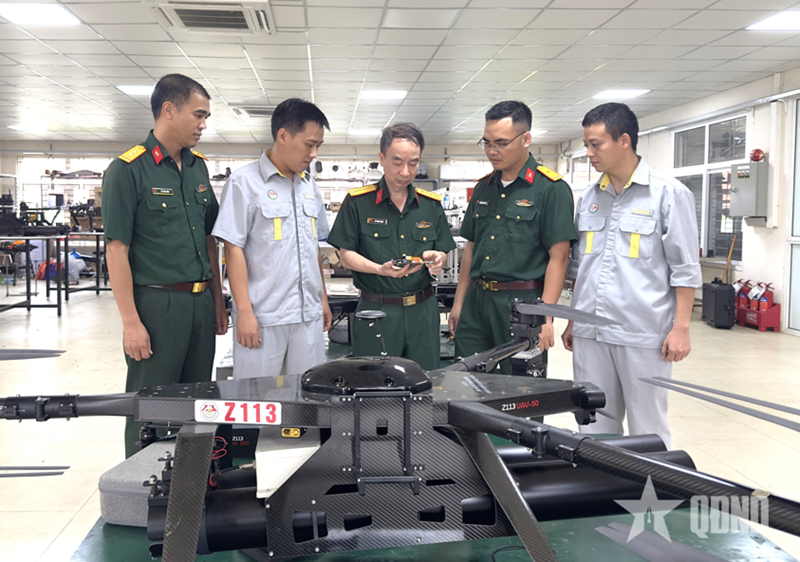
Sr. Col. Ly Thanh Minh, Deputy Director of Factory Z113 (center), inspects UAV production at the factory. |
“Integrated and control technologies are key to UAV development. We have also integrated artificial intelligence (AI) technology into these products to improve their operational efficiency,” Maj. Sau said.
After graduating from the Military Technical Academy and studying abroad, the young officer gained practical experience through years of hands-on work at the factory while continuing to strengthen his expertise through professional training and development programs.
Alongside investment in modern equipment and production lines, Factory Z113 regards human resources as the decisive factor in strengthening its science and technology capabilities. According to Sr. Col. Ly Thanh Minh, Deputy Director of Factory Z113, the factory consistently works to develop highly qualified scientific personnel, engineers, and skilled technical workers capable of accessing and mastering new technologies.
Recruitment is complemented by comprehensive human resource training, including on-the-job training, specialized programs, scientific research, and research projects and initiatives. The factory also promotes the role of experts and young personnel in addressing technologically sophisticated challenges, such as researching, designing, and manufacturing remote firefighting systems and UAVs.
Building expertise, experience, and capability through practical work
Practical work, research, and production also provide an important environment for personnel at units under the General Department of Defense Industry to build their capabilities and accumulate experience. At Factory Z195, which produces propellants and explosives for the military as well as industrial explosives for economic purposes, personnel have contributed to significant advances in product development. The factory has gradually mastered propellant and explosive production technologies and established a closed-loop process from raw material production to finished products.
According to Sr. Col. Nguyen Mau Vuong, Deputy Director of Factory Z195, the achievements are closely linked to the efforts of the factory's officers, employees, and workers. Their knowledge and practical experience have steadily improved, while problems arising in production have helped identify areas requiring further study and research to meet practical demands.
Young personnel, in particular, have benefited from systematic training at military academies and schools combined with hands-on experience at the factory. Their professional qualifications and practical capabilities have consequently continued to grow, making them a promising force for scientific research and new product development in the years ahead.
The factories also encourage personnel to turn creative ideas into initiatives and technical improvements. Col. Le Van Phuong, Head of the Technology and Engineering Division at Factory Z129, said personnel are encouraged to conduct research and propose initiatives. From workers to technical staff, anyone with an idea that delivers results is given the opportunity to put it into practice and share in the benefits generated by the initiative. This mechanism provides an incentive for personnel to continuously explore, innovate, and improve technologies and production lines.
Developing incentives to attract human resources
Attracting high-quality human resources also requires appropriate incentive policies. When working conditions and living standards are secured and their contributions recognized, workers have greater confidence, motivation, and desire to contribute. Sr. Col. Pham Cong Hau, Deputy Director of Factory Z183, said good incentive policies and recognition help workers feel secure and remain committed to their work. The factory pays attention to employee welfare, including tours, vacations, and canteen services, while promoting workplace democracy and promptly addressing workers' recommendations. Salaries and bonuses are ensured and linked to job performance in a fair, objective, and transparent manner.
Many defense industry units also provide fully equipped official housing, give priority consideration to recruiting relatives of officers and employees, and provide financial support for training and professional development. By fostering the motivation to excel and the desire to contribute, these policies provide a solid foundation for defense industry factories to strengthen production capabilities and master technology.
From self-reliant arms workshops producing weapons during wartime to today's modern factories mastering advanced technologies, the spirit of self-reliance continues, but the requirements have reached a new level: achieving technological self-reliance, mastering the value chain, and ultimately developing mastery of human resources. This is the foundation for Viet Nam's defense industry to strengthen its self-reliance today while building the capacity to master new capabilities in the future.
Translated by Tran Hoai