Lessons from the COVID-19 pandemic
In 2020, the COVID-19 pandemic exposed how quickly seemingly stable supply chains could break down. Transportation was disrupted, production stalled, and many countries restricted exports of essential raw materials and equipment. Products needed to prevent and control the pandemic suddenly became scarce.
In Viet Nam, medical-mask production at the time relied heavily on imported raw materials. When external supplies were disrupted, domestic manufacturers faced difficulties and costs rose sharply. The experience showed how a single weak link at the start of a supply chain can affect the ability of an entire industry to maintain production.
Against this backdrop, Factory Z176 successfully researched and produced four-layer medical masks using nonwoven fabric that it had developed and manufactured itself. The experience demonstrated that the value of self-reliance lies in the ability to maintain production when external supplies can no longer be guaranteed.
    |
 |
|
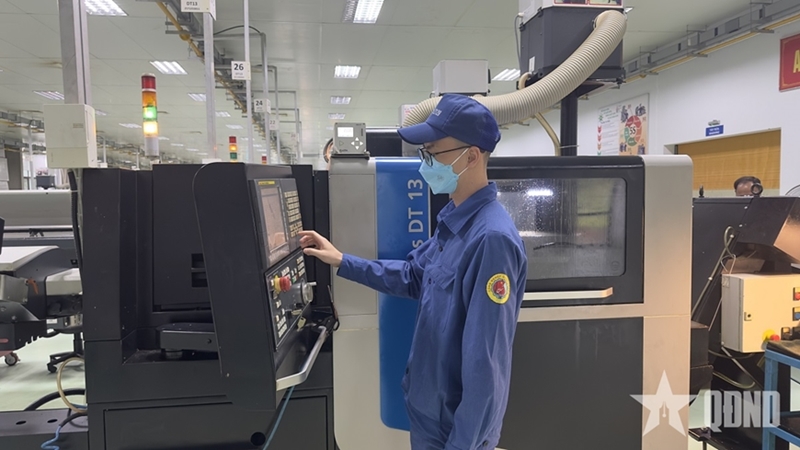
Workers operate a modern production line at Factory Z129. |
For the defense industry, the pandemic offered a clear lesson that a specialized material, component, precision-machined part, or technological process can become a bottleneck for an entire production line. If critical inputs remain dependent on external sources, final production capacity cannot be truly independent.
Self-reliance, therefore, must cover the entire chain. Mastering final products without controlling critical upstream links represents only partial self-reliance. Control over raw materials, components, technology, production, technical support, and markets is what enables the industry to build resilience and sustain long-term self-reliance.
“In recent years, conflicts, including non-traditional conflicts, and pandemics have shown that domestic self-reliance in equipment and technical supplies is extremely necessary to ensure sufficient weapons and equipment whenever the country needs them,” said Sr. Col. Nguyen Gia Trong, Chairman of One Member Ltd. Company 27 (known as Factory Z127).
In response, Factory Z127 has taken the lead in research and developed the capability to produce high-quality alloy steel. Under the new framework established by the Law on Defense and Security Industry and Industrial Mobilization, the factory has pro-actively invited materials experts from domestic universities to find solutions for restoring production lines for copper and high-quality alloys. The effort is aimed at supporting the defense industry eco-system while serving domestic and export markets.
Moving steadily toward the future
Under the Law on Defense and Security Industry and Industrial Mobilization, Factory Z127 is being newly built and equipped with modern facilities, machinery, and production lines to manufacture high-quality aluminum, copper, and steel alloys. “With its current machinery, equipment, and workforce, Z127 will soon master the new technologies and production lines to process and manufacture products,” Col. Trong said.
As Z127 gradually gains control over raw material supplies, downstream links in the value chain will have greater room to develop. Factory Z115 is stepping up investment and research into new defense products, strengthening its production capabilities, and working with research agencies to develop products that meet modern requirements. Its goal is to shorten the gap between research and production and turn scientific results into practical industrial capabilities.
At Factory Z125, alongside developing traditional product lines, the factory is strengthening its capacity to produce large-caliber weapons in a synchronized manner while gradually mastering key stages of the production process.
Over the next five years, Z115 aims to invest in new production lines and technological equipment, develop new defense products, expand commercial production and exports, and accelerate digital transformation and advanced management, with the goal of becoming a green, modern, and smart factory.
Factory Z183 is also focused on expanding production, modernizing technology, developing new defense products and strategic commercial products, and making defense product exports a new pillar of growth.
These developments show that self-reliance across the value chain does not mean producing everything independently. The key is to identify strategically important links that require investment, mastery, and control while working with other parts of the economy to leverage resources, technology, and markets. This approach can transform the defense industry from a collection of individual production systems into a resilient ecosystem.
Once the industry can secure critical raw materials and inputs, master technologies, manufacture products, and gradually expand markets, strategic self-reliance goes beyond simply “producing domestically.” It means mastering the entire value chain, building resilience against global competition and volatility and creating a foundation for the defense industry to meet immediate requirements while developing industrial strength for the future.
(To be continued)
Translated by Tran Hoai