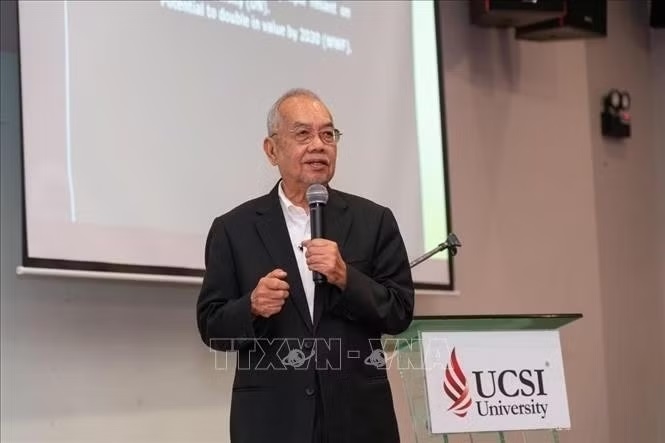
Speaking to a Viet Nam News Agency (VNA) correspondent in Malaysia, Professor Dato Dr. Ahmad Ibrahim, an expert in technology, digital transformation and agricultural value chains at UCSI University, said the combination of Malaysia’s ambition to develop high-tech agriculture and Viet Nam’s agricultural strengths could provide a solid foundation for bilateral cooperation. The two countries have already taken steps to deepen collaboration, including a Memorandum of Understanding signed in April on agriculture, fisheries and food security.
    |
 |
|
Professor Dato Dr. Ahmad Ibrahim at the event |
According to the professor, one promising area is the development of high-tech Halal agriculture and food products. Cooperation between Viet Nam’s QHC Global and Malaysia’s Antah Group in developing a wheat-based Halal ecosystem illustrates the potential for collaboration beyond conventional trade.
The two sides can combine Malaysia’s strengths in Halal certification and market access with Viet Nam’s agricultural and technological expertise to develop value-added products for Muslim markets. Such cooperation could also extend to deep processing, biotechnology and circular-economy models, he stated.
Digital transformation of the rice value chain represents another major area of potential cooperation under NAP 2.0, Ahmad Ibrahim stressed. Malaysia aims to raise its rice self-sufficiency level to 80% by 2030, while Viet Nam has extensive experience in large-scale rice production and smart farming. Bilateral cooperation could therefore focus on joint research and the adaptation of Vietnamese farming technologies to Malaysia’s soil and climatic conditions. Investment and technology partnerships in smart irrigation, AI-powered pest detection and data-based farm management could also contribute to Malaysia’s rice self-sufficiency goals.
The expert also highlighted prospects for joint research and technology development, including climate-resilient crop varieties and automated farming systems suited to Southeast Asian conditions. As Malaysia seeks to develop into a regional digital agriculture hub, cooperation with Viet Nam in establishing compatible digital technical standards for agricultural trade could help streamline supply chains and facilitate regional economic integration.
These areas of cooperation would move bilateral agricultural ties beyond traditional buying and selling towards joint research, technology transfer, investment, and co-development of products and solutions.
By leveraging their complementary strengths under the NAP 2.0 framework, Malaysia and Viet Nam have considerable potential to deepen cooperation to build a more technology-driven, sustainable, and resilient agricultural sector in Southeast Asia, he added.
Source: VNA