    |
 |
|
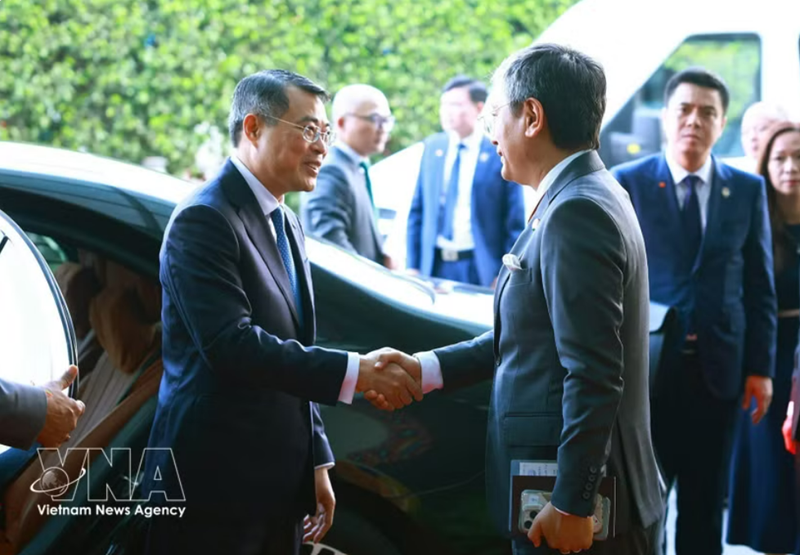
A senior Indian official sees off PM Le Minh Hung (left) as the Vietnamese leader concludes the working trip to attend the 18th BRICS Summit and conduct bilateral activities in India. |
Indian officials seeing the delegation off at Indira Gandhi International Airport were Minister of State for Cooperation and Civil Aviation Murlidhar Mohol and Indian Ambassador to Viet Nam Tshering Wangchuk Sherpa. On the Vietnamese side were Minister of Foreign Affairs Le Hoai Trung, Vietnamese Ambassador to India Trinh Minh Manh, Deputy Chief of Mission Tran Thanh Tung, Consul General in Mumbai Le Quang Bien, along with officials and staff from the Vietnamese Embassy in India.
During the trip, PM Le Minh Hung held talks with host PM Narendra Modi, attended and delivered remarks at the 18th BRICS Summit as a representative of a BRICS partner country, met with leaders and heads of delegations from BRICS member and partner nations, and engaged with heads of several international organizations and leading Indian enterprises.
Also as part of the visit, PM Le Minh Hung and his entourage laid flowers at the statue of President Ho Chi Minh in G20 Park, New Delhi, and met with the staff of the Vietnamese Embassy and representative agencies in India.
During their talks, PMs Le Minh Hung and Modi agreed to bolster result-oriented cooperation across various areas, thereby developing the Viet Nam–India relationship in an increasingly effective, comprehensive, and substantive manner. Both sides expressed the determination to raise bilateral trade turnover to 25 billion USD, promote connectivity corridors between South Asia and Southeast Asia, and enhance coordination at regional and international forums.
Addressing the 18th BRICS Summit, PM Le Minh Hung proposed three major directions, namely enhancing the resilience and self-reliance of economies; creating new, inclusive, and sustainable growth drivers; and promoting cooperation in science, technology, and innovation. He affirmed Viet Nam's support for BRICS in strengthening coordination with multilateral mechanisms and playing an active role in fostering dialogue, cooperation, and the resolution of global challenges, all aimed at peace, stability, and sustainable, inclusive development.
At his meetings with leaders and heads of delegations from BRICS member states and partner nations, the Vietnamese leader discussed ways to advance bilateral relations, cooperation in areas of mutual interest, and coordination at multilateral forums. These meetings helped consolidate friendship, reinforce political trust, and expand the scope of cooperation between Viet Nam and other countries, thereby affirming Viet Nam's rising role and stature in international relations.
Talking to leaders of international organizations such as the World Trade Organization (WTO) and the Asian Infrastructure Investment Bank (AIIB), PM Le Minh Hung called on them to continue supporting Viet Nam in its international economic integration, strategic infrastructure development, green transition, and efforts to enhance competitiveness. The international partners pledged to continue expanding partnerships with the country, helping to mobilize resources for sustainable development and enhance the country's stature and role in the regional and global economy.
During the meetings with leaders of major Indian corporations, PM Le Minh Hung encouraged Indian enterprises to expand their investment and cooperation in Viet Nam, particularly in such fields as clean energy, green industry, aviation infrastructure, high technology, and digital transformation. He affirmed that the Vietnamese Government will create favorable conditions and support businesses possessing the necessary capabilities, technology, and long-term vision, thus promoting increasingly substantive and effective economic, trade, and investment links between the two countries.
The working trip by PM Le Minh Hung and the high-level Vietnamese delegation reaffirmed the country's foreign policy of proactive and active integration into the world, and multilateralization and diversification of external relations. It also helped to strengthen ties with partners, broaden avenues for cooperation, and enhance Viet Nam's role and standing at regional and global multilateral mechanisms.
Source: VNA