Prof. Tan Jian Ping, Director of the Center of Excellence for Sustainable Technologies for Agricultural Advancement and a Zero-Waste Economy (STARGAZE) at Xiamen University Malaysia (XMUM), said NAP 2.0 focuses on applying Industry 4.0 technologies, including the Internet of Things (IoT), unmanned aerial vehicles, artificial intelligence (AI), automation and biotechnology.
The transformation aims not only to increase productivity but also to reduce the sector’s heavy reliance on foreign labor and strengthen national food security. Priority areas include Malaysia’s competitive sectors such as palm oil, rubber and high-value fruit crops, including durian, as well as high-tech food production models such as indoor farming and aquaculture.
    |
 |
|
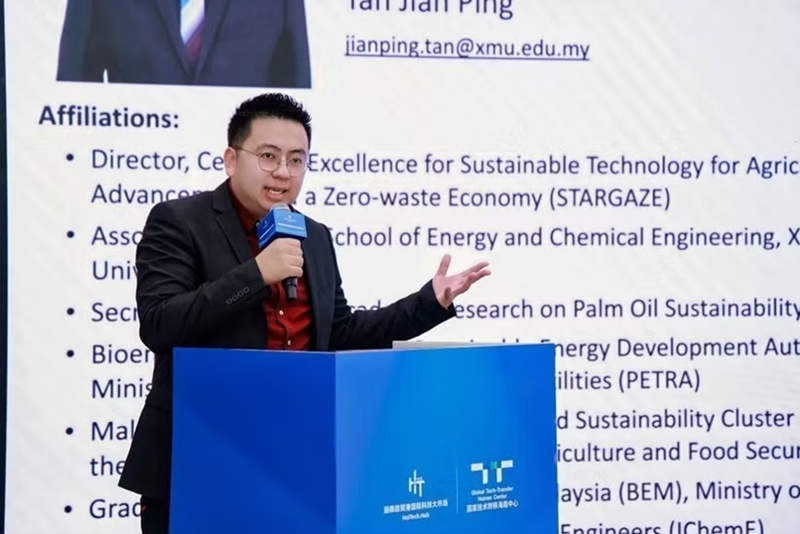
Prof. Tan Jian Ping, Director of the Center of Excellence for Sustainable Technologies for Agricultural Advancement and a Zero-Waste Economy (STARGAZE) at Xiamen University Malaysia |
Regarding rice production, Tan noted that Viet Nam has strong advantages in terms of production scale and expertise. Rather than duplicating Viet Nam’s achievements, Malaysia sees an opportunity to learn from the country and establish strategic partnerships, he said.
Malaysia nevertheless faces challenges in scaling up high-tech agriculture, including high initial investment costs for smallholder farmers, infrastructure and connectivity gaps, an ageing workforce and difficulties in adapting technologies designed for large plantations to smaller farms.
The professor stressed the need to strengthen links between research and industry and between laboratories and farms. He described Viet Nam-Malaysia cooperation as a “win-win” partnership, with Viet Nam contributing expertise in rice production, horticulture and aquaculture, while Malaysia could share its strengths in plantation technology and biotechnology.
He proposed establishing a Malaysia-Viet Nam High-Tech Agriculture Innovation Center to connect researchers from universities and research institutions through joint government funding. The center could subsequently bring together startups and businesses to develop pilot farms, share agricultural data and commercialize technological solutions.
In the longer term, the initiative could expand beyond bilateral cooperation to create a common agricultural technology platform for ASEAN, enabling member states to leverage their respective strengths and develop sustainable solutions for the region.
Source: VNA