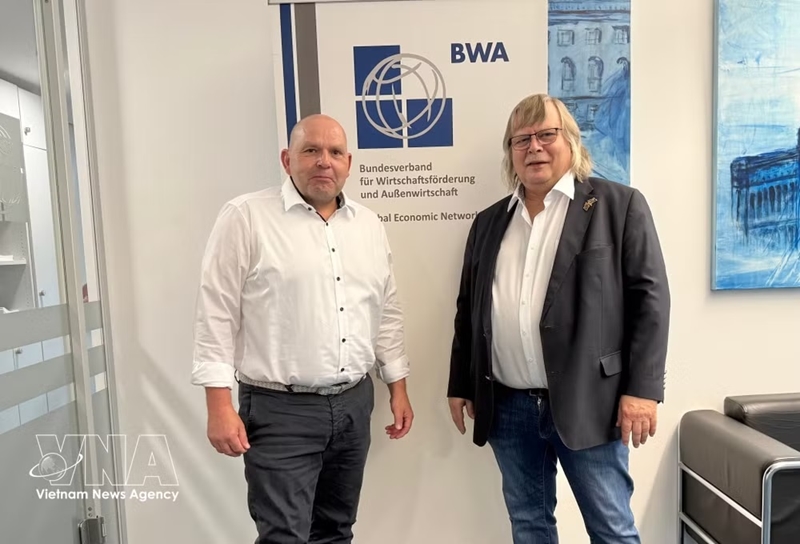
Heinrich Gerd-Witte, Advisory Board Member and Chairman of the Agriculture and Food Committee of the German Federal Association for Economic Development and Foreign Trade (BWA), and Hans-Joachim Radtke, BWA’s trade representative for Viet Nam and Chairman of the German-Vietnamese Innovation and Economic Forum, highlighted the strong potential for bilateral cooperation in this sector.
    |
 |
|
Heinrich Gerd-Witte (left), Advisory Board Member and Chairman of the Agriculture and Food Committee of the German Federal Association for Economic Development and Foreign Trade, and Hans-Joachim Radtke, a member of the Advisory Board and BWA’s trade representative for Viet Nam and Chairman of the German-Vietnamese Innovation and Economic Forum |
Radtke said Viet Nam is heading in the right direction with economic reforms and has considerable scope to apply AI and other advanced technologies in agriculture. The key, he stressed, is ensuring that technology delivers clear economic value.
Viet Nam also needs a pragmatic path towards net-zero emissions, learning from mistakes made by Germany and Europe rather than repeating them, he said.
The two experts noted that Viet Nam possesses a solid agricultural foundation and is a dynamically developing economy. However, like many other countries, climate change, water pressures, urbanization and rising demand for safe and sustainable food are creating an urgent need for new agricultural solutions.
Gerd-Witte said the goal of bilateral cooperation is not only to develop agriculture and improve the livelihoods of local people but also to help Viet Nam's agricultural products gain better access to global markets, particularly the European market, thereby boosting bilateral trade.
Germany has strengths in and can contribute expertise in AI, automation, autonomous machinery, digitization, machine connectivity, the circular economy and climate adaptation, which can help with Viet Nam's modernization of agriculture, he added.
Yet financing and differences in expectations remain major hurdles. Radtke said while Vietnamese partners may seek investors, German businesses need financially viable projects capable of securing bank financing. A lack of funding can prevent promising ideas from moving beyond the planning stage.
Technology also needs to be tested on the ground. Solutions successful in Germany may not suit Viet Nam’s conditions. Farmers, technicians, scientists, authorities and consumers should therefore be involved from the outset.
The experts called for a shift from “technology export” to “joint transformation,” with the two sides researching, adapting and localizing solutions before scaling them up.
Promising areas include smart rice farming, precision agriculture, sustainable aquaculture, water management, sensor technology, data platforms, AI and climate-resilient agriculture. Urban and indoor farming could also offer opportunities, especially in Ha Noi and Ho Chi Minh City, where such models can help strengthen local food supplies while saving land and water.
They also emphasized the crucial role of intermediaries, particularly those proficient in both Vietnamese and German, in connecting the parties and bridging differences in culture and working styles.
The experts stressed that success should not be measured by how much German technology is brought into Viet Nam, but by whether the two sides can develop solutions that work in Viet Nam and deliver lasting benefits for farmers, the economy and the environment.
Source: VNA