Speaking at the event, Vietnamese Deputy Minister of Finance Nguyen Duc Chi said that the seminar was significant to promoting bilateral cooperation, particularly as the two countries are set to mark the 55th anniversary of their diplomatic ties in 2027. The participation of regulators, investment funds, financial institutions and businesses reflects growing interest among Austrian and European investors in the Vietnamese market and prospects for expanded bilateral collaboration.
    |
 |
|
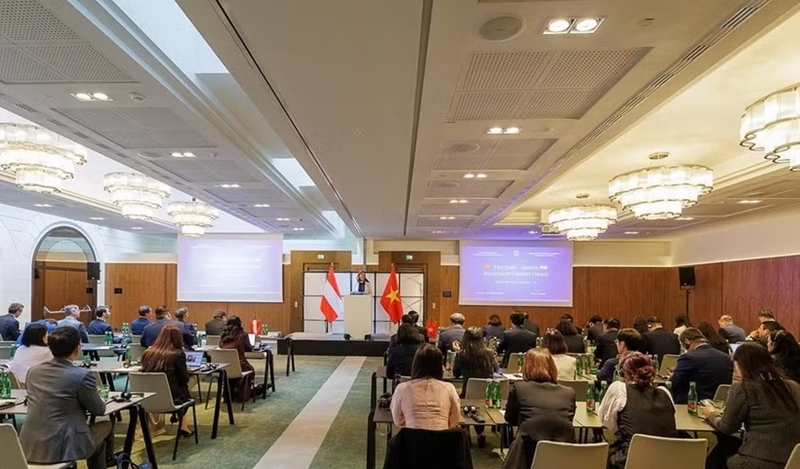
An overview of the seminar on Viet Nam-Austria investment connectivity (Photo: State Securities Commission of Vietnam) |
Viet Nam is undergoing strong reforms to enter a new era of development, with GDP growing 8.18% in the first half of 2026, placing the country among the fastest-growing economies in the region and the world, Chi said. To achieve its goal of becoming a developed, high-income country by 2045, Viet Nam needs to mobilize substantial resources for development investment, creating significant opportunities for Austrian and European investors.
Viet Nam is prioritizing high-quality investment, ensuring equal treatment and full protection of investors’ legitimate rights and interests. It is also accelerating the development and operation of its International Financial Centre in Ho Chi Minh City and Da Nang City, focusing on fintech, green finance and controlled regulatory sandbox mechanisms, he told participants.
Regarding the capital market, the official noted that FTSE Russell has announced the upgrade of Viet Nam’s stock market from Frontier Market to Secondary Emerging Market status. Vietnamese equities will be included in FTSE Russell’s global equity indexes from September 21, while the country will continue comprehensive reforms to meet higher standards and improve transparency, safety and accessibility for international investors.
According to the deputy minister, bilateral economic ties are also benefiting from favorable conditions. Driven by the E.U.-Viet Nam Free Trade Agreement (EVFTA), two-way trade has reached around 2.5-2.7 billion USD, making Viet Nam Austria’s largest trading partner in ASEAN. Austria currently has 49 valid investment projects in Viet Nam with total registered capital of nearly 150 million USD, while around 60 Austrian companies have representative offices or branches in the country. A 150-million-EUR (173 million USD) framework agreement on financial cooperation signed by the two countries in June 2025 has laid the foundation for future joint programs and projects.
Chi called for closer cooperation in three key areas: promoting the full ratification of the E.U.-Viet Nam Investment Protection Agreement (EVIPA); encouraging Austrian financial groups, banks, investment funds and fintech companies to enter the Vietnamese market, including as strategic investors; and expanding investment in complementary sectors such as high technology, artificial intelligence, clean and renewable energy, transport infrastructure, smart cities, green finance, carbon-credit markets and the circular economy.
State Secretary at the Federal Ministry of Finance of Austria Barbara Eibinger-Miedl said that amid a rapidly changing world economic landscape, the two countries have significant room for stronger cooperation in finance, investment, innovation and green transition. She expressed her hope that agencies and businesses will maintain dialogue, share experience and develop more concrete joint projects.
The seminar also featured presentations on Viet Nam’s stock market, financial ecosystem and investment potential, as well as reforms to its legal framework and market supervision. Representatives of Vietcombank, Raiffeisen Bank International, HDBank and StageInvest shared perspectives on mobilizing international capital, sustainable finance, capital-market development and investment opportunities in Viet Nam.
Participants agreed that Viet Nam’s dynamic economy, political and social stability, deep international integration and emerging growth drivers offer substantial opportunities for Austrian and European investors. The upgrading of the stock market, institutional reforms, development of green finance and establishment of the International Financial Centre are expected to further expand cooperation between the two countries.
Source: VNA