    |
 |
|
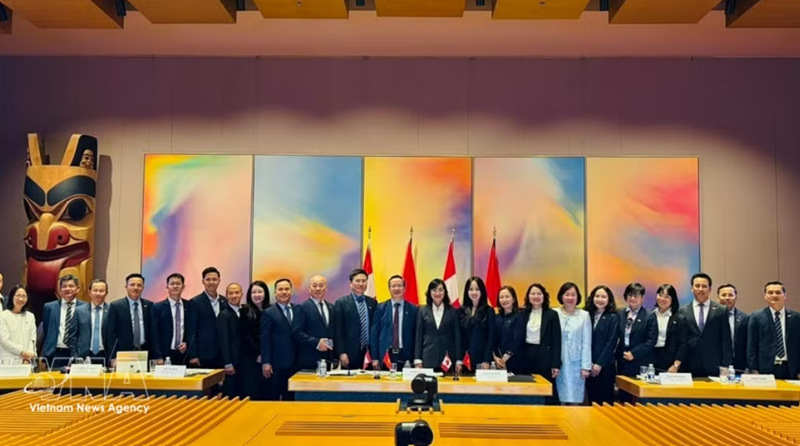
The Vietnamese delegation poses for a group photo at the third meeting of the Viet Nam-Canada Joint Economic Committee. |
Viet Nam is currently Canada’s largest trading partner in ASEAN. Building on the Comprehensive and Progressive Agreement for Trans-Pacific Partnership (CPTPP), the two countries are expanding bilateral economic ties into higher value-added areas such as clean energy, critical minerals, advanced technology, manufacturing and value-chain linkages.
The third meeting of the Viet Nam-Canada Joint Economic Committee and the recent Viet Nam-Canada Business Forum highlighted this shift, with areas of mutual interest expanding beyond agriculture, consumer goods and traditional investment to clean energy, critical minerals, advanced technology, aerospace, the defense industry and the knowledge economy.
Talking to Viet Nam News Agency correspondents in Canada, Vina Nadjibulla, CEO of the Center for Strategic Statecraft of Canada, said bilateral trade has grown significantly but still has considerable room for expansion, noting that CPTPP has facilitated businesses’ access to each other’s markets.
According to Tran Thu Quynh, Commercial Counsellor at the Vietnamese Embassy in Canada, the Joint Economic Committee mechanism and interest from the two governments are creating new growth drivers. Future priorities are expected to include technology, energy, critical minerals, advanced technology and even defense industry cooperation.
From trade to industrial cooperation
In the short term, Canada has clear advantages in natural resources, agricultural products and energy products. However, Senator Yuen Pau Woo, Chair of the Canada-Viet Nam Parliamentary Friendship Group, said the long-term potential lies in deeper cooperation in industry, advanced manufacturing and renewable energy.
He noted that Canada could supply abundant resources, agricultural products and energy products to Asian markets, including Viet Nam, while the longer-term potential lies in jointly developing industrial capacity and creating value.
Energy and technology clearly demonstrate this complementarity. Nadjibulla said Canada could cooperate with Viet Nam in areas ranging from liquefied natural gas, hydrogen and carbon capture to nuclear and renewable energy. AI, quantum technology, aerospace and defense are also emerging areas of connection.
Businesses urged to deepen value-chain participation
The broader cooperation agenda is creating new requirements for Vietnamese businesses. According to the Viet Nam Trade Office in Canada, the goal is not only to increase exports but also to enhance brand value, establish a stronger direct presence in the Canadian market and participate more deeply in international distribution, manufacturing and services networks.
Connecting trade with production and making better use of the free trade agreements shared by the two countries could help link supply chains with production chains.
Quynh said this shift could lay the foundation for closer links between trade and industrial policies, promoting substantive cooperation and further upgrading bilateral ties.
Meanwhile, Yuen Pau Woo stressed the importance of a sound policy environment, noting that international relations, trade agreements and foreign policy can directly affect ties with Viet Nam. Policymakers therefore need a better understanding of Viet Nam and its importance to Canada.
From goods trade to production linkages and from traditional sectors to energy, technology and the knowledge economy, Viet Nam-Canada relations are developing increasingly diverse connections, laying a stronger foundation for more substantive bilateral economic ties.
Source: VNA