The event is organized by Rencontres du Vietnam, the International Center for Interdisciplinary Science and Education (ICISE), the Vietnamese Biophysical Society and the Microscopy Society of Vietnam.
    |
 |
|
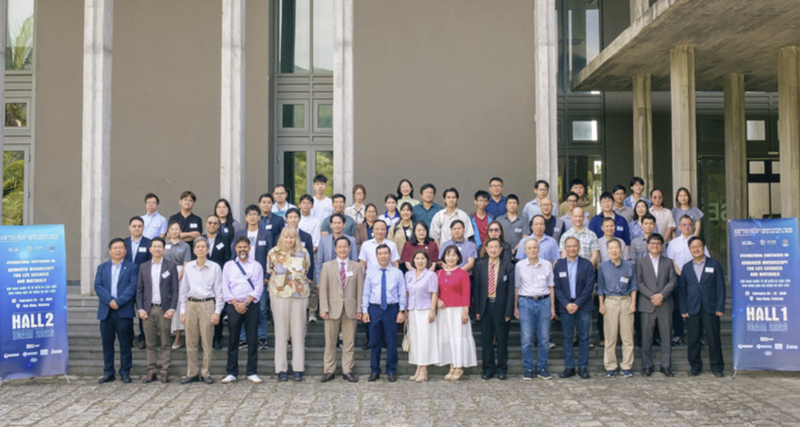
Participants pose for a group photo at the International Conference on Advanced Microscopy for Life Sciences and Materials held in Gia Lai on February 25. (Photo: ICISE) |
Nearly 70 scientific reports are set to be presented across plenary, parallel and poster sessions, focusing on two principal themes. The first centers on the development and application of advanced microscopy in life sciences and materials research. The second addresses microscopy education and training, as well as the development of shared infrastructure aimed at tackling challenges in regions where access to high-end microscopy resources remains limited, including Vietnam. Participants also share successful models for building and networking microscopy facilities in developing countries, while promoting international cooperation in the field across Vietnam, Southeast Asia and beyond.
Dr. Nguyen Huu Ha, Deputy Director of the provincial Department of Science and Technology, said the conference, through in-depth academic exchanges, would help strengthen research capacity, foster connections between the Vietnamese microscopy community and counterparts in Southeast Asia and the world, and enhance Vietnam’s scientific standing in high-technology fields.
He affirmed that Gia Lai regards science and education as core pillars of innovation and sustainable development, pledging continued support to enable ICISE to serve as a knowledge hub and bridge between Vietnamese science and the global scientific community.
Despite the increasing deployment of advanced microscopy technologies in hospitals, universities, research institutes and industrial facilities across the country, the Microscopy Society of Vietnam continues to face significant challenges. Formal training programs, hands-on instruction and systematic knowledge dissemination in microscopy remain limited. Most users rely largely on self-study or short training sessions provided by equipment suppliers, which can constrain the effective use of these powerful tools in research and innovation.
Moreover, the microscopy user community in Vietnam remains fragmented, lacking a common platform for sharing technical expertise, research experience and collaboration opportunities. This limited connectivity has, to some extent, curtailed the full potential of microscopy technologies in advancing scientific progress and industrial applications at home and abroad.
Through ICAM-LSM 2026, the conference’s co-chairs, Assoc. Prof., Dr. Tran Quang Huy and Assoc. Prof., Dr. Ngo Xuan Kien, expressed their hope for stronger engagement and cooperation from domestic organizations and individuals to jointly build an advanced microscopy network capable of effectively supporting education, research and development (R&D) in life sciences and materials science.
Source: VNA