Finding names of fallen comrades
Under the scorching heat of the border area, many veterans, martyrs’ relatives, and people from across the country have traveled to Vi Xuyen in Tuyen Quang Province to pay tribute to the heroes and martyrs who laid down their lives in the struggle to defend the Fatherland’s northern border. They visit war cemeteries, historical sites, and strategic heights where fierce battles once took place.
    |
 |
|
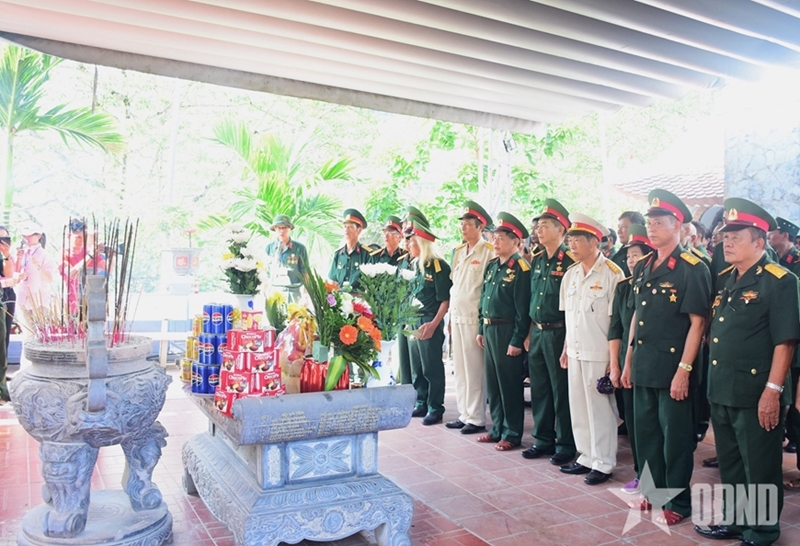
Veterans offer incense at the Temple of Heroes and Martyrs of Vi Xuyen Front on Hill 468, Thanh Thuy commune, Tuyen Quang province. |
After completing the incense-offering ceremony at the Temple of Heroes and Martyrs of Vi Xuyen Front on Hill 468, veteran Pham Quang Tien, former head of Battery H12 of Company 14, Regiment 122, Division 313, stood silently for a long time. He fought in this area from 1979 to 1981. He spoke slowly that in the past, soldiers fought courageously and tenaciously, and many sacrificed their lives. What weighed most heavily on them was that they were unable to bring their comrades home.
Since the launch of the 500-day campaign, Tien and many other veterans have been even more eager to contribute to the effort. This aspiration is also shared by many veterans who fought along the northern border, including veteran Chu Xuan Khiem, a former 2W signal soldier of Company 18, Regiment 876, Division 356, which fought on Vi Xuyen Front.
According to Khiem, after completing his military service, he returned to his hometown in Xuan Dinh ward, Hanoi. However, he could never stop thinking about the comrades left behind on the battlefield. That lingering sense of responsibility became a determination to act following a late-night phone call in late March 2012 from Luu Thi Lan, the wife of martyr Nguyen Huu Thanh, former officer commanding of Battalion 3, Regiment 876, originally from Quang Binh province. Thanh was killed on July 12, 1984, on Hill 772. Lan said that for decades, she and her family had returned to Ha Giang many times to search for her husband’s grave, but without success. After years of seeking information from various sources and thanks to connections made by veterans of Vi Xuyen Front, she finally managed to contact Chu Xuan Khiem, who had directly witnessed the circumstances of her husband’s death.
The widow’s account and the shared longing to recover their fallen comrade’s remains spurred Khiem to set out in search of soldiers still lying on the battlefield.
In June 2012, after several field surveys and preparatory visits, Khiem, Nguyen Van Kim from Company 11, and several other comrades from Battalion 3 took Lan and her family to Hill 772 to locate the place where Thanh had been killed.
When they returned to the site where the Battalion 3 commander had fallen, the veterans and his family spent hours searching the surrounding area before finding some of his remains and several familiar personal belongings. Thus, after lying on Hill 772 for many years, the remains of martyr Nguyen Huu Thanh were finally recovered and reburied by his family at the war cemetery in their hometown.
|
|
 |
|
Veterans offer incense at the Temple of Heroes and Martyrs of Vi Xuyen Front on Hill 468, Thanh Thuy commune, Tuyen Quang province. |
Continuing journey of gratitude
Veterans of Vi Xuyen Front remain committed to the belief that the search for their fallen comrades must never stop. Many are now advanced in age and in declining health, yet whenever new information emerges, they find ways to return to the former battlefields.
Their contributions extend beyond the search for fallen comrades. Veterans of Vi Xuyen Front, including Chu Xuan Khiem, Nguyen Van Kim, and their associates, also played a major role in mobilizing support for the construction of a monument dedicated to the heroes and martyrs on Hill 468, in Nam Ngat hamlet, Thanh Thuy commune. The site is now home to the Temple of Heroes and Martyrs of Vi Xuyen Front.
During the struggle to defend the northern border, Hill 468 and other heights, including Hills 772 and 685 and Height A5, were subjected to hundreds of thousands of artillery shells and other forms of firepower. On July 12, 1984 alone, nearly 1,000 officers and soldiers were killed and left behind on this borderland.
On November 23, 2013, the monument dedicated to fallen soldiers on Hill 468 was built. About a year later, 80 veterans representing those who had participated in the struggle to defend the northern border were honored to meet President Truong Tan Sang at the Presidential Palace. During the meeting, the President endorsed their proposal to renovate and expand the memorial complex dedicated to the heroes and martyrs of Vi Xuyen Front.
In January 2016, construction began on the Temple of Heroes and Martyrs of Vi Xuyen Front, building on the existing memorial monument on Hill 468. The complex was officially inaugurated on June 25, 2016, reflecting the gratitude and aspirations of veterans, people, and benefactors nationwide. The site has become a “red address” commemorating those who sacrificed their lives in defense of the Fatherland, while also helping educate younger generations about the nation’s traditions.
This journey of gratitude also continues through simple acts in Thanh Thuy commune today.
In Giang Nam hamlet, mother Ly Thi Xoa, now over 80, lost her son, Ly Van Thang, a martyr who died on May 22, 1981, while fighting to defend the border. For many years, local officials, Youth Union members, and young people have regularly visited her to offer assistance, clean her home, prepare meals, and share meals with her.
According to Phung Viet Vinh, Secretary of the Thanh Thuy commune Party Committee, caring for national contributors and policy beneficiaries, while preserving and promoting the value “red addresses,” has always been a priority for local Party committees and authorities.
Alongside visits and assistance for policy beneficiary families, the commune coordinates efforts to improve memorial sites and accommodate veterans, martyrs’ relatives, and other visitors paying tribute to the fallen. It also organizes activities to educate younger generations about national traditions.
Under the 500-day campaign, local authorities and residents continue to coordinate efforts, provide information, and support the forces tasked with searching for and recovering martyrs’ remains, helping bring home those who are still missing.
The 500-day campaign has kindled new hope. Once again, it affirms that searching for, recovering, and identifying martyrs’ remains is not merely about addressing the unresolved consequences of war. It also reflects the moral values, responsibility, and gratitude of the Party, State, and people toward those who sacrificed their lives for the Fatherland. Through these efforts, present-day generations are reminded to cherish and preserve the values of peace and independence.
(The end)
Translated by Quynh Oanh