The days of fierce fighting and bombardment have long passed. Trees have grown green, and the mountains and forests have become peaceful and tranquil. Yet, beneath rocky crevices and in deep ravines along the country’s northern frontier, many fallen soldiers are still buried there. The search for and recovery of their remains has become a heartfelt aspiration and an unspoken duty for those today who seek to honor the dedication and sacrifice of previous generations.
Deeply committed to finding fallen comrades
    |
 |
|
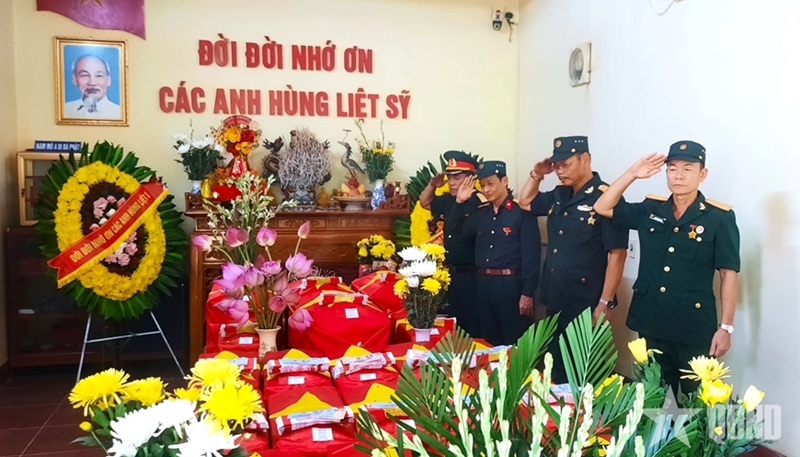
War veterans pay tribute to fallen soldiers at the memorial hall of the Search and Collection Team of the Tuyen Quang Provincial Military Command. |
The road to Thanh Thuy commune, Tuyen Quang province, glows in the sunshine. Layer upon layer of mountains rises beneath a canopy of green trees. It is difficult for us to imagine that this area was once described as a “lime kiln of the century.” Relentless bombardment reduced gray rocks to lime and stripped the forests bare. Those painful memories now remain only in the minds of war veterans. They witnessed those tragic days and risked their lives to defend every inch of the Fatherland’s border. We stopped to offer incense at the memorial stele dedicated to fallen heroes and martyrs in Thanh Thuy commune.
Having traveled more than 600 kilometers from Thanh Hoa province back to Thanh Thuy, veteran Dau Minh Thinh felt restless and anxious. He walked as though he could hear his comrades calling out to him. The veteran’s footsteps have traced forest slopes, rocky outcrops and deep ravines, driven by one heartfelt wish: to find his fallen comrades.
The road climbed steeply uphill, with the wind roaring past our ears. A sheer mountainside rose on one side, while a deep ravine yawned on the other. Our motorcycle sputtered and revved, belching smoke as it slowly made its way toward the position occupied by the Search and Collection Team of the Tuyen Quang provincial Military Command. When veteran Thinh arrived, the team welcomed him like one of their own. For years, he has accompanied the team, providing information to help locate the remains of fallen soldiers.
|
|
 |
|
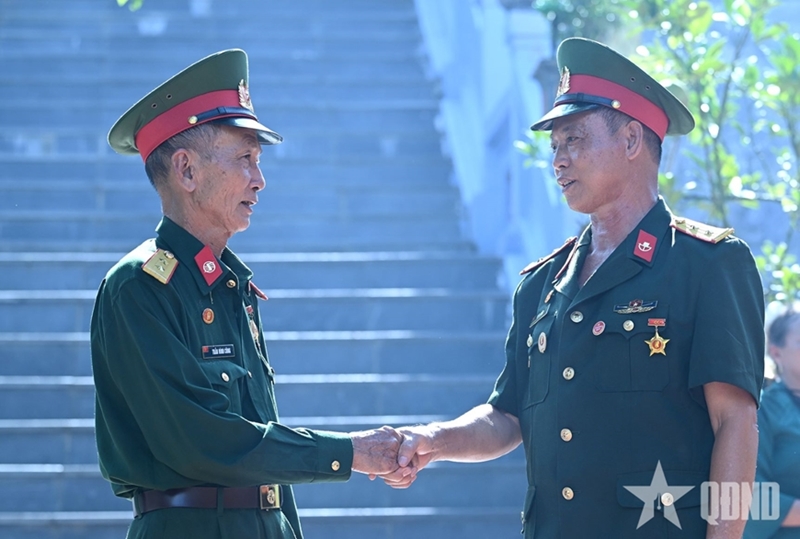
War veterans at the Temple dedicated to heroes and martyrs of Vi Xuyen Front on Hill 468, Thanh Thuy commune, Tuyen Quang province. |
The mention of Sap Cave, on the Eastern slope of Hill 685, brought back such vivid memories that veteran Thinh fell silent for a long time. It was shortly before the Lunar New Year in 1985. At the time, Dau Minh Thinh was head of the signal platoon of Battalion 4, Regiment 153, Division 356. His unit had been assigned to defend its position on Hill 685. Then came successive artillery barrages. The world was engulfed in dust and smoke as earth and rocks were hurled into the air. Rocks collapsed over the entrance to Sap Cave, where soldiers had been sheltering. After the bombardment, veteran Thinh made his way toward the cave and heard a voice for help. Following the calls, he found comrade Hong, from Nong Cong district, Thanh Hoa province, deputy head of Company 4, Battalion 4, Regiment 153. Hong was trapped inside the cave, with only his head protruding outside. Because his legs were trapped deep inside, Hong suffered abrasions all over his body as Thinh pulled him out. Hong told him that many other soldiers were still trapped inside and unable to escape because the narrow cave entrance had been completely blocked. With artillery shells continuing to pound the area relentlessly, rescue efforts could not be carried out. As a result, his comrades remained forever in the cave.
Decades have passed, yet the anguish of knowing that some of his comrades remain behind continues to haunt veteran Thinh. He shared: “I have returned home to reunite with my family, while my comrades still lie in the vast forests and rugged mountains. The mere thought of this weighs heavily on my conscience.”
In 2013, veteran Thinh contacted the liaison board of veterans from Vi Xuyen Front in Ninh Binh province and provided information about the fallen soldiers in Sap Cave, but the search yielded no results at the time. From 2024 to 2025, he returned to the former battlefield several times. With his memories and the remaining traces, he gradually identified the location of Sap Cave and provided information to the Search and Collection Team so that it could continue searching for the comrades still lying there.
Unresolved concerns
From Tuyen Quang, we followed a mountain road to Lao Cai province. By the time we reached Bat Xat commune, night had fallen. Following the directions provided in advance by the Search and Collection Team of the Lao Cai Provincial Military Command, we made our way to the home of war veteran Hoang Xuan Duc in An Thanh hamlet, Bat Xat commune.
Originally from Nghe An province, veteran Duc served with Regiment 192, which was redeployed in July 1978 to reinforce the defense of the northern border in Hoang Lien Son province (now Lao Cai province).
In his memory, there was once a field cemetery belonging to his unit at the foot of Hill 350B, in Dong Quang hamlet, Bat Xat commune. Many fallen soldiers were buried there by their comrades amid fierce fighting. After the war, the terrain changed. Floodwaters eroded the mountainsides, while forest vegetation covered the paths. Over the years, the graves gradually disappeared. Many sets of martyrs’ remains have yet to be found. This unresolved concern has weighed on veteran Duc for decades.
When Lao Cai province launched its 500-day campaign, a temporary Search and Collection Team was established. Veteran Hoang Xuan Duc enthusiastically provided information about the fallen soldiers buried at the foot of Hill 350B.
Thanks to the guidance provided by veteran Hoang Xuan Duc and the determination of the forces involved, the remains of nine fallen soldiers were recovered at the site. The remains were subsequently reburied by the local Party committee and authorities at the Martyrs’ Cemetery in Ban Qua, Bat Xat commune. Yet, despite recovering the remains, one concern remains unresolved: the identities of the fallen soldiers have not been established.
This is also the hope of those working tirelessly to search for and recover fallen soldiers’ remains. Over the past several months, officers and soldiers of the Search and Collection Team under the Lao Cai provincial Military Command have been present in many areas that were once fierce battlefields, including A Mu Sung, Y Ty, Muong Khuong, Pha Long and Si Ma Cai.
To improve the effectiveness of search and recovery efforts, the Lao Cai provincial Steering Committee 515 has mobilized the whole political system. All 99 communes and wards across the province have established teams to receive information about fallen soldiers and their remains. Veterans’ associations and mass organizations have been encouraged to review records and gather information from witnesses, local residents and those who directly participated in the fighting. Every lead received is cross-checked, verified and analyzed before a field survey is conducted.
The war has long since ended, and the border forests have grown green again. Yet some fallen soldiers still lie beneath layers of earth and rock, deep inside caves or on remote mountainsides. For this reason, the search for and recovery of fallen soldiers’ remains must continue...
(To be continued)
Translated by Quynh Oanh