According to Vien’s recollections, on December 18, 1972, shortly after receiving a warning that the enemy was preparing to launch B-52 raids against the capital, Vien, then a worker at Mai Dong Mechanical Factory, immediately joined her comrades in the self-defense unit (comprising personnel from three factories, Mai Dong Mechanical Factory, Luong Yen Mechanical Factory, and Ha Noi Wood Factory) and quickly moved from a position along the Kim Nguu river to a 100mm artillery position on Hai Ba Trung street to carry out ammunition resupply duties.
    |
 |
|
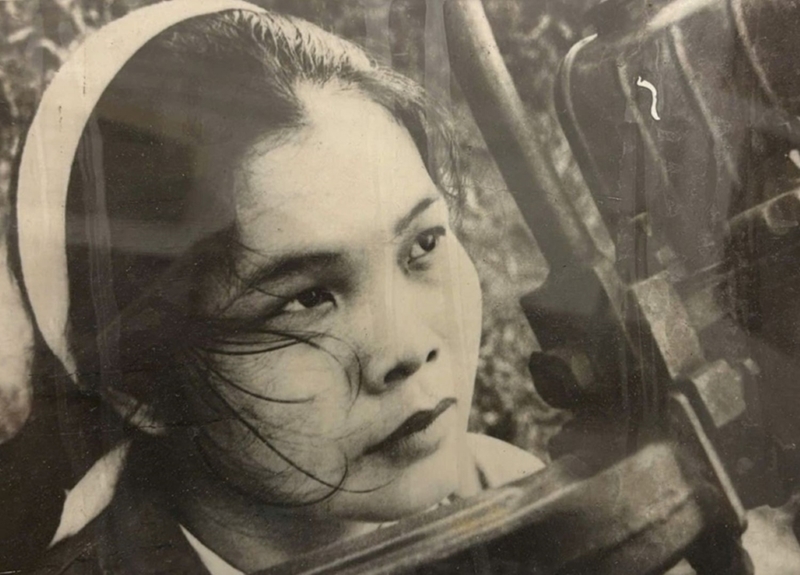
Photograph of Pham Thi Vien, a female self-defense fighter wearing a mourning headscarf beside her gun. (Photo provided by the gunner) |
For four consecutive nights, Vien and her comrades took turns rushing back and forth to rescue the wounded and clear collapsed buildings. At other times, they quietly prepared the bodies of people killed by bombs around the factory for burial. They had no time to eat or rest. It was not until the afternoon of December 22, when they received orders to move, that they took turns stopping by their homes to collect additional provisions in preparation for a prolonged deployment.
Vien and her comrades then marched to Van Don gun position, urgently hauling the guns onto their emplacements and carefully adjusting each weapon. After 8 p.m., a series of warning sirens rang out. The whole unit immediately assumed combat positions, maintaining a high level of concentration as they waited for the opportunity to strike.
When the commander shouted the order, “Fire!”, Vien, serving as Gunner No.1, and her comrades in the unit simultaneously opened fire, unleashing 19 rounds of 14.5mm ammunition at an F-111A “swing-wing” aircraft. Vien clearly saw the aircraft’s tail flash as it was hit. At the time, the F-111A was among the most advanced supersonic bombers in the U.S. Air Force.
The following morning, official word arrived: The enemy aircraft had crashed in Hoa Binh, and both pilots had been captured alive.
Before the joy of the victory had even faded, tragedy struck on the night of December 26, 1972, when enemy bombs hit her family’s shelter, killing Vien’s father and two of her cousins.
Early the following morning, her two younger sisters came to the unit looking for her. Their clothes were covered in dirt and their eyes were red with tears as they told her that their father had been killed. Vien hurriedly arranged her duties and returned home. When she reached the place where her father had taken shelter, all the young female self-defense fighter could see was a pond covered with the white bodies of dead fish.
It was not until three days later, when a person carrying water to irrigate vegetables discovered the body and reported it, that Vien was able to find her father’s remains. The family’s losses were transformed into hatred for the enemy, giving the young female self-defense fighter greater strength and determination to continue the fight.
After quickly settling matters at home, she returned to the firing position. Wearing a white mourning headscarf, female self-defense fighter Pham Thi Vien continued to stand steadfastly by her gun.
|
|
 |
|
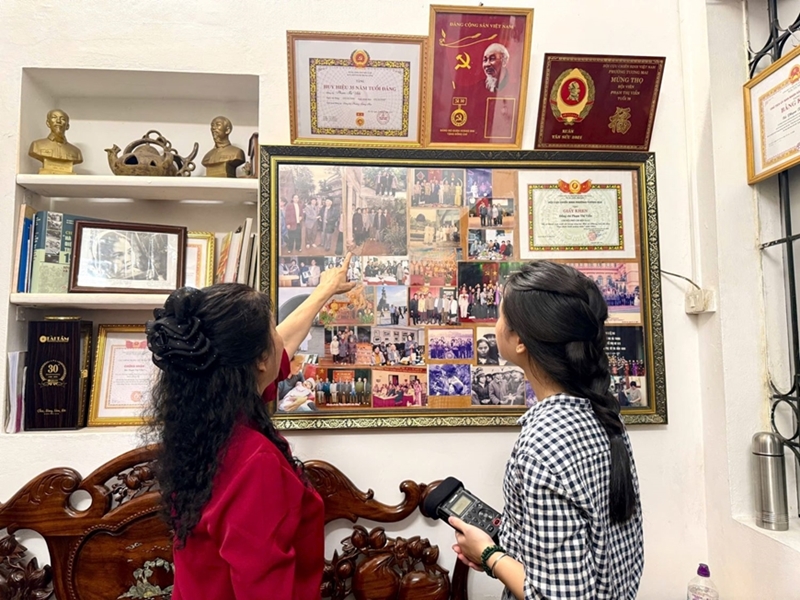
Pham Thi Vien (left) introduces wartime photographs displayed prominently on the walls of her home. |
More than half a century has passed. The courageous female self-defense fighter of those days now lives a simple and peaceful life with her children and grandchildren in a small house. Every day, her frail hands still carefully tend to the wartime photographs displayed on the walls, preserving memories of a defining period in her life.
Translated by Quynh Oanh