These days, numerous agencies, units and residents have visited Ho Chi Minh City War Cemetery to offer incense and flowers in tribute to the 731 fallen soldiers whose remains were recovered during the first phase at Le Thi Rieng Park and subsequently laid to rest in a solemn ceremony at the city’s war cemetery. The incense burned through the night not only honored the 731 fallen soldiers, but also reminded people of the value of peace and the great sacrifices made by previous generations. The public’s solidarity, empathy and support have provided tremendous encouragement for the forces carrying out this difficult yet sacred mission.
    |
 |
|
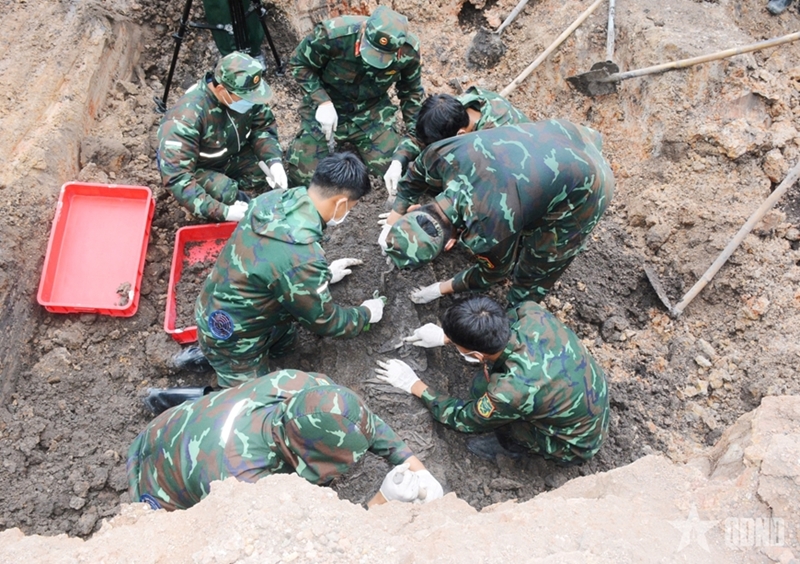
Search and recovery of fallen soldiers’ remains at Le Thi Rieng Park |
The search for, recovery and identification of fallen soldiers’ remains in Ho Chi Minh City is far from over. Many sites suspected of containing fallen soldiers’ remains have yet to be investigated, while numerous families continue to wait anxiously for news of their loved ones. This is not only a political task but also a responsibility, an expression of gratitude and an order from the heart of the living to previous generations who sacrificed their lives for national independence and freedom.
Currently, functional forces are proceeding with the second phase of the search and recovery operation at Le Thi Rieng Park. Since October 15, Team K74 under the Ho Chi Minh City Military Command has recovered an additional 111 sets of remains, 26 of which were accompanied by artifacts. Across the city, 12 areas contain information or traces suggesting possible mass burial sites of fallen soldiers and require further surveys and verification.
The Ho Chi Minh City Military Command will continue to serve as the standing agency, proactively advising the city’s Steering Committee 515 on the effective implementation of the 500-day campaign. Meanwhile, the command will intensify efforts to collect and decipher historical records, particularly archival materials at home and abroad. It will broaden the search for witnesses and call on veterans and local people to provide relevant information, photographs and memorabilia.
Scientific and technological methods will be applied more extensively in surveys and searches. Authorities will also complete case files, preserve recovered artifacts, collect biological samples for DNA testing and compare genetic results with those of relatives to gradually establish the identities of fallen soldiers.
Incense continues to be offered in solemn tribute. Bringing fallen soldiers home is not simply a matter of recovering remains buried deep underground. It is also a mission to preserve historical memory, uphold the nation’s traditions of gratitude, help heal the wounds of war and educate younger generations about the value of peace, independence and freedom.
By Major General Nguyen Thanh Trung, Standing Deputy Head of Steering Committee 515 and Political Commissar of the Ho Chi Minh City Military Command
Translated by Quynh Oanh