    |
 |
|
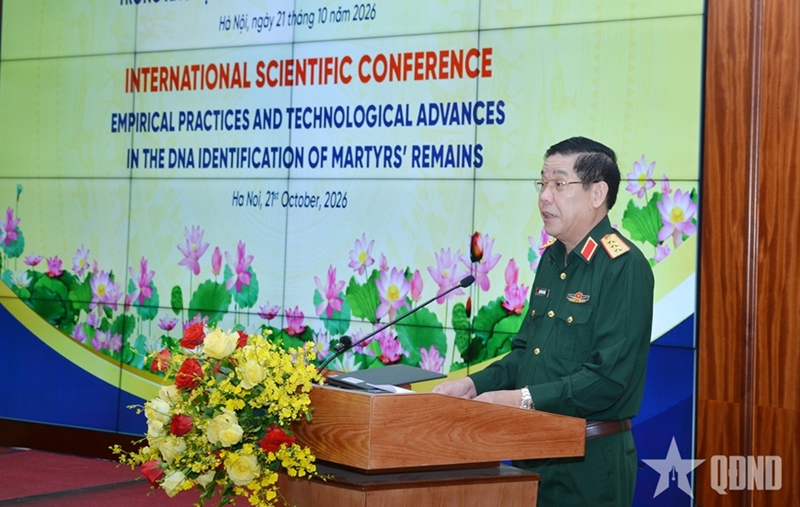
Sr. Lt. Gen. Nguyen Van Gau delivers the opening remarks, highlighting the challenges in identifying martyr remains. |
The seminar, themed “Empirical practices and technological advances in the DNA identification of martyr remains,” was held in a hybrid format, connecting participants in Viet Nam with international locations. Senior Lieutenant General Nguyen Van Gau, Deputy Minister of National Defense and Standing Deputy Head of the National Steering Committee for the Search, Collection and Identification of Martyr Remains, chaired the event.
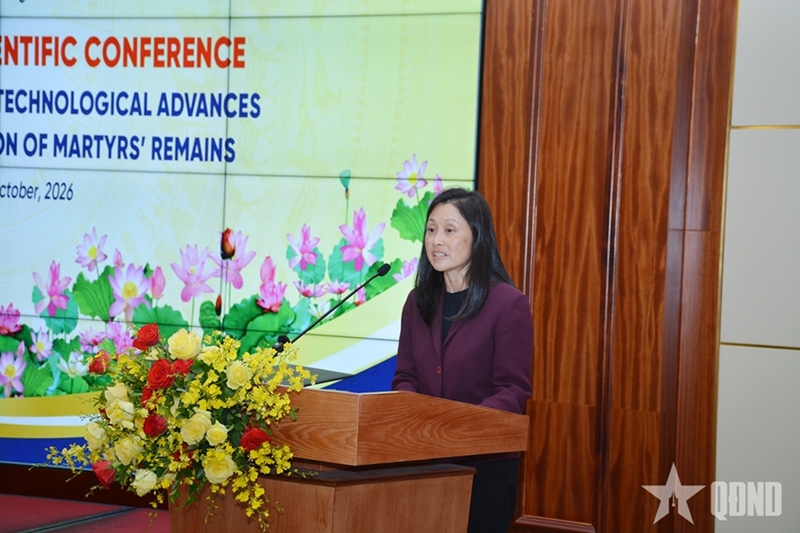
Also attending were Lieutenant General Truong Manh Dung, Deputy Chief of the General Staff of the Viet Nam People’s Army; U.S. Ambassador to Viet Nam Jennifer Wicks; representatives from agencies under the Ministry of National Defense (MND); and international delegates.
In his opening remarks, Sr. Lt. Gen. Nguyen Van Gau emphasized that the Party, State, and Viet Nam People’s Army have always paid special attention to and invested resources in the search, collection and identification of martyr remains. Relevant forces have made efforts to overcome difficulties, apply scientific and technological advances, and benefit from effective support from international partners. However, the identification of martyr remains is challenging, as many have severely deteriorated over time due to environmental conditions, while information for verification is limited.
|
|
 |
|
U.S. Ambassador to Viet Nam Jennifer Wicks speaks at the seminar. |
Under the “500-day campaign to accelerate the search, collection, and identification of martyr remains,” as of the morning of October 21, Viet Nam had collected more than 3,800 sets of martyr remains, 211,300 biological samples from unidentified remains for testing, and completed DNA analysis of 786 samples, the deputy defense minister said.
At the seminar, delegates exchanged experience in developing a national-scale system for identifying martyr remains; preserving biological samples over the long term; applying environmental DNA; and using forensic techniques in the examination of mass graves. Experts also discussed new DNA testing methods, trends in next-generation sequencing (NGS), combined analysis of mitochondrial DNA (mtDNA) and nuclear DNA (nDNA/STR), and approaches to dealing with severely degraded samples.
Participants also shared experience in laboratory management and the development of standardized and secure database systems.
In his concluding remarks, Senior Lieutenant General Nguyen Van Gau said the discussions provided valuable references for Viet Nam’s specialized agencies to improve task implementation, select appropriate technologies and enhance testing quality. He stressed that international experience should be carefully assessed against Viet Nam’s specific conditions to ensure effectiveness and avoid fragmented investment.
To put the seminar’s outcomes into practice, Sr. Lt. Gen. Nguyen Van Gau asked the General Department of Logistics and Technical Services to direct its Military Medicine Department to coordinate with relevant agencies and units in systematizing the recommendations and clearly identifying measures for immediate application, pilot implementation and international cooperation. Agencies and units tasked with DNA analysis should review procedures for receiving and testing samples and attach greater importance to personnel training.
He also asked the U.S., the International Commission on Missing Persons (ICMP), and other partners to continue supporting Viet Nam in training and technical cooperation in line with practical requirements.
Translated by Minh Anh