Behind the new schools was a race against time, as officers, engineers, and workers of Corporation 789 worked day and night and overcame difficult terrain, material shortages, labor constraints, and adverse weather to complete the project.
    |
 |
|
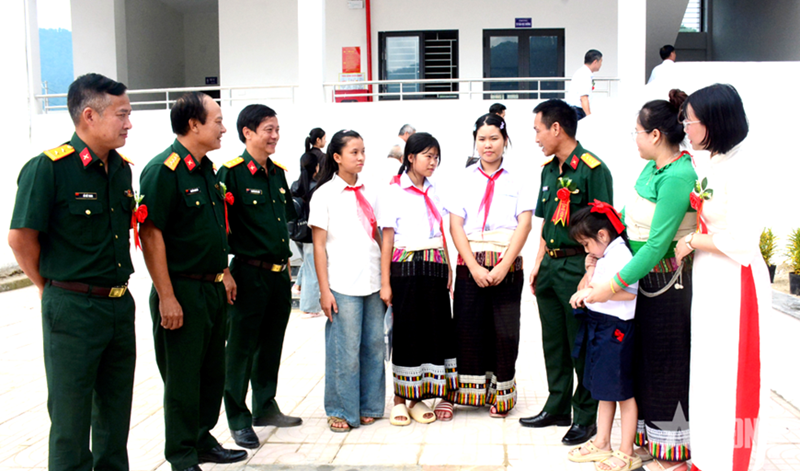
Officers and engineers from Corporation 789 of the Ministry of National Defense and teachers and students of Bat Mot Primary and Secondary Boarding School in Bat Mot commune at the newly-built school |
In Ea Rok, more than 500 students started the new school year on September 5 at newly-completed Ea Rok Primary and Secondary Boarding School. The project includes an administration building, primary and secondary classrooms, a dining hall and kitchen, boarding facilities, a multipurpose sports building, a cultural house, and technical infrastructure. Although the project was originally scheduled to take 360 days, Corporation 789 completed it in 216 days, 144 days ahead of schedule, so it could open at the start of the new school year.
In Bat Mot commune, new Bat Mot Primary and Secondary Boarding School, built on about 1.5 hectares, has 22 classrooms, 12 subject-specific classrooms, an administration building, a multipurpose building, a library, boarding and semi-boarding facilities, teacher housing, and supporting structures.
According to Principal Le Hong Sam, the school has 614 students in 23 classes, including 328 boarding students and 286 semi-boarding students. All receive the benefits stipulated by regulations. More than 98 percent of the students are children of Thai ethnic people. The teaching staff and personnel responsible for meals, security, and sanitation have also been fully arranged for the new school year.
Building the schools, however, required much more than putting up new facilities. In Muong Leo commune, steep and treacherous mountain roads made transporting materials particularly difficult. Many materials were unavailable locally, while 11.7-meter steel bars had to be unloaded, transferred, and reloaded several times. With no ready-mix concrete plant in the area, the contractor had to transport concrete pump trucks, mixer trucks, excavators, wheel loaders, and specialized cranes to the site. Local labor was also scarce, and the rainy season frequently disrupted construction.
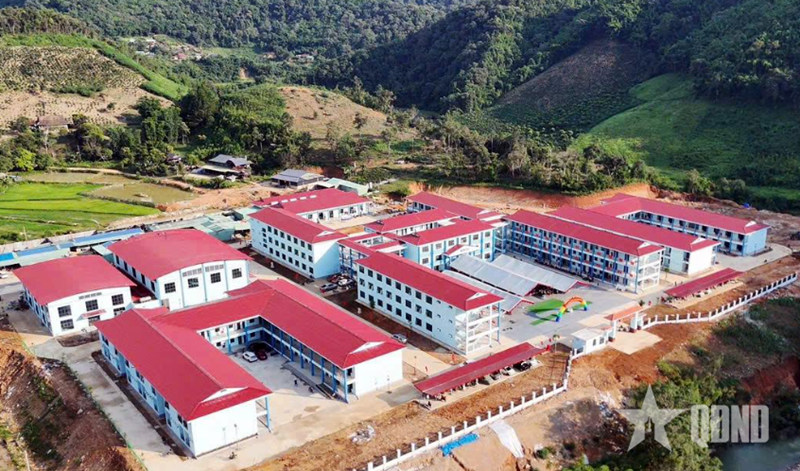
The Muong Leo school project comprises nine main buildings with a total floor area of about 18,500 square meters, providing 27 classrooms for 874 students, along with boarding facilities, teacher housing, a dining hall, a multipurpose sports hall, a swimming pool, and technical infrastructure.
Nguyen Van Manh, Party Secretary and Chairman of the People's Council of Muong Leo commune, was impressed by the approach taken by Corporation 789's personnel. At times, more than 500 people worked at the site each day, including overtime and night shifts whenever weather conditions allowed. The project was completed on schedule on August 30, 2026. The construction was similarly accelerated in Bat Mot.
|
|
 |
|
A bird's eye view of Muong Leo Primary and Secondary Boarding School in Muong Leo commune at the opening ceremony of the 2026-2027 school year |
In Ea Rok, limited supplies and the need to transport many materials from elsewhere posed additional challenges. Experienced construction teams were also difficult to mobilize because several major projects were underway at the same time. The construction proceeded alongside the approval and appraisal of required procedures.
Despite the pressure to meet tight deadlines, quality remained a priority. Sr. Col. Nguyen Cong Hieu, General Director of Corporation 789, repeatedly visited the construction sites to inspect the work. He checked not only the projects as a whole but also individual classrooms and specific work items, stressing that time pressure must not compromise construction quality.
On the first day of school, students saw only their new classrooms, boarding facilities, dining halls, and playgrounds. They may not know the difficult roads traveled by trucks carrying construction materials, the nights workers spent at construction sites, or the rainy days that slowed the work. Now the new schools are open, providing students in the border areas with better conditions for learning, living, and other daily activities. Within these classrooms, young students are nurtured and educated, growing up to follow in the footsteps of previous generations and contributing to preserving their homeland and firmly protecting the country's “border outposts.”
Translated by Tran Hoai