A key highlight of this effort is the Vietnamese–Ethnic Language Bilingual Communication Team model, which has helped strengthen trust among ethnic communities in the border areas where the unit is stationed.
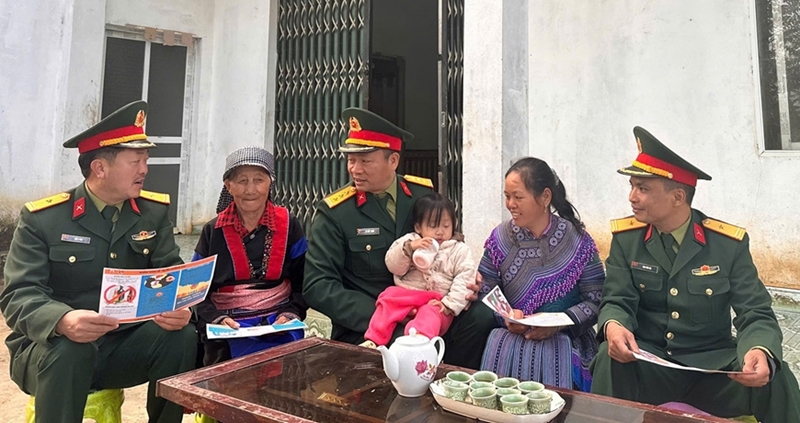
At daybreak, when mist still blankets the hills, members of the team are already on the move. At the house of Ly A Po, a H’mong resident of Tung Sang hamlet, A Mu Sung commune, Major Hau A Pao, Deputy Head of Production and Grassroots Political Development Team No.2, conducts legal outreach in the local language. Using a smartphone, he explains common tactics used by malicious people to carry out phone scams, helping residents recognize and avoid such risks.
    |
 |
|
The Vietnamese–Ethnic Language Bilingual Communication Team conducts outreach activities in Tung Sang hamlet, A Mu Sung commune, Lao Cai province. |
“The cadres explain things very clearly,” Ly A Po said. “I will join others in the hamlet to stay united, focus on economic development, and not listen to bad elements who try to incite or deceive us, especially through phone scams.”
Similar practical support can be seen in Ban Lau hamlet, Trinh Tuong commune, at the cattle-raising model of Ly A Sung, a Dao resident. After receiving guidance and training from the unit, Sung boldly borrowed additional capital to purchase two pairs of mature cows. The bilingual team assigned Senior Captain Dang Ton Suu, Deputy Head of Production and Grassroots Political Development Team No.3, to regularly visit the household, providing hands-on instruction in building stables, caring for livestock, and preventing disease. As a result, Sung’s cow-raising model has shown initial success and has become a reference point for other villagers to visit, learn from, and replicate.
Defense-Economic Mission 345 operates across five border communes, namely Trinh Tuong, A Mu Sung, Y Ty, Cao Son, and Pha Long in Lao Cai province, where ethnic minorities, such as the H’mong, Dao, Ha Nhi, Nung, and Giay account for more than 90 percent of the population. Living conditions remain difficult, educational levels are uneven, and access to information is limited. At the same time, hostile and reactionary forces continuously seek to distort the Party’s guidelines and the State’s laws, aiming to undermine national unity. These realities demand that information dissemination and mobilization efforts be accurate and targeted, and easy for people to understand, remember, and apply, and appropriate to local customs and cultural practices.
The bilingual communication team is made up of cadres, personnel, and volunteer young intellectuals from ethnic minority families who are experienced in mass mobilization, deeply familiar with local traditions, and fluent in ethnic minority languages. In the first week of each month, the team meets to assign tasks and plan outreach activities. Its work focuses on helping residents understand the Party’s guidelines, the State’s policies and laws, particularly those related to ethnic minority areas, the responsibility to safeguard national border sovereignty, awareness of hostile forces’ plots and tactics, and practical guidance on developing household economies.
According to Colonel Le Viet Xuan, Deputy Political Commissar of Defense-Economic Mission 345, the model has enabled people not only to absorb information more effectively, but also to confidently engage in dialogue with team members. Many households that once relied on fragmented, small-scale production have gradually developed a more commodity-oriented mindset, learned to select crops and livestock suited to local conditions, and become more vigilant against online fraud.
Looking ahead, Defense-Economic Mission 345 will continue to expand and refine the bilingual communication team model across its production and grassroots political development units. The approach will be integrated into literacy classes, combined with the distribution of seedlings and livestock, and incorporated into village meetings, while also promoting the role of village heads and respected community members. These efforts aim to maintain political security, social order, and safety in the border areas, and to build a solid “people’s posture” along the Northwestern frontier of the country.
Translated by Tran Hoai