Opening the conference, Gen. Nghia stressed that building and completing the circular is a crucial step in institutionalizing the Party’s guidelines and the State’s policies on talent attraction and use in the military, meeting the requirements of building a revolutionary, regular, elite, and modern military.
Policy development, he said, must align with national development goals toward 2045, with high-quality human resources serving as a key breakthrough. For the military, this is essential to enhancing overall strength and meeting the requirements of protecting the Fatherland in the new situation.
    |
 |
|
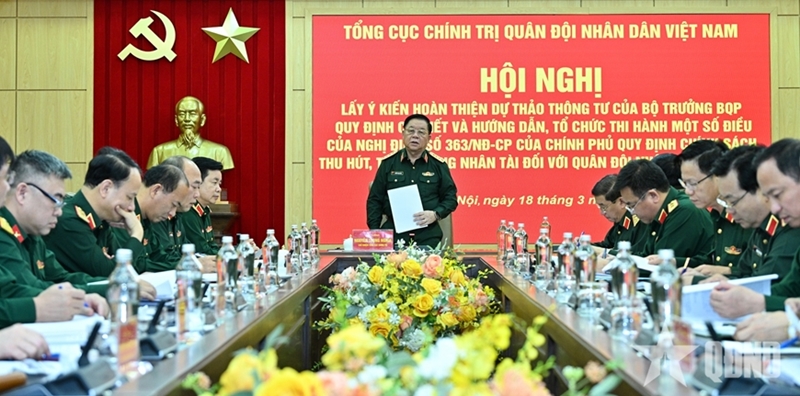
General Nguyen Trong Nghia speaks at the conference. |
In discussions, Deputy Chief of the General Staff Lt. Gen. Le Quang Dao praised the thorough preparation by the GDP, affirming that the draft has a solid political and legal foundation and aligns with the goal of building a modern military. He suggested further refinement of several technical aspects.
In his speech, GDP Deputy Chief Sr. Lt. Gen. Do Xuan Tung noted that the draft identifies nine priority sectors and emphasizes that talents should not be defined in general terms, but must be linked to concrete outputs and contribution, while ensuring fairness in implementation.
At the conference, many delegates called for further completion of criteria tailored to specific fields, enhanced incentives, improved working conditions, expanded international cooperation, and efforts to attract overseas Vietnamese talents, among others.
Concluding the event, the GDP chief commended the contribution from participants. He emphasized that the circular must continue to align with the Party’s latest resolutions, particularly those related to science and technology and high-quality human resources, while incorporating emerging issues from practice.
He called for breakthrough thinking in talent attraction and utilization, stressing that policies should go beyond incentives to include working environment, opportunities for contribution, and guarantees of security and safety, while underscoring the need to clearly define responsibilities of agencies and units in identifying, employing, and retaining talents.
Translated by Quynh Oanh