By expanding direct flight routes, welcoming a continuous stream of mega-cruise ships, and notably announcing the provincial Tourism Development Strategy for the 2026-2030 period with a vision toward 2045, the locality is determined to realize its goal of becoming a leading coastal resort destination in Asia.
    |
 |
|
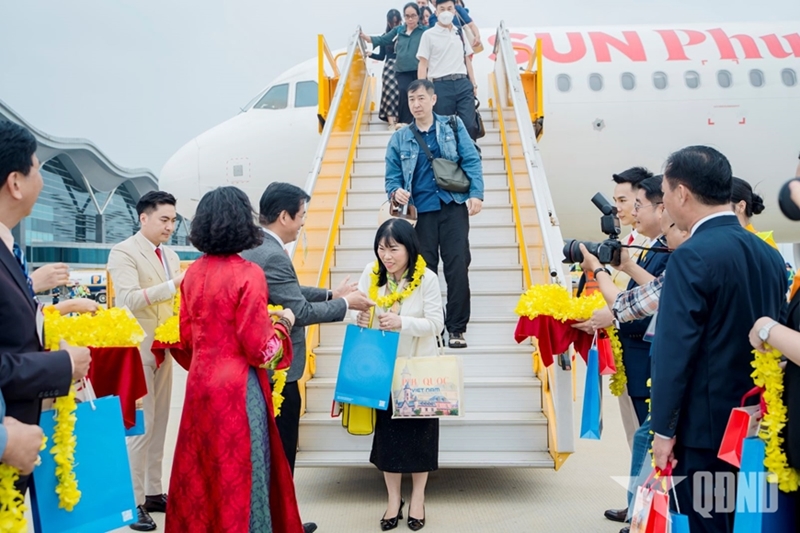
Khanh Hoa leaders and delegates welcome the first flight from Phu Quoc to Cam Ranh on March 15. |
The year began with significant momentum on March 15, when a commercial flight from Sun PhuQuoc Airways, arriving from the Phu Quoc International Airport (An Giang province), touched down at Cam Ranh, Khanh Hoa. At 18:00 on the same day, the return flight from Cam Ranh also landed in Phu Quoc, officially establishing a direct link between two of Vietnam’s primary tourism centers. The airline operates this route with a frequency of four flights per week. Truong Van Tien, Director of the Khanh Hoa Investment, Trade, and Tourism Promotion Center, noted that Nha Trang and Phu Quoc had lacked a regular direct flight for a long time, forcing passengers to transit through Hanoi or Ho Chi Minh City. The launch of this route is expected to strengthen connectivity between the South Central Coastal and the Southwestern regions, facilitating two-way visitor flows and expanding international access to both destinations while allowing businesses to develop multi-destination itineraries.
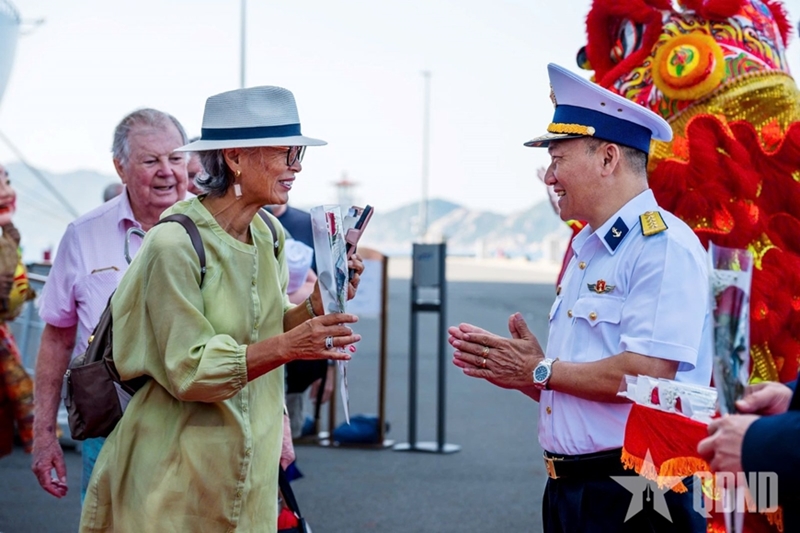
The maritime sector is thriving alongside aviation, with Cam Ranh International Port recently welcoming 2,200 tourists aboard the Bahamas-flagged cruise ship "Andora Mediterranea." This marked the vessel’s sixth visit to Khanh Hoa in 2026. Since January, the province has hosted 21 international cruise ships with over 37,300 visitors, with 27 more vessels expected by year-end. Simultaneously, road infrastructure has seen a breakthrough as the North-South expressway segments, Nha Trang - Cam Lam, Cam Lam - Vinh Hao, and Van Phong - Nha Trang, commenced synchronized operations. Travel time from Ho Chi Minh City to Khanh Hoa is now just 4-5 hours, stimulating self-driving tourism and attracting short-term holidaymakers from the Southeast region.
Provincial data from the Department of Culture, Sports, and Tourism reflects these improvements. In February 2026, local accommodations served 951,000 tourists, a 30.7% year-on-year increase. This included 371,000 international and 580,000 domestic guests. Monthly tourism revenue reached an estimated VND 7,570.7 billion, up 45.2%. For the first two months of 2026, the province welcomed 1.7 million staying guests and generated VND 13,915 billion in total revenue, signaling robust growth.
|
|
 |
|
A representative of the Saigon Newport Corporation welcomes the first cruise ship tourists of the new year at the Cam Ranh International Port. |
Regarding long-term planning, Nguyen Long Bien, Standing Vice Chairman of the Khanh Hoa provincial People’s Committee, announced the provincial government’s approval of the Tourism Development Strategy in February 2026. This concretizes Resolution No.01-NQ/TU of the Khanh Hoa provincial Party Committee, identifying tourism as a key economic pillar alongside industry, energy, and urban construction. By 2030, Khanh Hoa aims to become a top-tier international maritime tourism center, ranking among Vietnam’s top five tourism provinces and a Southeast Asian hallmark. Immediate priorities include the Ninh Chu National Tourist Area planning and a Tourism Promotion Support Fund. Execution follows the “6 clears” (clear people, clear tasks, clear responsibilities, clear authority, clear timelines, and clear results) to ensure quality.
By 2030, Khanh Hoa strives to welcome 33 million visitors, with international guests accounting for 40-45%. Tourism is expected to contribute 20% to the provincial GRDP, reaching approximately USD 9 billion in revenue. By 2045, the province envisions becoming a premier Asian coastal destination. Lovrenc Kessler, an expert from Simon Kucher (Dubai, UAE) who consulted on the strategy, identified six strategic areas: status, branding, connectivity, experience, finance, and smart governance. These are supported by 36 tasks focusing on digital and green transformations, the night-time economy, and promoting cultural heritage such as salangane nests, agarwood, and Cham culture.
Translated by Minh Anh