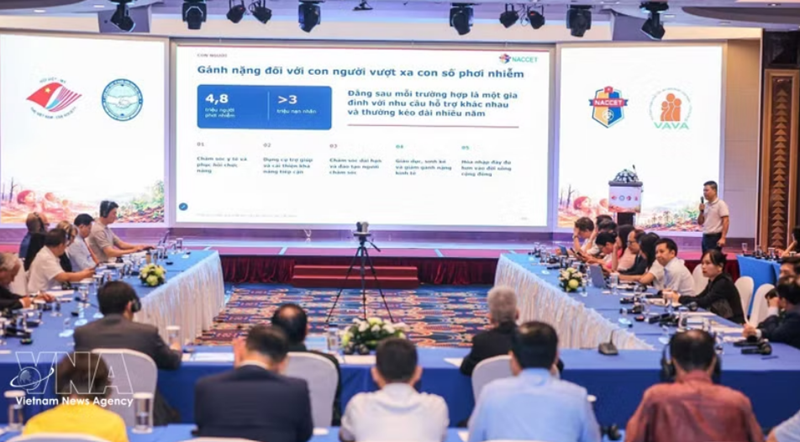
The issue was highlighted at a seminar entitled “65 Years of the Agent Orange/Dioxin Disaster in Viet Nam” held in Hanoi on October 21. The event was organized by the Viet Nam Union of Friendship Organizations (VUFO), the Viet Nam Association for Victims of Agent Orange/dioxin (VAVA), the National Action Center for Toxic Chemicals and Environmental Treatment (NACET), the Standing Office of the National Steering Committee for Addressing Post-war Consequences of Unexploded Ordnance and Toxic Chemicals in Viet Nam (Office 701) and the Viet Nam–USA Society.
    |
 |
|
The seminar entitled “65 Years of the Agent Orange/Dioxin Disaster in Viet Nam” takes place in Hanoi on October 21, 2026. |
In his opening remarks, VUFO Vice President Dong Huy Cuong said the union hopes to promote people-to-people diplomacy and mobilize support from the Viet Nam Fatherland Front, socio-political organizations, people’s organizations, and international friends in helping the country address the consequences of Agent Orange.
VAVA President Lt. Gen. Nguyen Huu Chinh stressed that assistance should extend beyond immediate relief to ensure victims have better access to healthcare, rehabilitation, education, vocational training and livelihood opportunities, enabling them to integrate into society.
He acknowledged contributions from domestic and international organizations and individuals to victim care and environmental remediation, but said substantial needs remain. Addressing them requires targeted programs, stable funding, and effective coordination, as well as the substantive engagement of victims.
Bui The Giang, Vice President of the Viet Nam–USA Society, called for turning goodwill into concrete humanitarian action, with adequate resources and measurable results to support victims and remediate dioxin-contaminated areas.
|
|
 |
|
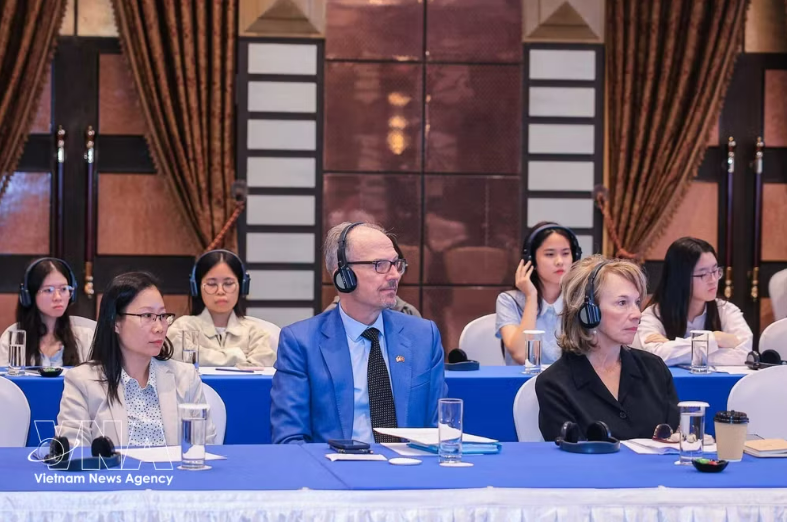
International participants attend the seminar at the Hanoi venue. |
Charles R. Bailey, former head of the Ford Foundation's Viet Nam office, proposed providing resources for VAVA and NACET to update lists of households affected by war-related disabilities and identify those meeting Viet Nam's criteria for Agent Orange and unexploded ordnance victims.
He recommended prioritizing poor households in heavily sprayed areas where people with severe disabilities require full-time family care. Direct assistance could be delivered to selected families over three years, covering housing improvements, vocational training, small-business loans, rehabilitation and social services.
Such support will improve living conditions and help the families become more self-reliant, he said.
Vuong Thi Quyen, a second-generation Agent Orange victim from Quang Tri province, shared the lasting impact of the toxic chemicals on her life and other families. She called for continued support from domestic and international organizations and individuals to improve victims' living conditions and help them integrate into society.
“Our bodies may be damaged by Agent Orange, but our will to live and yearning for justice will never be subdued,” she emphasized.
Participants discussed resource mobilization, the role of international non-governmental organizations, and people-to-people diplomacy in addressing war legacies and protecting victims' fundamental rights.
The seminar also included an open discussion with participants attending in person, and international ones joining online.
An estimated 4.8 million Vietnamese people were exposed to toxic chemicals, including about three million Agent Orange/dioxin victims. The effects continue to affect subsequent generations. Incomplete statistics showed that as of 2024, more than 35,000 victims belonged to the third generation and over 6,000 to the fourth.
The figures underscore the urgent need for long-term assistance and sustained cooperation between domestic organizations and international partners to address the enduring consequences of war.
Source: VNA