In Ha Lieu Residential Area, Phuong Lieu ward, officers and soldiers of the ward Military Command, militia and self-defense forces, and local residents have joined hands to build a new house for Tran Thi Huyen, the daughter of Tran Trong Luyen, who participated in the revolution and was exposed to toxic chemicals. Huyen's health and cognitive abilities have been affected by the consequences of toxic chemical exposure. After her parents died, she lived with her younger brother in a severely deteriorating house.
    |
 |
|
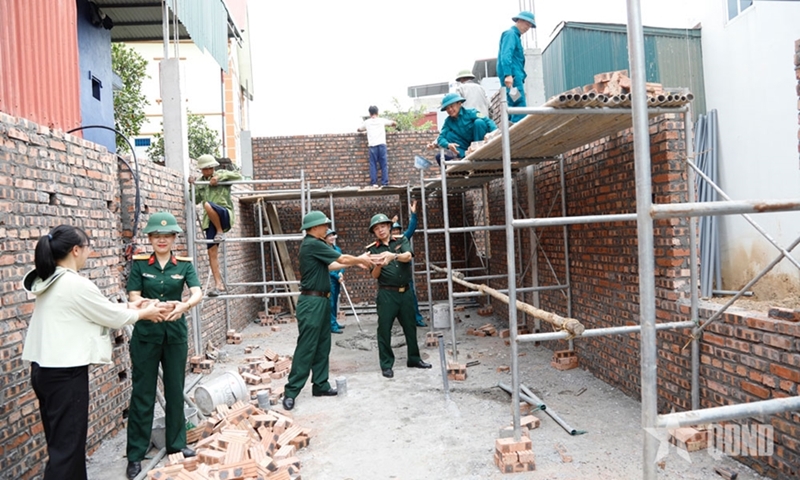
Troops assist in building the house for Tran Thi Huyen |
From the day the foundation was laid, local military personnel and residents worked together to transport sand, stone and bricks and level the ground. Their contributions helped reduce construction costs and speed up the project.
Tran Van Tuyen, Huyen's younger brother, said the family deeply appreciated the care and support from local authorities, the armed forces and residents, describing it as a great source of encouragement.
|
|
 |
|
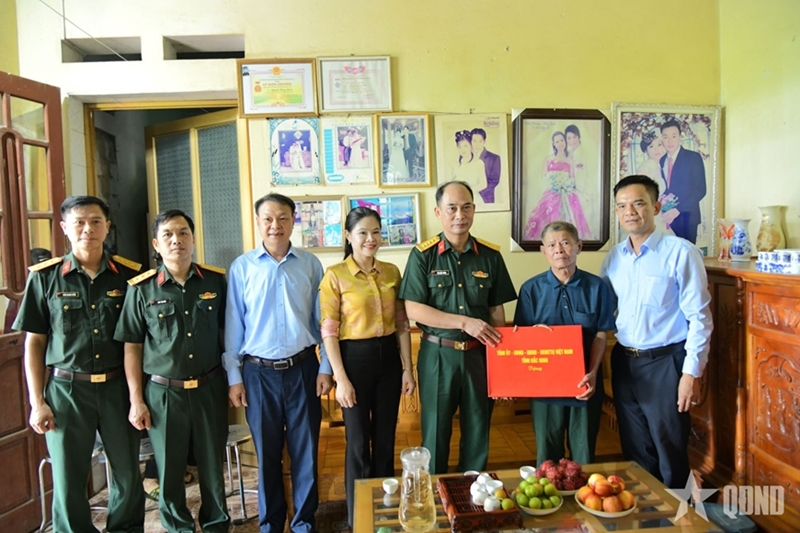
Representatives from the Bac Ninh Provincial Military Command, agencies, units, and organizations visit and present gifts to those affected by toxin chemicals. |
Lt. Col. Do Huy Hoang, Political Commissar and Deputy Head of the Military Command of Phuong Lieu ward, said the work was both a key political task and the responsibility of the local armed forces toward families who had sacrificed and contributed to the country. He said the labor contributed by officers and soldiers, though modest, helped ease families' financial burdens and allowed them to soon stabilize their lives.
Similar efforts are being carried out in other parts of the province. In Tam Son ward, military personnel, women's union members and young people have worked at the house construction site of Tran Minh Mui, born in 1943. A former volunteer youth who helped open the Truong Son route and fought on several battlefields, Mui was exposed to AO/dioxin. Now in his old age and with declining health, he faces financial difficulties while his house has seriously deteriorated.
The assistance is part of Bac Ninh's program to eliminate temporary and dilapidated houses for biological children of people who participated in the resistance war and were exposed to toxic chemicals. According to provincial statistics, more than 8,500 people in Bac Ninh who participated in the resistance war and were exposed to toxic chemicals are currently receiving benefits.
On May 19, the Bac Ninh Provincial People's Committee approved support for the building of 42 new houses and repairs of 24 others. Each new house receives VND 60 million, while each repair receives VND 30 million, and the total funding was more than VND 3 billion. The completed houses must meet the “three solid's” criteria: solid foundations, solid frames and walls, and solid roofs.
The Bac Ninh Provincial Military Command has coordinated with relevant agencies and localities to implement the program, including identifying eligible beneficiaries and mobilizing thousands of labor days to help families build and repair their houses.
Sr. Col. Nguyen Manh Ha, Political Chief of the Bac Ninh Provincial Military Command, said the participation of the armed forces in eliminating temporary and dilapidated houses for policy families demonstrates the responsibility and affection of officers and soldiers toward the people, particularly those who rendered services to the revolution and their families.
For families affected by toxic chemicals, the support is more than a housing project. Each new or repaired house provides a more secure place to live while reflecting the care of authorities, the armed forces and the community, continuing the Vietnamese tradition of honoring and repaying those who contributed and sacrificed themselves for the country.
Translated by Tran Hoai