At the meeting in Hanoi, Cai briefed the Deputy PM on the school’s development, operating model and training strategies in business and business administration.
He also shared its experience in internationalization, partnership building and research, noting that the school is attracting talented academics from around the world.
    |
 |
|
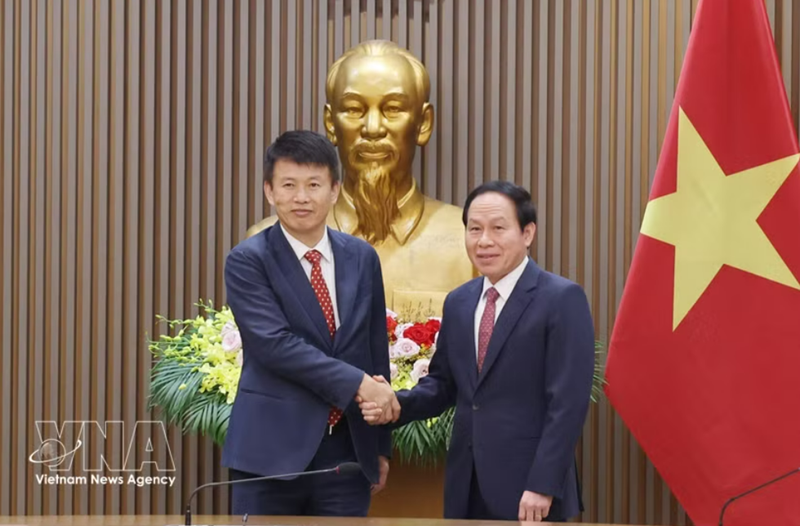
Deputy Prime Minister Le Tien Chau (right) and Prof. Hongbin Cai, Dean of the University of Hong Kong (HKU) Business School, at their meeting in Hanoi on October 20, 2026 |
Commending the HKU, the oldest research university in Hong Kong (China), for its standing among the world’s leading higher education institutions, Chau also recognized the contributions by the HKU’s representative office in Viet Nam since 2022. The office has helped secure more than 4.7 million USD in scholarships for Vietnamese students and organized training in AI management and digital transformation for a high-level delegation of Viet Nam’s National Assembly.
The Deputy PM said Viet Nam has identified the development of high-quality human resources as one of its three targeted strategic breakthroughs. The Politburo’s Resolution No.71-NQ/TW also calls for stronger cooperation and greater foreign investment in higher education.
Emphasizing the importance of close and sustainable educational cooperation, Chau welcomed the proposal to establish a campus of the HKU Business School in Viet Nam and develop a global business research and education platform in Hanoi.
Viet Nam has continued to improve its institutional framework and investment environment to facilitate the school’s operations, he noted, adding that the Government’s Decree No.361/2026/ND-CP sets out specific conditions for foreign higher education institutions to establish branch campuses in Viet Nam.
To advance the proposal, Chau suggested a phased investment approach, starting with joint training programs in cooperation with reputable Vietnamese higher education institutions or pilot courses in selected fields. These initial steps will help assess demand and gradually expand enrolment before the school proceeds with the necessary procedures and investment in a fully fledged campus.
He called on the school and its partners to further expand academic cooperation with Viet Nam, encouraging HKU faculty members to teach and supervise doctoral candidates in the country, and promoting joint research, co-authored scientific publications and the commercialization of research results.
He also proposed establishing priority admission arrangements for outstanding young scientists and students sent by Viet Nam for training, increasing the number and value of scholarships for Vietnamese students, and supporting the training of Vietnamese lecturers and education managers.
Highlighting areas that align with the school’s strengths and Viet Nam’s potential, including artificial intelligence, data science, semiconductors, green finance, financial technology, business administration and public health, Chau expressed his confidence that the HKU will become a strategic partner and trusted friend of Viet Nam, helping advance substantive and effective cooperation projects.
Source: VNA