The tragedy for N. began shortly after giving birth to her fifth child. She initially experienced weakness in both legs, which rapidly progressed to complete paralysis of lower limbs, loss of sensation from chest down, and bowel and bladder incontinence. All her daily activities depended entirely on her relatives.
    |
 |
|
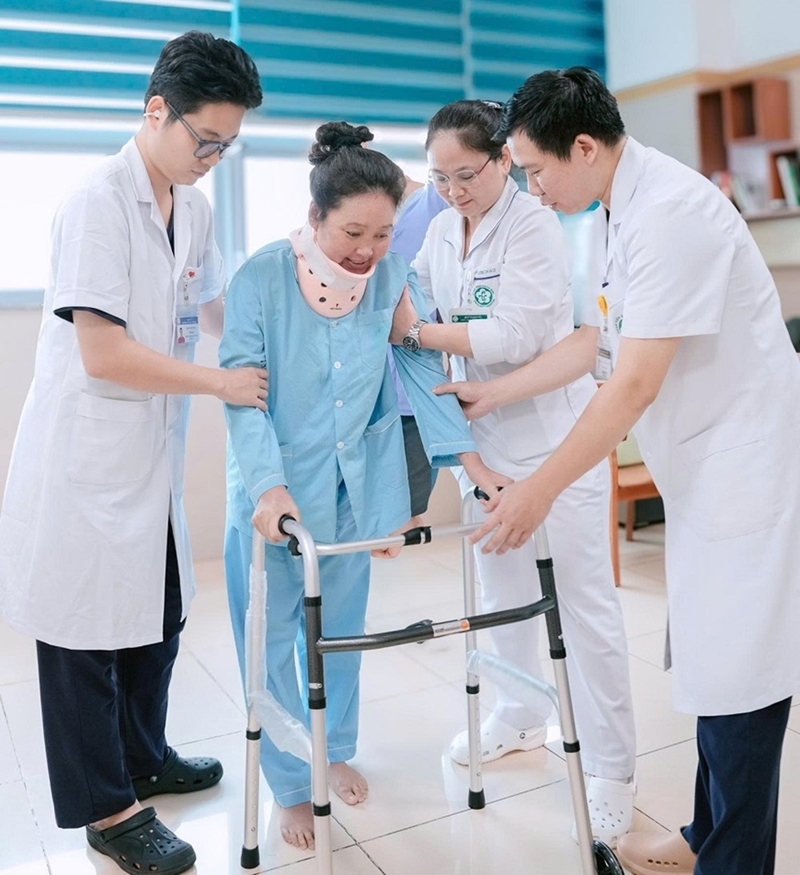
Dcotors of Bach Mai Hospital helps the patient practice walking. |
Her family sought treatment at multiple medical facilities in Laos, but could not determine the underlying cause. When all hope seemed lost, a Vietnamese citizen working in Laos convinced the family to seek treatment in Viet Nam. The couple sold their last seven cows, raising approximately VND 50 million to travel to Ha Noi-based Bach Mai Hospital.
Upon admission, doctors at the hospital’s Orthopedics and Spine Department conducted an examination and ordered a cervical spine magnetic resonance imaging (MRI) scan. The results revealed a Schwannoma tumor measuring nearly 4 by 1.5 centimeters in the cervical spinal canal from C5 to C7. The tumor severely compressed the spinal cord, causing progressive spinal edema and central necrosis.
Dr. Nguyen Van Trung, head of the department, noted that a cervical spinal tumor manifesting clearly only postpartum is a rare occurrence. While the hospital has treated numerous spinal canal tumors, this was the first instance of such a large cervical Schwannoma causing an eight-month postpartum compression, which carried a very high risk of permanent neurological damage.
Following a consultation, the medical team opted for a posterior cervical decompression surgery. Dr. Nguyen Duc Hoang, Deputy Head of the Orthopedics and Spine Department, pointed out that the greatest challenge was not the tumor’s size, but the spinal cord’s prolonged compression over several months. He explained that the edematous and highly sensitive nature of the cervical spinal cord meant that a single vibration or inaccurate maneuver under the microscope could cause irreversible nerve damage.
The entire operation was conducted using microsurgery. The surgical team opened and decompressed the spinal canal, meticulously dissecting the tumor in a highly restricted space while preserving blood vessels and nerve roots to the maximum extent. After completely removing the tumor, doctors sutured the spinal dura mater to minimize the risk of cerebrospinal fluid leakage.
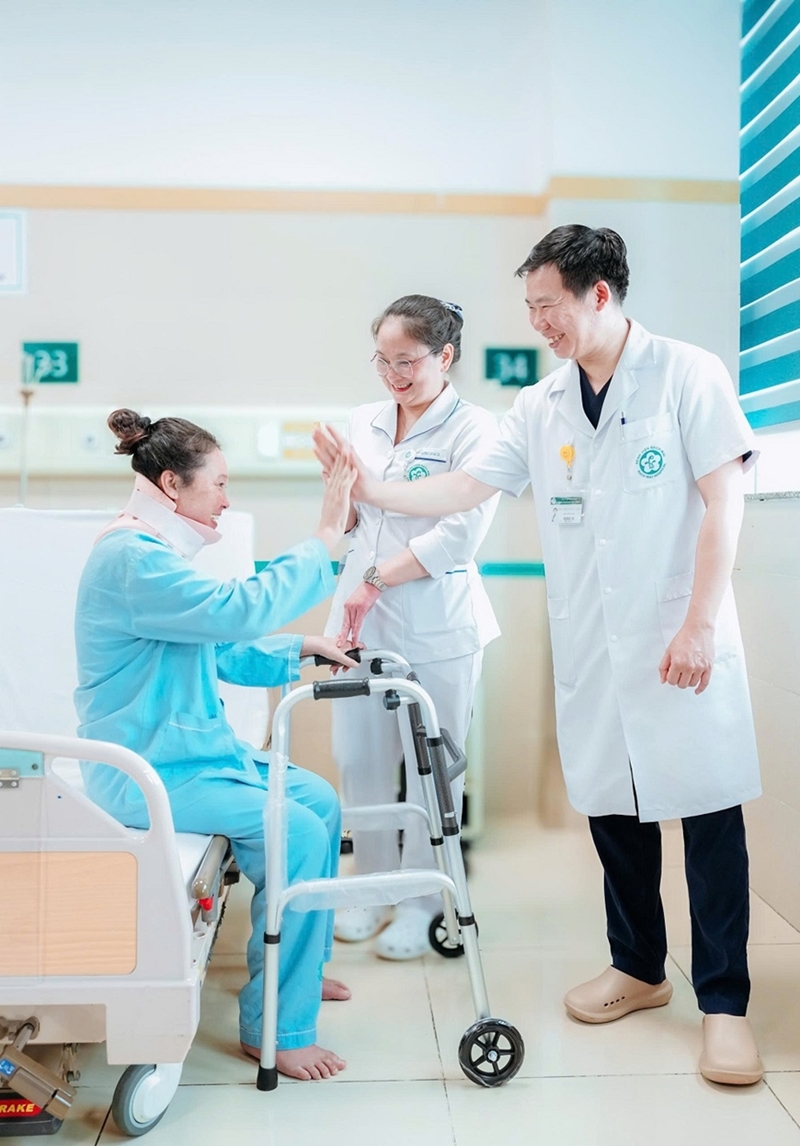
Despite the surgery’s success, doctors anticipated a lengthy recovery due to the eight-month spinal cord compression. However, just 48 hours later, the patient could lift and move her legs independently, with muscle strength rapidly improving from near zero to a level of 3 to 4. One week later, her urinary catheter was removed, and she fully regained bowel and bladder control. The patient is currently able to stand and practice walking.
After the surgery, the team continued to implement a rehabilitation, nutrition, and exercise program to help the patient promptly return to a normal routine.
|
|
 |
|
Dr. Nguyen Duc Hoang shares the joy with the patient after her eight-month paralysis. |
Evaluating the case, Assoc. Prof., Dr. Dao Xuan Co, Director of Bach Mai Hospital, stated that the successful admission and treatment of the Lao national has reinforced the hospital’s regional reputation. It has also reflected the hospital’s strategic focus on boosting international cooperation, transferring medical technology, and elevating healthcare quality.
Based on this case, Dr. Nguyen Duc Hoang advised that not all postpartum symptoms of neck pain, limb numbness, or weakness should be dismissed as normal physiological changes. He recommended that when patients experience persistent neck pain, progressive numbness, loss of balance, or bowel and bladder dysfunction, they should seek immediate evaluation and intervention at a neurology and spine medical facility to prevent irreversible spinal cord damage.
Translated by Minh Anh