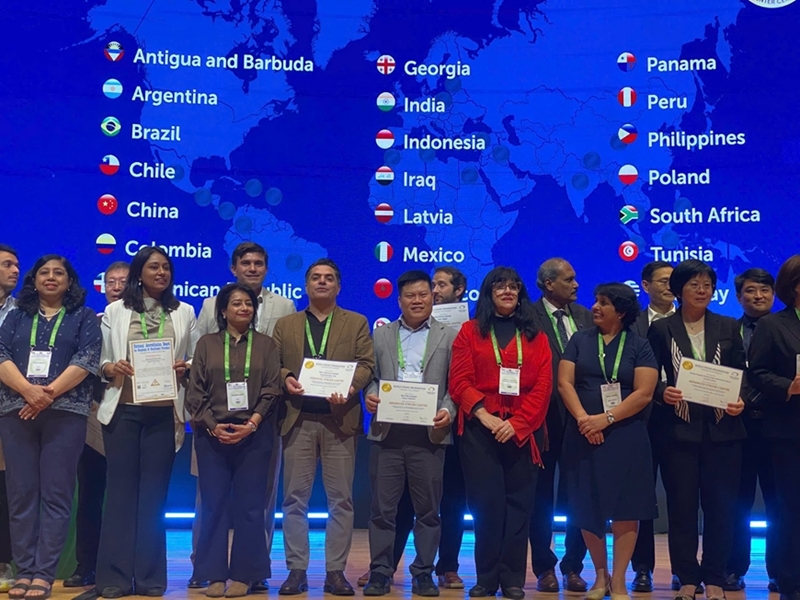
The certificate, the highest level in the WSO’s stroke center certification system, was presented during the plenary session of the 18th World Stroke Congress (WSC 2026) in Seoul, the Republic of Korea, on October 23. It is valid from July 20, 2025, to July 19, 2028.
The ceremony marked the WSO’s 20th anniversary and brought together thousands of experts, physicians, and healthcare administrators from more than 100 countries.
    |
 |
|
Dr. Dao Viet Phuong (front row, center), representing Bach Mai Hospital’s Stroke Center, receives the prestigious certification from the World Stroke Organization. (Photo: Courtesy of Bach Mai Hospital) |
To qualify as an Advanced Stroke Center, a facility must meet 68 criteria, comprising 37 mandatory and 31 recommended requirements. Applicants must satisfy all mandatory criteria and at least 75 percent of the recommended ones, meeting a minimum of 61 criteria overall. The evaluation covers the entire stroke care pathway, including infrastructure, equipment, specialized personnel, 24/7 emergency services and reperfusion treatment, intensive care, rehabilitation, and quality management.
A key requirement is the ability to demonstrate consistent, coordinated operations through a system of key performance indicators (KPIs). During the four-month assessment period, Bach Mai Hospital reviewed and standardized its clinical procedures, consolidated documentation from multiple departments, and collected and verified data on all stroke patients.
The data had to be complete, accurate, consistent, and traceable. After the hospital submitted its documentation through the WSO’s accreditation system, experts appointed by the organization conducted an on-site assessment to verify the records against actual clinical practice. The WSO Certification Committee then reviewed the findings before making its final accreditation decision.
Assoc. Prof., Dr. Dao Xuan Co, Director of Bach Mai Hospital, said the certification demonstrated the hospital’s strong commitment to providing high-quality care to the public. It also served as independent verification that the hospital had standardized its stroke emergency and treatment procedures in accordance with the world’s most stringent standards.
Bach Mai Hospital provides diagnostic imaging and emergency laboratory services around the clock. CT, MRI, CT angiography, MR angiography, and emergency laboratory tests enable medical teams to rapidly identify lesions and make timely treatment decisions.
Before the ceremony in Seoul, Bach Mai Hospital’s Stroke Center presented the results of its efforts to standardize operations at the Global Stroke Alliance conference in Hanoi. The event brought together delegates from 17 countries and representatives of the Ministry of Health.
The WSO is also working with Vietnamese experts to develop and expand a nationwide network for emergency stroke care.
Translated by Song Anh