Active member of international community on human rights
Vietnam began joining major international human rights treaties at a time when the country had just emerged from war and was facing difficulties in every field. This clearly demonstrates the State’s efforts to ensure and promote human rights in accordance with international standards.
    |
 |
|
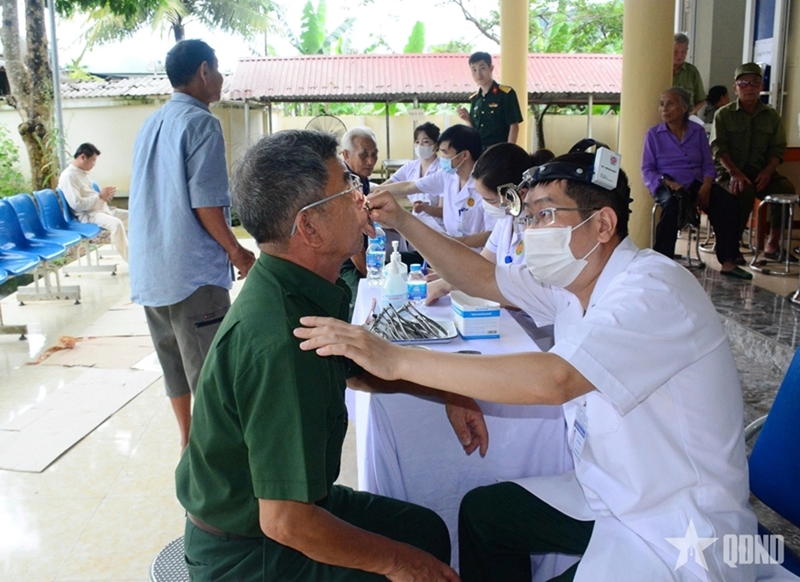
Doctors of Military Hospital 354 under the General Department of Logistics and Technical Services provide medical examinations, health consultations and free medicine for policy beneficiaries in Yen Tho commune, Thanh Hoa province. |
In its foreign relations, Vietnam has seriously fulfilled its obligations under international human rights conventions, actively participated in the United Nations Universal Periodic Review (UPR) and engaged in various other treaty-monitoring mechanisms. Recent national reports show that Vietnam has continued to improve its legal framework and strengthen international dialogue and cooperation on the basis of respect for the U.N. Charter, international law and the country’s practical circumstances. Vietnam has also become increasingly active at international human rights forums, fully and seriously implementing its commitments under the UPR mechanism and fulfilling its obligations under international human rights treaties to which it is a party.
Associate Professor, Dr. Tuong Duy Kien, Director of the Institute for Human Rights at the Ho Chi Minh National Academy of Politics, said Vietnam’s international contributions to human rights have increasingly shifted from “participation” toward “pro-actively proposing, co-creating, and leading certain initiatives.” Vietnam is an active and responsible member that makes substantive contributions. International credibility, he said, is not built through self-praise, but through the votes of other countries, the ability to build consensus, the adoption of initiatives and the fulfillment of commitments.
A consistent feature of Vietnam’s contributions is the message of “respect and understanding – dialogue and cooperation – all human rights for all people.” Vietnam does not deny differences among countries, but maintains that such differences cannot be used as grounds for imposition or confrontation, or for turning human rights into an instrument of interference. Conversely, sovereignty cannot be invoked as a reason to evade voluntarily undertaken international obligations. These two principles must be balanced and applied responsibly.
|
|
 |
|
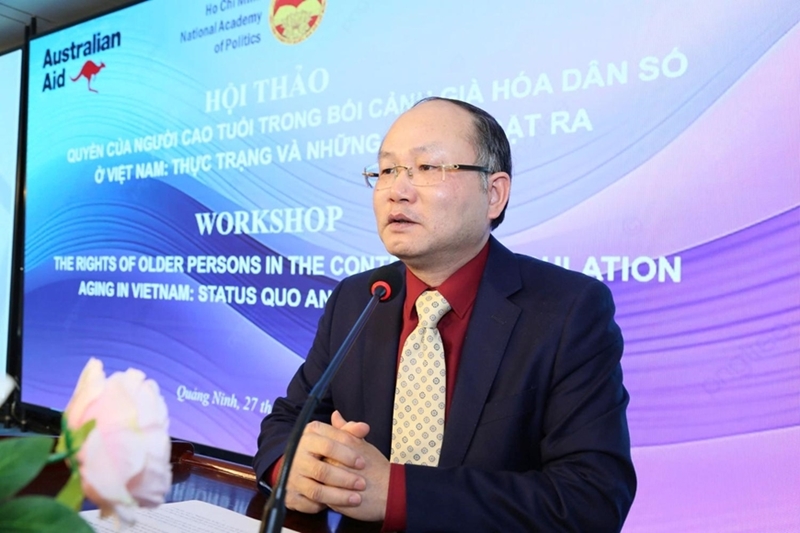
Associate Professor, Dr. Tuong Duy Kien, Director of the Institute for Human Rights, Ho Chi Minh National Academy of Politics |
Human rights guaranteed by law
Associate Professor, Dr. Nguyen Toan Thang of Hanoi Law University said that the 2013 Constitution provides the strongest foundation for respecting, guaranteeing and protecting human and citizens’ rights in Vietnam. The Constitution marked an important milestone by not only recognizing these rights but also clearly defining the State’s responsibility to recognize, respect, protect and guarantee them.
Based on constitutional principles, Vietnam has gradually developed a legal framework covering most fundamental human rights. According to Associate Professor, Dr. Nguyen Toan Thang, civil and political rights have been translated into practice through the Civil Code, Penal Code and Criminal Procedure Code, along with specialized laws such as the Law on Access to Information, the Press Law and the Law on Belief and Religion.
|
|
 |
|
Si Pa Phin Primary and Secondary Boarding School in Dien Bien province, inaugurated on January 31, 2026, is the first project completed under the campaign to build 248 schools in border areas, reaffirming the commitment to improving educational standards and social welfare. |
Economic, social and cultural rights are also guaranteed through an extensive body of legislation, including the Law on Employment, Law on Social Insurance, Law on Medical Examination and Treatment, Law on Education, Law on Housing and Land Law. In particular, Vietnam has developed a relatively comprehensive system of specialized legislation to protect vulnerable groups, including the Law on Children, Law on Persons with Disabilities, Law on Gender Equality, Law on Domestic Violence Prevention and Control, Law on Prevention and Combat of Human Trafficking, and Law on Juvenile Justice.
A notable feature of Vietnam’s current legislative approach is the strong shift from simply “recognizing rights” toward establishing mechanisms that enable people to exercise those rights in practice and ensure that they are effectively protected.
Resolution No.27-NQ/TW on continuing to build and improve the socialist rule-of-law State of Vietnam in the new period identifies the protection of justice, human rights and citizens’ rights as a core objective of institutional reform. Subsequently, Resolution No.66-NQ/TW on reforming lawmaking and law enforcement to meet the country’s development requirements in the new era calls for legislation that places people and businesses at the center, while regarding the quality of law enforcement as a criterion for assessing the effectiveness of the legal system. This approach reflects a shift from a management-oriented mindset toward one centered on public service, development facilitation and the protection of rights.
Vietnam has demonstrated a high degree of responsibility by joining most of the fundamental international human rights conventions, including the International Covenant on Civil and Political Rights (ICCPR), the Convention on the Elimination of All Forms of Discrimination against Women (CEDAW), the Convention on the Rights of the Child (CRC), and the Convention on the Rights of Persons with Disabilities (CRPD). In 2015, Vietnam also ratified the Convention against Torture and Other Cruel, Inhuman or Degrading Treatment or Punishment, reaffirming its strong commitment to protecting human dignity and individual freedoms. In addition, as a member of the International Labour Organization (ILO), Vietnam has joined 25 conventions concerning labor rights, covering issues ranging from the minimum working age for children to occupational safety and health and the elimination of forced labor.
Incorporating these international commitments into domestic law is not only an obligation but also part of Vietnam’s own efforts to improve people’s quality of life. Practical achievements in guaranteeing the rights to education, health care and social security have earned Vietnam significant international recognition. One of the clearest examples is Vietnam’s repeated election to the U.N. Human Rights Council for multiple terms. In particular, on October 14, 2025, Vietnam was elected for the 2026-2028 term with 180 votes, the highest number among candidates from the Asia-Pacific group, affirming the country’s standing and credibility in the field of global human rights protection.
|
|
 |
|
Associate Professor, Dr. Nguyen Toan Thang, Hanoi Law University |
Ensuring all human rights as consistent goal
Vietnam’s achievements in ensuring and promoting human rights have been recognized by the international community. However, under the pretext of “protecting democracy and human rights,” hostile forces continue to deliberately distort the nature of criminal cases, attack the legal system, and issue one-sided reports aimed at damaging Vietnam’s international reputation. Some allegations and accusations made by certain foreign organizations and individuals are so unfounded and unreasonable that they are difficult to accept.
For example, on the afternoon of July 23, at the Ministry of Foreign Affairs’ regular press briefing, a reporter asked for Vietnam’s response to a statement by Human Rights Watch calling for the release of five people prosecuted in connection with the book “Chuyen voi Thanh - Loi ke moi ve anh sang” (Story with Thanh - New Story of Light), Foreign Ministry Spokesperson Pham Thu Hang stated, “The so-called allegations by Human Rights Watch are not worth commenting on.”
This once again reaffirms that isolated voices and baseless accusations by reactionary forces cannot tarnish Vietnam’s achievements in ensuring human rights. Documents of the 14th National Party Congress state that “All Party’s guidelines and State’s policies must genuinely stem from the needs, aspirations, and legitimate and lawful rights and interests of the people; respect for, guarantee and protection of human and citizens’ rights, as well as the people’s happiness and satisfaction, must serve as both the benchmark and the goal.”
On this issue, Associate Professor, Dr. Tuong Duy Kien said the constitutional framework for human and citizens’ rights has become increasingly comprehensive and robust. The 2013 Constitution devotes the entirety of Chapter II to human rights and the fundamental rights and obligations of citizens, while establishing the State’s responsibility to recognize, respect, protect and guarantee human rights.
The Constitution also recognizes rights directly related to political life, including freedom of speech, freedom of the press, access to information, meeting, association and demonstration; the rights to vote and stand for election; the right to participate in the administration of the State and society; the rights to lodge complaints and denunciations; and the rights to a fair trial and the presumption of innocence. These standards are binding on legislative, executive and judicial activities.
In addition, the people’s right to exercise mastery and participate in political life continues to be exercised on a broad scale. About 76.2 million voters participated in the election of deputies to the 16th National Assembly and People’s Councils at all levels, representing a turnout of 99.70%. All 500 seats in the 16th National Assembly were filled, including 150 female deputies, accounting for 30%; 76 ethnic minority deputies, or 15.2%; and 18 non-Party deputies, or 3.6%. The proportion of deputies expected to serve full time reached 40%, the highest number ever. These figures provide evidence countering claims that Vietnamese people are excluded from political life or that representative bodies have a closed and unchanging composition.
Rights of detainees are better guaranteed
In recent years, hostile forces have also distorted and fabricated allegations that Vietnam violates human rights in the detention of offenders. Associate Professor, Dr. Tuong Duy Kien affirmed that Vietnamese law absolutely prohibits torture, coerced confessions, corporal punishment and inhuman treatment, while providing mechanisms for prevention, oversight and accountability. Any proven violation must be investigated and dealt with in accordance with the law.
An unverified allegation or misconduct by an individual, if any, cannot be extrapolated into a “policy of the Vietnamese State.” Moreover, assessments of human rights must be based on legal standards, the actual ability of people to exercise and enjoy their rights, and power controlling mechanisms. An objective assessment must take into account international obligations, domestic law, detention conditions, oversight mechanisms, and policies on education and reintegration.
In practice, Vietnam has made important progress in incorporating international legal provisions concerning the right not to be subjected to arbitrary arrest or detention into its domestic legal framework. Under the 2013 Constitution, no one may be subjected to torture, violence, coercion, corporal punishment or any other forms of treatment that violate their body or health or offend their honor or dignity.
To actualize the Constitution’s provisions, on November 28, 2014, Vietnam’s National Assembly approved the country’s accession to and implementation of the U.N. Convention against Torture. In addition, the 2015 Criminal Procedure Code, as amended and supplemented in 2017; the 2015 Law on the Organization of Criminal Investigation Agencies; the 2015 Law on Enforcement of Custody and Temporary Detention; the 2011 Law on Complaints; the 2011 Law on Denunciations; the 2019 Law on Execution of Criminal Judgments; and the 2017 Law on State Compensation Liability have further specified the provisions of the 2013 Constitution.
Associate Professor, Dr. Tuong Duy Kien said Vietnam’s criminal justice policies are aimed not only at punishment but also at education, rehabilitation and reintegration. A humane policy is meaningful only when people returning to society are given an opportunity to rebuild their lives. If prison doors are opened while the doors to employment, credit and social integration remain closed, the goal of rehabilitation cannot be fully achieved.
(to be continued)
Translated by Tran Hoai