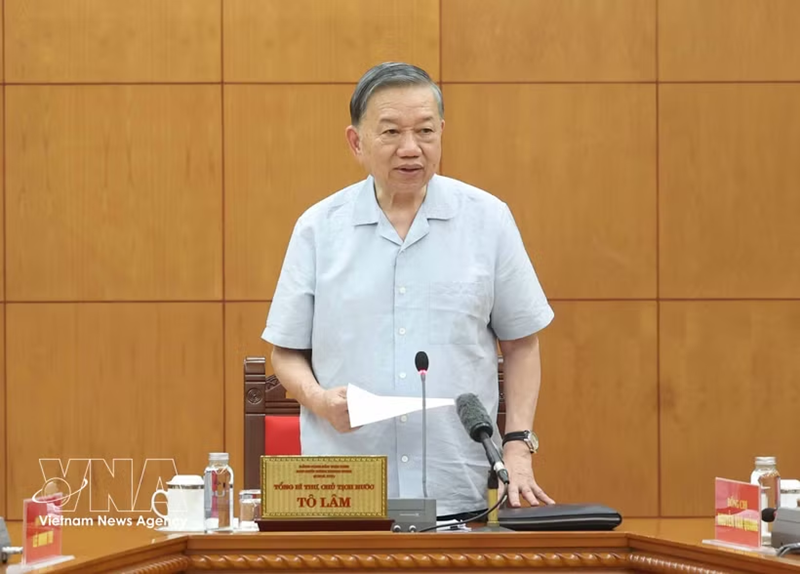
At a working session with the Party Central Committee's Commission for Internal Affairs and relevant agencies in Hanoi on September 28, General Secretary and President To Lam told Party committees, organizations and their heads to keep a close watch on direction and move quickly to spot prolonged backlogs and loopholes that invite violations and misconduct.
Party leadership must be principled and never illegally interfere in adjudication, he said. Judicial independence, however, must not serve as a pretext for loosening leadership, examination, supervision or control of power. Oversight by people-elected bodies and the Party must become more substantive, with the whole political system involved, he requested.
    |
 |
|
General Secretary of the Communist Party of Viet Nam Central Committee and President To Lam speaks at the meeting with the Party Central Committee's Commission for Internal Affairs and relevant agencies in Hanoi on September 28, 2026. |
He demanded a sweeping review rather than piecemeal amendments to individual laws, so that people's rights are protected on a continuing basis.
He said rules must be clarified on evidence collection, provision and evaluation; expert examination; valuation; temporary emergency measures; appellate review; cassation; retrial; and responsibility for judgment enforcement. Erroneous administrative judgments must be corrected on proper grounds and through proper procedures, without undermining the stability of rulings. Legally effective decisions must not leave cases dragging on without a legal basis, and every dispute must have an endpoint.
The top leader said problems must be settled well before they become lawsuits. He called for a multi-tiered dispute settlement system that is more convenient and cost-effective, greater use of negotiation, mediation and arbitration where the law allows, and a study of rules to strengthen the legal effect of these mechanisms and make court-based mediation and dialogue more effective.
Priority should go to settling disputes early through suitable, convenient and low-cost methods on a voluntary and lawful basis, without curbing the right to sue, he went on, adding that courts are a reliable pillar of justice, but they are not necessarily the first port of call for every dispute.
The procuracy, General Secretary and President To Lam said, must raise the quality of its supervision and proactively detect errors, make recommendations and lodge protests. It should draw on supervision practice to identify systemic shortcomings and propose fixes that address root causes, particularly by improving the handling of administrative cases and ensuring all citizens are truly equal before the law.
Legitimate rights and interests recognized by a court judgment must be realized in practice, because only then is there a final result. He called for a focus on enforceable but delayed judgments, backed by strict oversight, asset verification, distrain, valuation, auction and coercive enforcement.
The leader stressed the need for tighter coordination to end fragmentation among agencies and stages of the settlement process, and for wider international cooperation in dispute settlement.
He asked for clearer coordination among courts, procuracies, enforcement agencies, police, local authorities, and bodies managing land, assets, banking, taxation, expert examination, valuation and auction. Complex, long-running cases must be dealt with, and the situation must end in which each agency handles only one segment and each sector meets its targets while people's cases remain unresolved.
The General Secretary and President urged resources to match the task, starting with a judicial workforce of sufficient size, strong quality and growing professionalism. Technology, digital transformation and data-driven governance must be accelerated. He also ordered a full mapping of corruption, wastefulness and other risks at every stage and step, so they can be prevented early and from afar rather than addressed only after violations occur.
Source: VNA