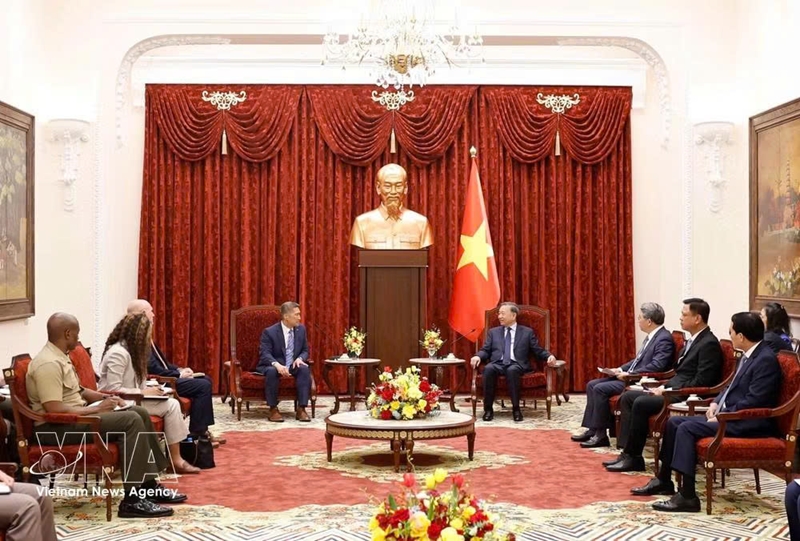
Recent diplomatic activities have vividly reflected this strategic shift. During a recent reception for Acting U.S. Secretary of the Navy Hung Cao, Party General Secretary and State President To Lam reaffirmed that Vietnam regards the U.S. as one of its most strategically important partners. He expressed his hope that both sides will continue to effectively implement their Comprehensive Strategic Partnership, making bilateral relations increasingly substantive, extensive and effective for the benefit of both peoples and for peace, stability and prosperity in the region and the world.
    |
 |
|
The meeting between General Secretary of the Communist Party of Vietnam Central Committee and State President To Lam and Acting U.S. Secretary of the Navy Hung Cao in Hanoi on June 22, 2026 |
The top leader also called on the U.S. to expand cooperation in dioxin remediation, unexploded ordnance clearance, support for persons with disabilities, technology transfer, and the provision of information and wartime memorabilia to assist in the search for and identification of the remains of fallen Vietnamese soldiers. He stressed that such cooperation not only carries profound humanitarian significance but also serves as tangible evidence of efforts to heal the wounds of war, foster reconciliation and build trust between the two countries.
For his part, Hung Cao reaffirmed the U.S.’s desire to further strengthen bilateral cooperation at the bilateral, regional and global levels, including in maritime security, capacity building, humanitarian assistance, disaster response and addressing common regional challenges. He noted that achievements in post-war consequence remediation stand as compelling proof of the two countries’ shared commitment to leaving the past behind and working toward the future.
That spirit was also reflected in the Pacific Partnership–Pacific Friendship 2026 program recently held in Quang Tri province, an area once heavily affected by war. Bringing together hundreds of U.S. military personnel and experts and representatives from Vietnamese agencies and units, the program featured cooperation in healthcare, humanitarian assistance, disaster response, mine action and community engagement. Such activities demonstrate how diplomacy today delivers practical benefits to local communities and strengthens mutual understanding and friendship among nations.
Vietnam’s defense diplomacy has likewise become increasingly practical and proactive. The co-organization by Vietnam and Canada of a United Nations-standard Staff Officer Training Course marked an important milestone in the professionalization and standardization of peacekeeping training at the Vietnam Department of Peacekeeping Operations. Meanwhile, Vietnam’s hosting of the Triangular Partnership Program stakeholders’ workshop involving the U.N., Australia and Japan underscored the country’s growing role in shaping and contributing to global peacekeeping efforts.
These developments illustrate the transformation of Vietnam’s diplomacy from participation to contribution and co-creation. In the past, diplomacy was often viewed primarily as a tool for maintaining a peaceful environment and mobilizing external resources for development. Today, amid intensifying strategic competition among major powers, profound shifts in the global economy and rapid advances in science and technology, diplomacy has been assigned a more prominent role within the nation’s overall development strategy.
The 14th National Party Congress clearly defines diplomacy as a “regular and crucial” task, which, together with defense and security, helps safeguard independence, sovereignty, unity and territorial integrity and create the most favorable international conditions for national development. This reflects not only an evolution in strategic thinking but also the practical requirements of a country striving to become a high-income, developed nation by 2045.
More importantly, diplomacy is no longer limited to expanding relations or attracting external resources. It is increasingly expected to directly create new opportunities, conditions and drivers for development. Every diplomatic activity is therefore aimed at enhancing national competitiveness, innovation capacity, international integration and Vietnam’s position in global value chains.
|
|
 |
|
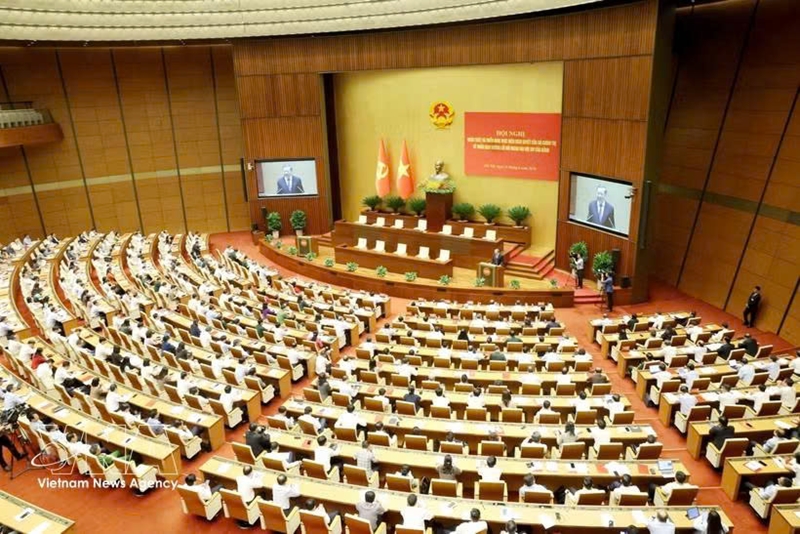
Delegates attend a conference to disseminate and implement the Politburo’s Resolution on carrying out the foreign policy orientations set forth by the 14th National Party Congress. |
This vision is being translated into action through comprehensive and coordinated diplomatic efforts across all pillars. From high-level exchanges with leaders and senior officials of the U.S., Canada, New Zealand and India, to active engagement at the United Nations; from supporting a lasting and sustainable solution to the Middle East peace process based on the Two-State Solution for Palestine, to expanding cooperation with the U.N. Children’s Fund (UNICEF) in child protection, education and human resources development, all initiatives serve the common goal of broadening development opportunities and strengthening the country’s international standing.
At the heart of these efforts lies the principle that national interests remain paramount, while Vietnam continues to demonstrate its responsibility as an active and constructive member of the international community. This approach reflects a harmonious combination of national strength and the strength of the times, national interests and universal values, as well as steadfast principles and flexible implementation.
Diplomacy is no longer the sole responsibility and mission of the foreign affairs sector. Enhanced coordination among diplomacy, defense and security has created a synergistic approach to safeguarding the nation from an early stage and from afar. Close cooperation among these three pillars has improved Vietnam’s ability to address both traditional and non-traditional security challenges, strengthen strategic forecasting and respond effectively to rapidly evolving regional and global developments.
At the same time, local-level diplomacy is emerging as an increasingly important component of Vietnam’s modern and comprehensive foreign policy framework. Many provinces and cities have proactively expanded international cooperation, promoted investment, trade and tourism, connected businesses and mobilized development resources. This demonstrates that diplomacy is reaching every sector and locality, becoming a direct driver of socio-economic development at the grassroots level.
Ultimately, these efforts embody the Party’s consistent vision of achieving rapid and sustainable development on the basis of independence and self-reliance while proactively and effectively integrating into the international community. This is also why Party General Secretary and State President To Lam called for a strategic transformation of Vietnam’s diplomacy in the new era: from protecting development space to creating national development capacity; from integrating into markets to helping shape markets; and from participating in the rules of the game to contributing to the shaping of those rules.
Source: VNA