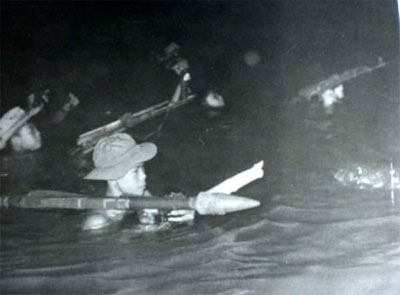
PANO – To implement the policy of the Politburo, the Central Military Committee and President Ho Chi Minh, the entire Army and people in the South opened a general offensive and uprising on the Eve of the Lunar New Year of 1968. The general offensive and uprising was carried out in most southern cities and towns, especially Saigon and Hue, and military bases of the Saigon Army and US Army in the South.
The surprising and bold offensive annihilated critical parts of the US and Saigon armies and attacked key targets, such as the Radio Station of the Saigon regime, the US Embassy, the General Staff of the Saigon Army, the Police Headquarters of the Saigon regime, airports, political prisons and other bases of the US and Saigon armies, as well as destroyed a large number of the enemy’s war vehicles and weapons, modern technical facilities of the US Army in southern Vietnam and captured Hue city for a long time.
The victory marked a decisive turning point for the national resistance war against the US and their followers, undermining the spirit of the US imperialists’ attempt to invade the country and at the same time forcing them, in some respect, to start reducing the degree of the war in Vietnam. The victory could be seen as a unique creative feature of Vietnamese military arts.
 |
To achieve the great victory, the Party, State, Army and people had prepared very carefully for the general offensive and uprising. In the beginning of 1965, after the Staley-Taylor plan went bankrupt, the US had to change its strategy to Joint Warfare, sending a large number of US troops to the battlefield of southern Vietnam in an attempt to break up the spine of the Viet Cong (Vietnamese revolutionary) force, capture the leadership of our resistance forces and enhance the degree of its destructive war against the North with the participation of the US Air Force and Navy. The US plan was divided into 3 phases and lasted between 25 and 30 months. Under US estimates, with a large number of US troops, modern war vehicles and weapons participating in the battlefield alongside the Saigon Army, our main forces in southern Vietnam would be annihilated by the end of 1967.
With the US and Saigon plot, the Politburo and the Party Central Committee assessed the strategic situation, sought high consensus among the entire Party, Army and people, and set up high resolve to fight the enemy. Amid the US Army’s strategic hesitation and political division due to the upcoming US presidential elections, the Party decided to generate a strong and surprising blow against the US invasion attempt. The Party chose a critical strategic approach and new attack method, creating a turning point, basically changing the balance in favour of our forces and driving the revolution in the South to a new phase, in which our forces would achieve the decisive victory in the battlefield.
Our creative military art in the General Offensive and Uprising of the 1968 spring rested on the way to attack the enemy, which had never been seen before in the resistance wars against French colonists and US invaders or the world’s warfare history. That left the US forces and the Saigon regime really shocked, leading them to a passive position.
In fact, before opening such a large-scale offensive, we had been building three strategic zones for many years. Without the three strategic zones with strong revolutionary bases and widespread support from the public, we could not have waged war in urban areas, especially such major cities as Saigon, Hue and Da Nang, the political and military hubs of the Saigon regime. We chose to launch attacks on important enemy agencies, command centres, high military concentrations and sensitive targets.
The Offensive and Uprising also showed our creativity in using and combining the two forces: political and military, to achieve victories in both political and military battlefields over the enemy. The two forces attacking the enemy at the same time created a thunder like blow at the enemy.
A large operation normally requires a long time of preparation, a huge amount of weapons, ammunitions and logistics and absolute secrecy. During the 1968 Spring Offensive, attacking 41 cities and towns simultaneously, our forces received much support from people with political awareness and patriotism. Local people thought of many good ideas to store thousands of tonnes of weapons, ammunitions and supplies, garrison our troops nearby enemy bases and in some cases, they were ready to sacrificed themselves to protect revolutionary forces.
The General Offensive and Uprising, in fact, mainly aimed to dispirit the US attempt to escalate the war in Vietnam, discourage the most warlike politicians on the other side of the Pacific Ocean and bring the war in Vietnam to US society. Via the operation, we could receive more support and assistance for our resistance war from international friends and progressive people around the world.
Finally, studying the General Offensive and Uprising also shows the creativity of our leadership in choosing the strategic time for the operation. Our forces carried out a large military operation at a time when the number of US troops was largest in the battlefield, but they were put in a dilemma as they gained little success after nearly three years of conducting the strategy of the Joint War. Moreover, the US situation at that time was sensitive as the Presidential elections were coming. Under those circumstances, our military operations would achieve much success and created profound impacts on US politics, society and military.
After two months of the General Offensive on March 31st, US President Johnson announced the unilateral ending of air-attacks on the North, accepted negotiating with our delegation at the Paris Peace Talks, and declined to run for the presidency again.
In the reality, the US fully acknowledged the bankruptcy of its strategy “Joint War” but this created a new turning point for our revolution.
Translated by Thu Nguyen