Practice has consistently shown that the Party’s steady leadership remains the cornerstone of national stability, enabling Vietnam to move forward pro-actively amid a rapidly reconfiguring international order, according to scholar Nguyen Huu Dong, a United Nations election expert who has spent many years on international missions in political hotspots worldwide.
    |
 |
|
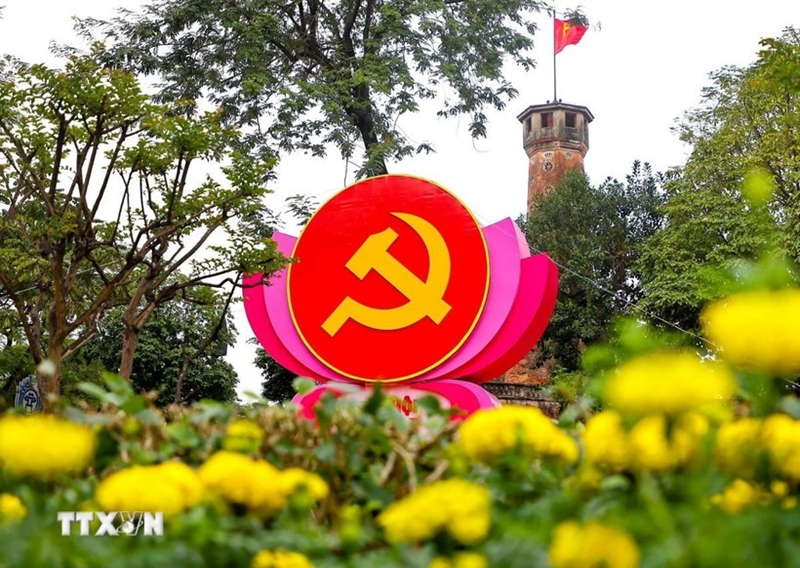
The 14th National Congress of the Communist Party of Vietnam will take place from January 19 to 25. |
In an interview with the Vietnam News Agency’s correspondent in Mexico, Dong described the congress as a milestone of particular strategic significance for Vietnam’s future development in an increasingly volatile and unpredictable world.
Looking back, the expert noted that never before has a Party Congress taken place against such a “multi-layered storm” of global challenges. Prolonged geopolitical conflicts with spillover effects are steadily eroding the fragile foundations of the post-Cold War international order.
Vietnam is not immune to these crosscurrents. New U.S. tariff policies, the resurgence of protectionism, and the restructuring, even fragmentation, of global supply chains are not merely abstract economic indicators, but powerful undercurrents capable of reshaping each country’s development environment, the chairman of the Vietnamese Association in Mexico stressed.
Against this backdrop, Dong viewed the 14th congress not as a routine political event, but as a “moment of strategic choice,” whose decisions will shape Vietnam’s development trajectory for at least the next decade. He described it as a true hinge point, between stability and renewal, between continuity and breakthrough, and between national strengths and global adaptability.
Drawing on years of experience in multilateral institutions, he underscored the central role of the CPV in maintaining strategic continuity. In many countries, leadership changes often trigger policy reversals or institutional crises. In Vietnam, he said, what matters most is the consistency of the Party’s guideline and its collective leadership capacity, a stability that helped the country weather the COVID-19 pandemic, global economic headwinds and mounting geopolitical pressures.
The scholar said the 13th term clearly demonstrates the mettle of the Communist Party of Vietnam. At a time when many countries struggled with uncertainty or even deep internal divisions, Vietnam maintained political and social stability, gradually recovered and sustained economic growth, while expanding its external relations and enhancing its standing on the international stage. He stressed that these outcomes were not the result of luck, but the product of a systematic leadership process grounded in historical experience and a capacity for flexible adaptation.
Using a familiar metaphor, Dong likened the Party to the helmsman steering Vietnam’s ship through stormy seas. Observers may focus on the towering waves and strong winds, he remarked, but fewer notice that the ship has stayed on course, without deviating from its chosen heading.
He emphasized that the 14th congress is not only a Party event, but a convergence of social expectations, for sustainable development, a more resilient economy, and a confident, proactive Vietnam on the international stage. Challenges remain formidable, he acknowledged, but opportunities have never been clearer.
From afar, Dong concluded, overseas Vietnamese intellectuals continue to follow the nation’s path with both reason and deep affection, ready to contribute their international experience to Vietnam’s long-term development and the success of the 14th National Party Congress.
Source: VNA